What is carbon colonialism?
Carbon colonialism is a term that has become increasingly familiar in recent years. Nevertheless, it has no single definition. In a broad sense, it has been used to refer to the power imbalances in the landscape of sustainability, which allow wealthy countries to determine how environmental impacts are measured.
In this resource, we will examine what carbon colonialism means, the different ways it has been used and the tools we need to think differently.
Referring to contemporary sustainability frameworks as colonial is of a way of highlighting continuities between the contemporary global economy and the logic that governed imperial production.
In the imperial era, value moving towards the core of the empire’s economy and waste remained at its periphery. Proponents of carbon colonialism argue that this is the same today.
On a practical level, this is about hiding the environmental impacts caused by fossil fuels and industrial processes by moving these impacts from one balance sheet to another, or simply allowing them to fall between the cracks of environmental accountancy.
Yet it is also about legitimation. In addition to logistics, carbon colonialism means shrouding extractive processes in the ‘moral cover’ of sustainability language. This can take several forms, such as greenwashing products, measuring environmental impacts in a way that favours polluters, or modelling future temperature rises in a way that is overly optimistic or based on technology that doesn’t yet exist.
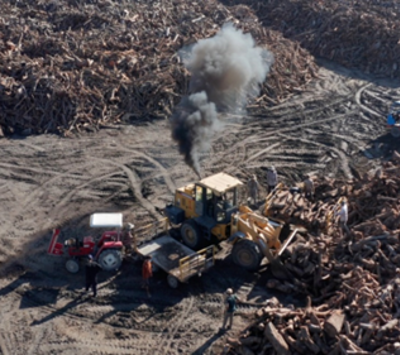
Figure 1. A garment factory in Cambodia producing goods for export to the global North. The wood being burnt is forest wood used to iron clothing before shipping. Almost all of the brands that pass through this factory have zero deforestation commitments, demonstrating the contradictions of green capitalism © Thomas Cristofoletti, Royal Holloway.
Carbon offsetting
Carbon colonialism is a term that has been used by various authors to critique the offsetting of industrial emissions through carbon credits: whereby polluting global Northern industries buy up land in the global South to plant trees or other flora. Trees and plants are carbon negative – they reduce the amount of carbon in the air – so industries that purchase carbon credits see this as a way of balancing out their carbon intensive production processes.
However, this approach has been criticised because it means large areas of land in less wealthy countries being used to compensate for carbon intensive industry in the rich world. In effect, these areas of land are colonised by wealthy countries as a way to continue emitting carbon, instead of reducing emissions at source.
At the same time, substantial criticism has been levelled at carbon offset projects because of their impact on local communities, who are often removed from areas allocated to carbon offsets and not properly compensated for the livelihoods they have lost.
Carbon outsourcing
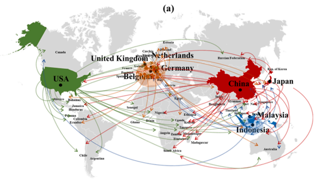
Carbon colonialism has also been used to refer to carbon outsourcing. This is a term linked to the historical transition of manufacturing in wealthy countries like the UK from being primarily domestic to predominantly international. Whereas in the 1970s the majority of the goods UK consumers used, ate and wore were produced within UK borders, this is no longer the case. Today, we import the majority of the goods we need.
As most of the manufacturing industry we depend on has moved beyond our borders, most of its environmental have moved within it. This means that around half of the carbon emitted to fuel the UK economy is produced beyond the UK’s borders.
The “outsourcing” of carbon emissions into global supply chains refers to wealthy countries like the UK, which import the majority of their goods, still counting their carbon emissions domestically. For example, it might have cost 5kg of carbon to make your t-shirt, but if it was made outside the UK – as most clothing is – then it doesn’t count towards UK emissions.
Carbon legitimation
Carbon capture and storage technologies [CCS] – machines that suck carbon out of the air and ‘sequester’ or store it in rocks underground – have been argued to be a form of carbon colonialism because, despite not currently existing at a useful scale, they feature in almost all long-term climate negotiations. As some argue, this legitimates and extends the ruinous pursuit of carbon-intensive industry.
As well as making industrial practices legitimate, sustainability thinking can also make traditional livelihoods illegitimate. In some parts of the world, communities burn small areas of agricultural land or forest as a way of replenishing the nutrients of in the soil. This is called swidden agriculture. Swidden burning does create carbon emissions, but on a global scale it is very small. Crackdowns on small-scale swidden have, therefore, been argued to unfairly uproot the livelihoods of communities who bear only a tiny responsibility for climate change.
Pollution colonialism
The export of plastic and other waste has been named pollution colonialism for similar reasons to carbon. Wealthy countries produce a huge amount of waste, including large amounts of single use plastics. There are laws governing how much of this plastic waste can be released into the environment. However, as some authors argue, the legal levels are too high and legitimate environmental destruction.
A second problem is the trade in plastic waste. From around 2000 onwards, the amount of plastic waste being exported from wealthy countries to less wealthy ones rapidly increased rapidly, before legal developments began to address it. This trade was almost always from wealthier countries to less wealthy ones, demonstrating another form of ‘pollution colonialism’.
What is to be done? The need for stronger supply chain laws
Our global environment is more interconnected than ever. Global supply chains are continually reshaping economic conditions, in some cases contributing to economic precarity that impedes local efforts to adapt to the changing climate. Workers in the exploited margins of the global factory are facing high levels of exposure to climatic hazards and little capital coming back to help them cope with them. In their local environments, citizens of the global South – those who provide the human and material resources that keep the global factory running – face intensified and complicated risks, shaped by local environmental degradation linked to international production processes.
Stronger supply chain laws are arguably crucial to resolving this problem. As long as it is cheaper and easier to move production outside of the scope of national environmental laws, then it is likely to continue to happen. Yet currently almost all of the regulation of the UK’s international economy is voluntary. The lack of legal frameworks governing global supply chains means the processes and practices that underpin our lives are in effect owned by no one, with responsibility being passed up and down the chain ad infinitum. No law can function effectively with loopholes undermining it. So, if there is to be any serious effort to address the impacts of the global economy, then resolving the gaps in the legal framework must surely be a key priority.
Further reading
- The Conversation What your T-shirt reveals about ‘carbon colonialism’ and the global economy’s vast hidden emissions
- Decolonising Geography Carbon Colonialism: How the UK Hides its Carbon Emissions and Environmental Impacts in the Global South
- George Monbiot Carbon Colonialism.
- ABC News video Carbon Colonialism: Can carbon credits really save the planet?
- Greenpeace Unearthed Revealed: Garment waste from Nike, Clarks and other leading brands burned to fuel toxic kilns in Cambodia
- New York Times You’ve Heard of Outsourced Jobs, but Outsourced Pollution? It’s Real, and Tough to Tally Up
- The Guardian Carbon capture is not a solution to net zero emissions plans, report says
- Disaster Trade The Hidden Footprint of UK Production Overseas
- LSE Carbon Colonialism: How Rich Countries Export Climate Breakdown – review
File nameFiles
File type
Size
Download
This resource was first published in 2023.