Earth Photo 2026
Out of 160 images and films by 33 photographers and filmmakers from around the world, eight outstanding works were chosen as the Earth Photo 2026 award winners.
Earth Photo is proud to announce its 2026 award winners. Created in 2018, Earth Photo is a world-leading programme engaging with still and moving image makers to showcase the issues affecting the climate and life on our planet.
The project is co-directed by the Royal Geographical Society, Parker Harris and Photoworks.
A judging panel of experts from the fields of photography, film, geography and the environment selected the Earth Photo 2026 shortlist: 160 images and films by 33 photographers and filmmakers from around the world. Eight outstanding works were chosen as the Earth Photo 2026 award winners.
We are delighted to reveal the winners who actively ask us to think about the world around us; the climate crisis that is unfolding and the way that is affecting people around the globe.Louise Fedotov-Clements, Director of Photoworks
Winner Earth Photo 2026 Award
The Earth Photo 2026 Award goes to Britta Jaschinski for her project documenting the illegal wildlife trade and the forensic science being developed to fight it.
Working with border force operations, customs investigators and wildlife crime units across the UK and Europe, Jaschinski's photographs bring viewers inside a global illegal trade estimated to be worth $23 billion a year.
From confiscated elephant tusks dusted for fingerprints by Metropolitan Police forensic investigators at Heathrow, to lion paws repurposed as bottle openers and reptile leather seized at Hamburg customs, the work transforms evidence into art, making the scale and strangeness of wildlife crime impossible to look away from.
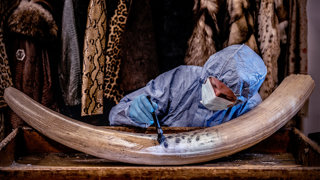
In 2024, the annual international operation, Operation Thunder, coordinated around 500 arrests and more than 2,000 seizures of animals and plants protected under CITES across 133 countries. Jaschinski's work sits at the intersection of photojournalism and activism, using precise, unflinching imagery to urge governments, lawmakers and the public toward meaningful action.
Climate of Change Award
The Royal Geographical Society Climate of Change Award goes to Payal Kakkar for her project Lives of Extraction, documenting the Khairwar indigenous community of Majhauli Paath, Singrauli, as they lead a resistance movement against coal mining and land dispossession in India's so-called Energy Capital.
For three years, Kakkar has embedded herself within the protest, photographing the women who have staged Gandhian-style sit-ins demanding fair compensation for land consumed by the ever-expanding Suliyari mine waste dump.
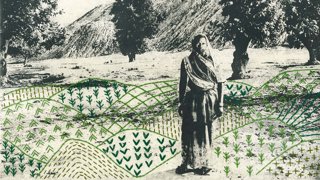
Working against the immediacy of digital photography, she uses a deliberate process of gum oil printing, collecting mining tailings and using them in the developing process itself, so that the stains of industrial contamination become part of the image.
The resulting prints are then hand-embroidered with green thread, evoking the forests and farmland the community has lost.
Moving Image Award
The Earth Photo 2026 Moving Image Award goes to Gideon Mendel for his film work documenting communities around the world living through the consequences of flooding and climate displacement.
Mendel began working as a photographer in South Africa during apartheid, and has since developed a long-term practice that sits between documentary, art and visual activism.
His Drowning World series uses precise, often unsettling compositions to frame people within their flooded homes and landscapes, portraits in which subjects meet the camera with dignity and resilience, building what Mendel describes as a typology of climate change.
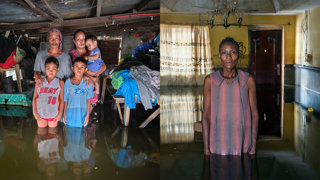
His film work expands this practice, weaving together testimony, imagery and the voices of those most affected, from Pakistan and Nigeria to the Philippines, into a record of communities on the frontline of the climate emergency.
Sidney Nolan Trust Residency Prize
The Sidney Nolan Trust Residency Prize, a two-week residency at The Rodd, Sir Sidney Nolan's former home and studio, goes to Zillah Bowes for her film Here Now There Then.
A Welsh/English multidisciplinary artist working across film, photography, poetry and installation, Bowes was awarded a Future Wales Fellowship (2023 to 2025) to research connection to nature.
Her practice explores a spiritual enquiry into climate change and biodiversity, focusing on the relationship between individuals and the natural world.
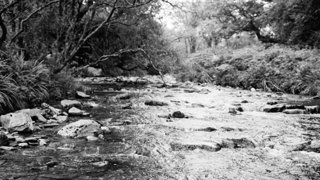
Here Now There Then is a two-channel film using analogue photographs animated by frame variation to explore traumatic memory and the healing effect of proximity to a river.
Set in Eryri, Wales and Bristol, England, the work references Chris Marker's seminal La Jetee and was commissioned by the British Council in partnership with Film London, g39 and Videotage, and exhibited in Hong Kong at the British Council's Spark Festival.
David Wolf Kaye Future Potential Award for Photography
The David Wolf Kaye Future Potential Award for Photography, given to a practitioner aged 25 or under, goes to Filbert Minja for his project Roots of Healing, documenting indigenous herbalists in the Kilimanjaro and Arusha regions of Tanzania.
Minja's photographs approach herbalism not as something symbolic or mystical, but as a real, everyday practice rooted in environment and cultural tradition.
Through portraits, quiet observation and landscape images, he asks what it looks like when knowledge is held in people, plants and land rather than written records, honouring a form of healing passed between generations through touch, gesture and close attention to the natural world.
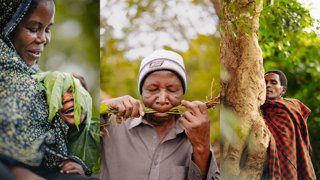
Filbert Minja will receive a cash prize of £1,000 toward the cost of his next project, alongside mentoring by award winning photographer, Marissa Roth.
Photoworks Digital Residency Award
The Photoworks Digital Residency Award worth £400 goes to Marco Garro for his project Quiulacocha, a long-term investigation into the environmental and human cost of mining at Cerro de Pasco, Peru, one of the world's most polluted places, situated at 4,300 metres in the Andes.
Garro has documented this community for two decades. For this project, he collected samples of mining tailings from Lake Quiulacocha, a former lake now filled with toxic waste, and used them in the photographic development process.
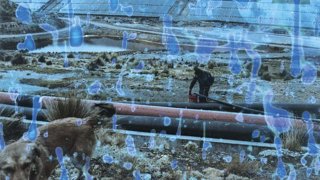
The resulting stains and textures echo the contamination that has entered the blood of local people, the soil, and the water supply for generations.
Marco Garro will work with Photoworks to present his work in a digital residency, with the resulting presentation published online.
New Scientist Editors Award - Photography
he New Scientist Editors Award, for a photographer with the potential of an image spread in the Aperture section of the magazine, goes to Natalya Saprunova for her long-term project documenting permafrost thaw and coastal erosion across the Inuvialuit territories of Canada's Northwest Territories.
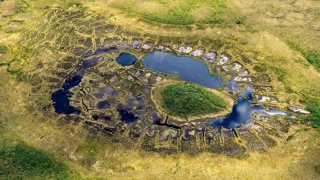
Saprunova's photographs follow communities in Tuktoyaktuk, Sachs Harbour, Ulukhaktok and Pelly Island as their coastlines erode at rates of up to 46 metres per year, releasing ancient carbon, mercury and organic matter into the waters on which Inuvialuit peoples depend.
Authorities in several of these communities are already exploring relocation, making them among the first climate refugee communities in Canadian history.
Natalya Saprunova will receive mentoring with Tim Boddy, Picture Editor, New Scientist.
New Scientist Editors Award - Film
The New Scientist Editors Award for a filmmaker with the potential for an online video article goes to Mohammad Rakibul Hasan for The Vanishing Childhood.
The film follows Mohammad Saown, a teenage boy from the flood-prone haor wetlands of Kishoreganj, Bangladesh, whose family is forced to migrate to the brickfields of Narayanganj after intensifying monsoon floods destroy their farmland.
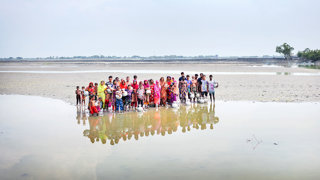
Amid smoke, dust and relentless heat, Saown spends his days stacking bricks instead of attending school, one of thousands of children whose childhoods are being interrupted by climate displacement across Bangladesh's haor communities.
Mohammad Rakibul Hasan will receive mentoring with David Stock, Head of Editorial Video, New Scientist.
The artists represented in Earth Photo 2026 have captured urgent and illuminating images and films of the defining issues facing people, environments and cultures all over the world today ... We are delighted to invite audiences to Earth Photo and Summit Photo 2026, to reflect on these stories of loss, restoration and resilience and be inspired to create change. Jamie Owen, Curator of Photography, Royal Geographical Society
Stay in the loop about Earth Photo
To keep up to date with the latest news and announcements, follow us on social media and use the hashtag EarthPhoto.
Earth Photo exhibitions 2026
Earth Photo 2026 is now showing at the Royal Geographical Society in London until 26 July 2026 — and then heading on tour across the UK. Find your nearest exhibition location.
About Earth Photo 2026
Earth Photo 2026 showcases photos and videos that convey the world around us and will make viewers think differently, capturing nature, people, place and space, forests, the land and seascapes, and the varied impacts of, and adaptations to, climate change.
The photography and films in the Earth Photo 2026 exhibition were judged by:
- Peggy Sue Amison, Artistic Director and Curator, East Wing gallery (Qatar/UAE and Berlin)
- Shahidul Alam, Photographer, Curator, Activist & Director of the Chobi Mela Festival of Photography
- Emma Bowkett, Director of Photography, FT Weekend Magazine
- Serubiri Moses, Curator, Writer and Educator; Faculty, Hunter College and Bard College
- Yining He, Researcher and Curator of Visual Arts, China; Co-curator, 8th Singapore International Photography Festival
- Jury chaired and exhibitions curated by Louise Fedotov-Clements, Director of Photoworks; Co-Founder and Patron of FORMAT International Photography Festival