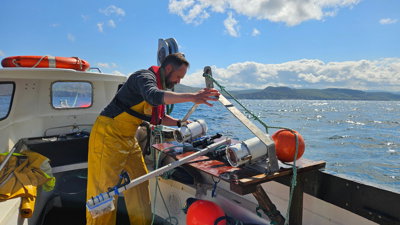
2026 RGS grant recipients are heading into the field
The 2026 RGS grants programme has seen a bumper year, with record numbers of applications (380 across the programme). We have awarded 98 grants totalling £249,553.
The awards range in value from £400 to £15,000, and are supporting schools, universities, undergraduate and postgraduate students, early career academics, senior researchers, and independent travellers. A full list of the 2026 award recipients can be found here.
The first of the 2026 grant recipients to go into the field was Dr Robbie Mallett (UiT The Arctic University of Norway), whose research into isotopic tracking of salt in snow on Arctic sea ice is being supported by the Walters Kundert Fellowship.
The Fellowship, which offers grants of up to £10,000 per year, was established to encourage researchers from across the breadth of geographical science to deepen understanding and support the wellbeing of the planet’s Arctic and high mountain regions.
Robbie recently shared his experience out in the field, keep reading to find out more...
The ‘New Arctic’
Over the past four decades, scientists have increasingly referred to the emergence of a ‘New Arctic.’ In the 1980s, sea ice floes often survived for several years before melting.
Today, most ice forms during winter and melts the following summer. This shift has led to an Arctic dominated by first-year ice, which is significantly saltier.
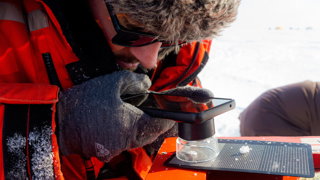
When snow falls onto first-year sea ice, it rapidly absorbs salt. This presents challenges for satellites, which measure sea ice properties using electromagnetic waves. While these signals can penetrate snow, high salt content can block them, potentially affecting the accuracy of existing satellite algorithms.
The snow on Arctic sea ice is getting saltier with climate change, and we wanted to understand the knock-on impacts of this signal blocking on satellite observations.Dr Robbie Mallett
Living and working on the ice
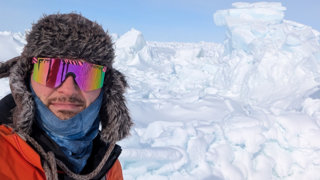
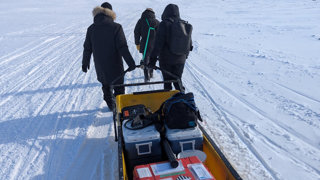
With fieldwork getting underway this year in March, Robbie and his collaborator, Dr Carmen Nab (British Antarctic Survey), travelled to Cambridge Bay (Nunavut, Canada). Field conditions were extremely challenging.
Temperatures frequently dropped to –30°C, leaving the team constantly at risk of frostbite. The ever-present danger of polar bears meant the team had to remain vigilant, and the research itself was made more difficult by the need to wear thick gloves in the extreme cold, which impaired research work.
Conditions were particularly bad during a blizzard, when wind chill dropped to –40°C and visibility was near zero.Dr Robbie Mallett
Memorable field moments
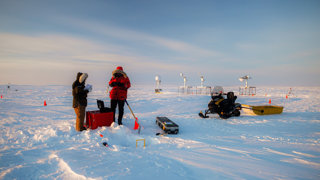
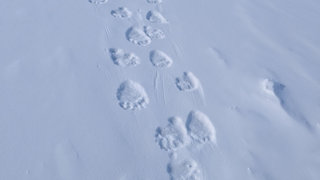
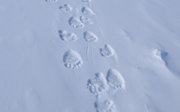
Alongside the harsh conditions, the expedition also included moments of awe and intensity. Robbie recalls landing at a field site only to discover that two polar bears had passed through just hours earlier.
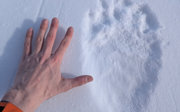
One bear's tracks were much bigger than my hands or feet, indicating it was probably a male weighing upwards of 600kg. We followed the tracks by helicopter for a few miles and couldn't see the bears, so got to work at the field site with an additional precaution - our helicopter pilot sat on top of the helicopter rotor keeping watch with his gunDr Robbie Mallett
Another memorable moment showing team innovation was when Robbie was deploying sensors from the floating ice onto the seabed – more than 60 metres below. To stop the seawater freezing and damaging the sensors, Robbie and the team thought up an interesting solution.
I spent 15 minutes warming the sensors up whilst lying under a tarpaulin with a borrowed travel hairdryer wired to a car battery, trusting another colleague to keep watch with his gun. It was a very strange experience, both for me and the hairdryer!Dr Robbie Mallett
Results
It’s still too early for Robbie and his team to analyse any results in detail, but they have been able to establish that the ice is thicker, and the snow is thinner than usual. This makes the snow harder to study with the team’s instruments, meaning that they must travel longer distances to find suitable field sites.
We will be documenting the progress of more of our grant recipients as they head into the field and we hope that you will enjoy following along on the Society's social media channels.
If you’re interested in finding out more about expedition, research, teaching, or student grants you can find out everything you need here.
- Fieldwork and expeditions
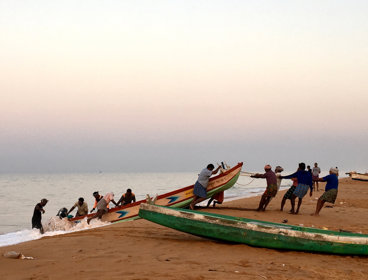
RGS Grants in action: safer seas for fishing communities
To mark World Drowning Prevention Day, we’re sharing insights from the focus of a recent workshop at the Society which built on research from one of our grant recipients on supporting safer and more sustainable fishing in Kerala, India.
Saturday 25 Jul 2026 - RGS news
New grant launched to support exploration and research projects
The Society is delighted to announce a new addition to its grant-giving programme this year – the Kensington Fieldwork Grant will support innovative geographical exploration and research projects that have the potential for significant positive change.
Tuesday 23 Jun 2026 - RGS news
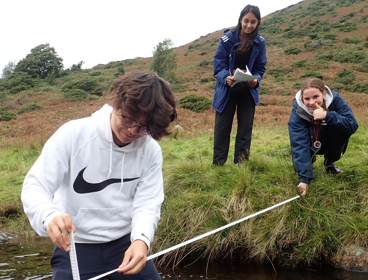
Inspiring young geographers through the Frederick Soddy Schools Awards
We're spotlighting the Frederick Soddy Schools Awards and the transformative opportunities that it brings. Find out its origins, who can benefit and how you can apply now!
Thursday 28 May 2026