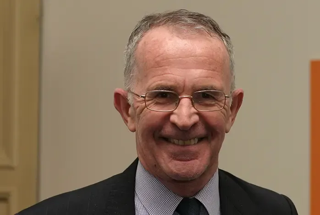
Andrew Shaw Goudie was born in Cheltenham, Gloucestershire on 21 August 1933 (‘just when it was safe to go outside’, to quote Andrew). He passed away, after a short illness, at Dorset County Hospital on 8th October 2026, with his family at his side. Andrew was a Fellow of the RGS for 57 years, served the Society in many roles, and received two of its prestigious awards.
Following school in Cheltenham, where his father was a pharmacist, Andrew went up to Cambridge with an Open Scholarship in 1964, to read geography at Trinity Hall. His appetite for the subject, whetted at Dean Close School through field visits to the Cotswolds, grew through engagement with discipline-changing academics. These included Dick Chorley, Peter Haggett, David Stoddart, and, perhaps with greatest influence, A.T. (‘Dick’) and Jean Grove, who were paving the path of innovative environmental change research. Access to physical laboratories and outstanding libraries (Andrew was a voracious bibliophile all his life) also shaped his love of and take on geography. Despite this, he succeeded in only getting a third in the first year Cambridge exams, which he blamed on answering too many questions on statistics on a paper marked by an individual with no grasp of the topic. Matters changed, fortunately for his long-term commitment to the discipline, and Andrew obtained a double first in the Tripos, starred in Part II.
Following completion of his undergraduate degree, Andrew accompanied Dick Grove in 1967 on a research trip to Africa. This included a notable six week reconnaissance of the Kalahari Desert, in recently independent Botswana. The deep sandy tracks were negotiated in an old American Ford truck, with key landforms from degraded dune systems, old lake shorelines and pan depressions visited, surveyed and interpreted. Grove was an outstanding field researcher and observer, guiding his work with meticulous preliminary mapping of landforms from aerial photographs. These were skills honed in post-war Nigeria and the Sahara margins, where Grove’s interest in peri-desert landscapes and their histories of environmental and climatic change had begun. He shared these skills and research interests with Andrew, though not the authorship of the seminal paper on the landforms and environmental history of the Kalahari that appeared in the Geographical Journal in 1969. An acknowledgment thanked ‘Andrew Goudie for his good humoured company’. In 1970, Andrew again accompanied Grove on African fieldwork, to investigate the shorelines around the Rift Valley lakes of Ethiopia. This time co-authorship of the resultant publication ensued, a ground-breaking paper in the journal Nature on ‘Late Quaternary lake levels in the Rift Valley of Southern Ethiopia and elsewhere in tropical Africa’.
Through this period Andrew was conducting his Cambridge PhD, with the doctorate awarded in 1972 for a thesis on Calcrete as a Component of Arid and Semi-Arid Landscapes. Andrew’s research involved significant periods of fieldwork, in southern Africa, North Africa and in Mediterranean Europe, as well as laboratory analyses. The thesis led to his first book, Duricrusts of Tropical and Subtropical landscapes, published by OUP in 1973. Over forty more books, an astounding number for any academic, let alone a physical geographer, followed through Andrew’s career, several achieving multiple fully revised editions. These, and over 300 research papers, reflect the richness and diversity of his geographical endeavour.
In 1970 Andrew had switched from Cambridge to Oxford, taking up a Demonstratorship (departmental lectureship), in the School of Geography, then led by the French urban geographer, Jean Gottmann, whose accent Andrew could mimic perfectly. In 1976 he secured a permanent position at Oxford, as University Lecturer in Geography with a Tutorial Fellowship at Hertford College. Andrew was a brilliant lecturer. This was acknowledged by the undergraduates, with the contrast between his packed lectures theatres and the near-empty ones of some colleagues glaringly acute. At this time Andrew was joined at Oxford and Hertford by his Cambridge contemporary, historical geographer John Patten. While Patten pursued politics - he was later MP for Oxford and Secretary of State for Education in Thatcher’s second government - Andrew threw himself into college life. He was even ‘Keeper of the Groves’ for a while at Hertford, an ironic post given the college’s small and largely stone and concrete footprint. Nonetheless he could often be seen on Saturday afternoons poking around the small flower beds with a trowel. Despite their obvious differences, the Goudie-Patten partnership worked well, building undergraduate geography at Hertford College into a formidable force. This drew on Hertford’s progressive position in the 1970s at the forefront of colleges admitting female as well as male students, and its pioneering practices to recruit from the widest mix of schools.
Andrew was extremely proud of the incredible esprit de corps amongst the Hertford geographers that cut across backgrounds, year groups, and career stages. End of academic year parties at his then house in Hayfield Road involved copious volumes of White Lady cocktails, and kayaking on, and capsizing into, the Oxford canal which the garden backed on to. Such events garnering a reputation only rivalled by the fear instilled in (and tolerance granted by) the college Dean for the termly dinners of the EW Gilbert Club that he and Patten had founded, named after Gottman’s predecessor as Professor of Geography. These often ended, deep into the night, in Andrew’s college rooms, old jazz records playing very loudly on a wind-up gramophone that he was very proud of. Andrew loved the audience and regaling very funny stories of his travels and the people he met. He once described one dentally well-endowed South African academic as the only person he knew who could eat sweetcorn through a tennis racquet. The vigour of the extra curriculum activities of Andrew’s student cohorts was however more than matched by an academic intensity that led to outstanding degree results: Hertford became the geography college at Oxford.
Andrew’s research career blossomed through the 1970s. Interests diversified geographically and thematically within geomorphology at a time when many academics were becoming more and more specialised and siloed. He expanded beyond Africa to work in the Indian Thar Desert, first on calcretes and then on environmental change with archaeologists from India and Cambridge. Out of this came his life-long research interest in human-environment interactions. Rock, especially salt, weathering was a further theme developed at this time, both in the field and through laboratory simulations. Weathering research was first with Ron Cooke of University College London (later Vice Chancellor of York University and President of the RGS) and then, following their marriage in 1987, with another brilliant physical geographer, Heather Viles.
African interests were extended beyond the deserts to semi-arid regions. In the mid-1970s Andrew developed a particularly rich vein of collaboration in the tiny Kingdom of Swaziland, with archaeologist David Price Williams. The focus was on gully (donga) evolution, including links between erosion and Iron Age land use, but Andrew’s eagle field eyes meant that locating and identifying extensive Stone Age lithological spreads exposed by erosion became a key part of his field activities. He never understood those who could not distinguish natural rock fragments from archaeological artefacts.
In the early 1980s, with growing research interests in the dusty Middle East, its dune fields, coastal sabkhas and rapidly changing landscapes, Andrew also pioneered physical geography research into atmospheric mineral dust sources and movement. Using an old vacuum cleaner, he also tried to build a wind tunnel, in the basement of a university building in Wellington Square. His research in Arabia expanded during the 1990s to include significant publications on early human presence and climate change, much conducted with his research assistant Adrian Parker. Geomorphology closer to home was never neglected though, with the interest in British landscapes first developed at school being represented throughout his almost sixty years of research. This ranged from investigations into dry valley formation, Cotswold landscape development, Thames Valley gravels, and coastal weathering and erosional change. He even got undergraduates on field classes involved in this in Dorset, sending groups to different locations on Chesil Beach, including at night (no risk assessments in those days!), to monitor tidal impacts on pebble movement and sorting. His fondness of Dorset, where he collaborated and conspired with the ebullient Denys Brunsden, was afforced when later in life Andrew and Heather moved their primary home to the Isle of Portland. He described this as a geomorphological paradise.
Whilst Andrew so obviously loved fieldwork, he was also a master at exploiting new approaches to research. Long before ‘big data’ became a common facet of environmental research, he found his own ways to generate data sets to investigate big problems and questions in geomorphology. This approach was born in the embryonic stages of his career. His first published paper, in 1969 in the Geographical Journal investigated ‘Statistical laws and dune ridges in southern Africa’, based on data taken from measurements from aerial photographs and orthophoto topographic map sheets. Andrew mastered information extraction from aerial photographs and maps, then satellite images and ultimately Google Earth. Substantial bodies of data were amassed on landforms not previously systematically described, measured or explained, creating geomorphologies achievable by no other means. Desert Landscapes of the World with Google Earth (2023) and Landscape Heritage of the World with Google Earth (2025) are two of four books published over his last years that continued and expanded this approach. Andrew was also brilliant at data mining: he spent hours each week trawling journals in the Radcliffe Science Library, and his School of Geography office was a veritable display of colourful filing card boxes, each full of cards summarising hundreds of research papers. By this means he collated the data that underpinned several of his pioneering books, notably Environmental Change, first published in 1977, and the ground-breaking The Human Impact, which first appeared in 1981, ran to eight editions, the last in 2018, and was translated into Chinese, German, Italian and Korean. In this he wrote about the Anthropocene long before that term became hackneyed.
In 1984, Andrew’s reputation in the discipline and academic success had led to his appointment to the University Statutory Chair in Geography at Oxford, in succession to Gottmann. Though this took him away from tutorial teaching, the post retained his affiliation with Hertford College. On appointment, he became Head of the School of Geography, a role he fulfilled for over eleven years before the rotation of headships became the norm. Championed by Andrew, The Environmental Change Unit (now Institute) was set up in 1991 as an interdisciplinary affiliate of the School, following its prioritisation as a university development goal four years previously. This reflected recognition at Oxford of the need to embrace environmental challenges in a more holistic manner. This world-renowned centre has since inception attracted major names in climate and environmental research from around the globe, as well as running Oxford’s most applied for and successful one year Masters degree.
With his stature at Oxford running high, it was inevitable that Andrew would take on senior university roles. In 1995 he was appointed a Pro-Vice Chancellor and simultaneously President of the University Development Programme. His charms and ability to work a room led to great fund-raising success. For a variety of reasons though, the 1990s had perhaps not been the best decade in Oxford geography’s history. In 2002 Andrew came back for a second stint as head, to the recently renamed School of Geography and the Environment. he led it for a transformational 18 months at a time when the School’s position in the university was highly vulnerable. Occupying a quaint former vicarage, with the physical laboratories located in the old kitchen, premises had been outgrown and were a limit on expansion for a department that was being outcompeted and outgrown by several other leading Geography departments in the country. Andrew was instrumental in developing and presenting to the university a plan for rejuvenation that saw new senior appointments, the development of further Masters courses, and a move to a large repurposed building in the University Science Area.
When, after 33 years in Oxford Andrew took up the position of Master of St Cross College in 2003, the first academic geographer to become a Head of House, the groundwork had been completed for the development of the thriving and world-leading School of Geography and the Environment that exists today. He played a similarly dynamic role at St. Cross, growing the college and its facilities. In 2011 Andrew took up the role of first Director of the University’s China Centre, an initiative he had championed since his time at the helm of the university’s development programmes. He held this role up to formal retirement in 2013, after which his geographical research and writing experienced a renaissance that continued up to his untimely passing.
Andrew was always proudly a geographer and geomorphologist. Teaching, research and disciplinary support were as one, all equally valued and seen as vital elements of an academic career. He could not understand those who eschewed supporting the discipline and fostering its next generations in favour of their own research pursuits. His ability to do many things simultaneously was in part borne out of impatience. He often appeared remarkably bored a few minutes into a seminar, and would sit, head on hand like an imitation of Rodin’s The Thinker. He was also never afraid to look bored in meetings when an individual rambled through their own agenda, often muttering witty comments under his breath to whoever was lucky enough to be sitting next to him. It is not surprising therefore that he was a brilliant, efficient but thorough, meeting chair, running them in the same way he ate meals and wrote papers- quickly. He noted that everyone loved a short meeting If they felt that the business has been covered appropriately, and woe behold those who had not read the papers in advance. Efficiency, speed, and an uncanny eye for detail and depth were hallmarks of everything Andrew did.
Andrew played vital and pivotal roles in several learned societies. Of particular note was his many years of engagement with the Royal Geographical Society. He was Honorary Secretary and then a Vice-President over ten years from 1980, travelling down from Oxford for pretty much every Monday Night Lecture at the Society in that period. Prior to that Andrew had been Founding Chair of the Society’s Young Member’s Committee, and he also chaired the Research Committee. During that time the RGS regularly ran major research expeditions to overseas locations. He participated avidly in those to the Karakoram (1980), Kora in Kenya (1983) and Oman’s Wahiba Sands (1984). In 1988 Andrew led the Kimberley Project in western Australia, which was not without controversy as several senior Australian geomorphologists felt this approach to research was a legacy from colonial days, though Australian partners were aplenty in the campaign.
Andrew also chaired the British Geomorphological Research Group (now British Society for Geomorphology) in 1988-9, and was very active in the International Association of Geomorphologists for twenty years from its inception, culminating in holding the Presidency from 2005-9. Perhaps most telling of all was the esteem he held the grass roots Geographical Association in. While Andrew was President in 1993, the GA’s centenary year, what he really valued and championed was giving talks to next generation geographers in schools around the country. Using his expert and engaging communication skills to excite and inspire others was a career hallmark. Andrew never forgot where his love of the discipline began. He always had time for geographers at every level and from every place, which was reciprocated in the esteem he was held in around the world.
Andrew loved to ‘bring people on’, and this is reflected in his human legacy that has permeated the discipline nationally and internationally. Many of his tutees and supervisees have gone on to have notable careers of their own, in no small part due to the support he offered both formally, and often informally in the back bar of the King’s Arms in Oxford. Amongst those to go on to success inspired by Andrew sharing his research interests have been Mike Summerfield (Professor at Edinburgh University, silcretes); Rita Gardner (Lecturer at King’s London and Director of the Royal Geographical Society; aeolianites); Ian Livingstone (Professor at Northampton, dune processes); Sarah Metcalfe (Professor at Nottingham, lake histories); David Thomas (Professor at Oxford, desert dunes); Nick Middleton (Fellow at Oxford, desert dust); Jon Holmes (Professor at UCL, limnology), Robert Boast (Pro Vice-chancellor, Bishops Grossteste University, dongas); the late Stephen Stokes (Lecturer and Fellow at Oxford, dating dunes); Richard Washington, (Professor at Oxford, African climatology and dust); and Frank Eckhardt (Professor at the University of Cape Town, gypsum crusts).
Andrew Goudie was one of the giants of geography over the past fifty years, in the UK and internationally. He received many well-deserved awards during his long and distinguished career, including a D.Sc. from the University of Oxford, The Farouk El-Baz Award from the Geological Society of America, The Cuthbert Peek Award from the RGS in 1975 and then the Founders Medal in 1991, The Mungo Park Medal from the Royal Scottish Geographical Society, and the Linton Award from the British Society for Geomorphology.
Andrew’s inability not to always be doing something geographical, his dedication to Heather, Amy, Alice and more recently the grandchildren, his wicked sense of humour and mischievous streak, and his support of many through their careers, will all be greatly missed. He was a giant in so many ways.
Words by David Thomas, Professor of Geography, University of Oxford
Undergraduate tutee of Andrew, 1977-80; D.Phil. supervisee, 1981-84.