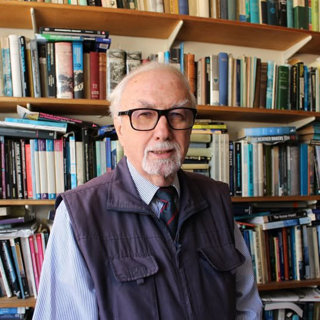
The man who transformed the Department of Geography and Environment at the London School of Economics.
We have lost Professor David K. C. Jones, and with him the Department of Geography and Environment at the London School of Economics has lost its defining figure. Geography, as a discipline, has lost one of its great makers and shapers, and I have personally lost a mentor, a friend and someone who shaped much of my professional life.
David was the Head of Department who welcomed me when I arrived in London in 1995. I was young, new to the country and still wondering quite what I had let myself in for. Within minutes, he had put me at ease and assured me —with that unmistakable grin of his— that I had come to the right place. He gave me my first assignment: to design a new MSc programme. If it failed to take off, he added with characteristic humour, I would be gone within three years. It took off. I am still here.
That encounter contained much of David in miniature. He was warm but direct, generous but demanding. He had an extraordinary ability to make people feel welcome and, almost in the same breath, to raise the bar before them. He expected a great deal because he believed people were capable of more. Many of us became better academics, colleagues and human beings because David refused to let us settle for less than our best.
David arrived at the London School of Economics in 1967 and, in every sense that matters, he never left. For more than half a century, he was a scholar, teacher, leader, counsellor and institutional memory. Even after formal retirement, the Department remained part of him, just as he remained part of the Department.
David was born on 12 June 1940 and grew up in Hertfordshire and Warwickshire. He studied Geography with ancillary Geology at King’s College London, graduating in 1965, and joined LSE as an Assistant Lecturer in 1967 after two years as a postgraduate tutorial student at King’s. He was promoted to Lecturer in 1970, Senior Lecturer in 1982 and Reader in 1985, before becoming Professor of Physical Geography in 1990. He served three terms as Head of Department —then known as Convenor— from 1992 to 1996, from 1998 to 2002 and again from 2004 to 2006. Few people give so much of themselves to one institution. Fewer still do so while retaining their humour, humanity and curiosity.
A geomorphologist by training and instinct, David was a reader of landscapes. He could look at a hillside and see not merely what stood before him, but the forces that had created it and the risks that might one day bring it down. His scholarship centred on applied geomorphology, landscape evolution, landslides, environmental hazards and the ways in which societies understand and manage risk. It took him across Britain and into the Middle East and Asia, from Egypt, Bahrain and Saudi Arabia to Pakistan, Nepal, Bangladesh and China.
He coordinated the national survey of landsliding that culminated in Landsliding in Great Britain in 1994 and co-authored Landslide Risk Assessment, first published in 2004 and revised in 2013. He thought hard and wrote seriously about how societies might understand, manage and cope with risk. His work informed wider debates about the perception and management of danger, including the Royal Society report Risk: Analysis, Perception and Management and the volume Accident and Design: Contemporary Debates in Risk Management. At a School devoted overwhelmingly to the social sciences, David never apologised for insisting that the physical world mattered. He understood that societies do not hover above nature: they inhabit it, reshape it and, at times, badly misread it.
That scholarly preoccupation with risk never remained confined to landslides or environmental hazards. David used what he knew as a scholar to become a master of handling risk within complex organisations, especially universities. He brought a geomorphologist’s eye to institutional life. He could detect pressure accumulating beneath apparently stable surfaces, distinguish a manageable disturbance from a genuine threat and understand when intervention would reduce risk and when it might merely displace or magnify it. Universities, like the slopes and landscapes he studied, have histories, hidden tensions and fault lines. David read them exceptionally well. This combination of scholarly insight, sound judgement and human understanding made him an unusually effective academic leader.
His standing within the profession was considerable. David chaired the British Geomorphological Research Group, served as Vice-President of the Royal Geographical Society (with IBG), led its 2001 Annual Conference and contributed for many years to the councils and committees that sustained British geography. As Managing Editor and later Executive Editor of Geoforum between 1976 and 1993, he helped shape one of the discipline’s leading journals. His contributions were recognised by the Royal Geographical Society’s Cuthbert Peek Award in 1982 and, in 2013, by an Honorary Fellowship of the British Society for Geomorphology.
Yet a list of posts, publications and honours does not quite capture what made David distinctive. His office offered a better clue. It was piled high with rocks and fossils, geological maps and surveying equipment: a small outpost of the physical world in the middle of Houghton Street. Students knew him through fieldwork as much as through lectures. For years, he led the first-year undergraduate trip to Juniper Hall in the Surrey Hills, teaching generations of LSE students to look closely, ask sensible questions and understand that geography begins with curiosity about the world immediately around us. Even after retirement, he continued to teach on Environment: Science and Society. His final lecture, in December 2018, closed more than five decades of teaching at LSE.
For much of his career at LSE, David was the only physical geographer in the room: first among human geographers and planners, and later among a growing cohort of economists and other social scientists. He could easily have withdrawn into his own disciplinary corner and defended his patch. Instead, he became an exceptional builder of bridges.
David understood something that universities often forget: a department is not simply a collection of specialisms, publications and titles. It is a community. Intellectual difference need not produce institutional distance; properly handled, it can become a source of strength. David worked tirelessly to keep our very diverse community together, often through periods of considerable difficulty and change. He listened, cajoled, negotiated and, when necessary, stood firm. His loyalty was not abstract. It was expressed through the daily, usually unglamorous, work of making an institution function and ensuring that the people within it felt part of something larger than themselves.
His stewardship was decisive during the most delicate transition in the Department’s modern history. This was precisely the sort of moment for which his understanding of risk —both scholarly and institutional— had prepared him. For more than seven decades, geography at LSE had been taught through the Joint School with King’s College London, with King’s providing much of the physical geography. When that partnership ended in 1994–95, geography at LSE had to learn to stand on its own feet. David recognised the dangers without becoming paralysed by them, managed the uncertainty without pretending it did not exist and helped transform the Department, first into an independent Department of Geography and later into the Department of Geography and Environment that we know today.
The change was far more than administrative. David inherited what was essentially a strong teaching department, with one master’s programme and a small doctoral operation. He helped create the foundations for what became arguably the largest postgraduate geography department in the world: a department central to LSE, internationally renowned for its teaching and research, and consistently ranked among the world’s best. David would never have claimed sole credit for any of this. But he did much of the hard, patient and foundational work without which the later achievements would not have been possible. When we speak of what the Department has become, we are speaking, in no small measure, of what David made possible.
He also became its institutional memory. David remembered the people, the arguments, the compromises and the small decisions from which larger histories are eventually assembled. When the Department marked his fifty years at LSE in 2016, it was natural that he should tell its story. By then, he was not merely recalling that history; he embodied it. Generations of colleagues will remember the reassuring regularity of seeing him emerge from Temple Station and make his way towards St Clement’s Building, often in a beige trench coat and carrying a well-worn leather briefcase. He seemed almost part of the School’s landscape: a symbol of continuity in an institution rarely short of change.
But it is the man, far more than the record, whom I will miss.
David was an imposing figure who commanded respect. One did not slouch into his office or waste his time. Yet behind that formidable presence was one of the kindest and most generous people I have ever known. He pushed people to their limits, not to diminish them, but because he believed they could go further. He could be exacting precisely because he cared. Once he decided that someone was worth backing, he backed them fully and without reservation.
To me, David was a mentor, a counsellor and a constant source of wisdom. He explained not only how LSE really worked but also much else about life in a system and a country that were not my own. He offered advice when I needed it, perspective when I lacked it and support, often before I had thought to ask. In a place far from home, I found in him something close to a father figure and a friend whom I could always trust. When, years later, I came to lead the Department that he had done so much to build, I did so in his footsteps and with his example never far from my mind.
He leaves behind his wife and fellow geographer, Dame Judith Rees, as well as generations of students, colleagues and friends shaped by his scholarship, teaching, leadership and kindness. His legacy lives on in the discipline he advanced, in the field teaching he championed, in the Department he helped build and, above all, in the many people whose potential he saw before they fully recognised it themselves.
David would probably have been surprised by the scale of that legacy. It is greater than he ever imagined and reaches far beyond the achievements recorded in any curriculum vitae. It lies in a community that still bears his imprint and in the lives and careers made richer by his faith in others, his generosity and his friendship. I owe him more than I can put into words, and I will miss him sorely.
Rest well, David.
Words by Andrés Rodríguez-Pose (with contributions from Hyun Bang Shin, Tom Smith, Paul Cheshire, and Richard Perkins)