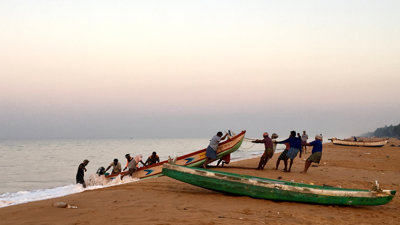
RGS Grants in action: safer seas for fishing communities
Every other minute, someone, somewhere, drowns. Over the past decade, drowning has caused more than three million preventable deaths, with the greatest burden falling on communities in low- and middle-income countries. Small-scale and artisanal fishers are among those most exposed, working at the frontline of increasingly unpredictable weather, rougher seas and changing fish stocks.
Fishing is one of the most dangerous occupations, with the Food and Agriculture Organization estimating that at least 32,000 people die every year. This is likely to be an underestimate.Helen O’Connor, Royal National Lifeboat Institution
To mark World Drowning Prevention Day, we’re sharing insights from one of our Environment and Sustainability Research Grant recipients, Dr Max Martin, on supporting safer and more sustainable fishing in Kerala, India.
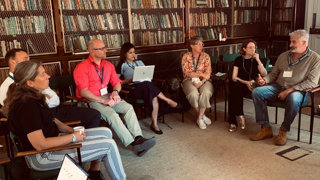
In June, researchers, humanitarian practitioners, maritime safety organisations and policymakers gathered at the Society, to reflect on how to support safer fishing globally. The workshop was convened by the Society’s Grants Office in partnership with the University of Sussex, Christ University, the Royal National Lifeboat Institution (RNLI) and Lloyd’s Register Foundation.
The findings: towards a systems approach for early warnings
The decision to go to sea is rarely straightforward. In Kerala, where India meets the eastern Arabian Sea, the monsoon comes with hazardous sea conditions but high fish availability. With mechanised fishing banned during this period, traditional fishers gain important access to coastal markets. For households facing precarious incomes, limited storage infrastructure and inadequate financial safety nets, staying ashore can carry its own risks.
Between 2016 and 2021, 345 fishers reportedly died while fishing off the Kerala coast, excluding the hundreds more killed during a severe cyclonic storm in November 2017. Climate change is expected to heighten these occupational risks further, and as the eastern Arabian Sea becomes stormier, communities will face high winds, rough seas and increasingly volatile weather.
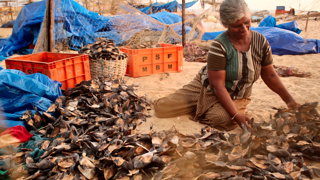
Around the world, as in Kerala, deeper pressures on fishing communities are at play, including income insecurity, debt, poor market conditions, limited access to safety equipment, low literacy, weak mobile connectivity, governance gaps, poor infrastructure, technological barriers and the absence of timely, usable weather and sea- (or lake)-state forecasts.
Despite the risks this group faces, early warning research has largely not been designed around occupational groups like fishers — a significant gap in the evidence base.Dr Elizabeth Kumah, Lloyd’s Register Foundation
Keynote speaker at the roundtable event Dominic Kniveton, Professor of Climate Science and Society at the University of Sussex and recipient of the Society’s 2019 Cuthbert Peek Award, argued that such complex challenges require a systems approach. Rather than treating risk communication as a simple process in which a warning is issued and action follows, a systems approach recognises the social, political, economic and environmental contexts in which decisions are made.
Hon. Emelia Arthur, Minister for Fisheries and Aquaculture, Republic of Ghana, described how hazardous coastal flooding in Ghana, caused by the construction of coastal defences designed to protect other communities further along the coast, is a striking example of well-intentioned action that failed to take account of the wider system.
The workshop underlined a clear message: better forecasts are vital, but they are not enough. Early warnings need to be timely, trusted, accessible, locally meaningful and connected to realistic options for action. They also need to be developed with the communities they are intended to serve.

Society grants programme
With climate change continuing to affect lives, and environmental risks and vulnerabilities associated with fishing expected to intensify in the future, this roundtable was an important reminder of how vital it is for the Society to be supporting impactful initiatives that address the urgent challenges facing the world’s people, places and environments. By enabling researchers and practitioners to generate new knowledge, build partnerships and share evidence for action, the grants programme continues to support work with the potential to make a meaningful difference both locally and globally.
- RGS news
Four leading conservationists and explorers to chair RGS Explore Weekend
The 2026 RGS Explore Weekend will be chaired by four leading conservationists and explorers. Read on to find out who...
Tuesday 6 Oct 2026 - RGS news
Apply now for our 2027 grants
We are now accepting applications for the 2027 grants cycle, with deadlines in November and January. Whether you’re a student, teacher or researcher, discover what’s on offer.
Monday 5 Oct 2026 - RGS news
New grant launched to support exploration and research projects
The Society is delighted to announce a new addition to its grant-giving programme this year – the Kensington Fieldwork Grant will support innovative geographical exploration and research projects that have the potential for significant positive change.
Tuesday 23 Jun 2026