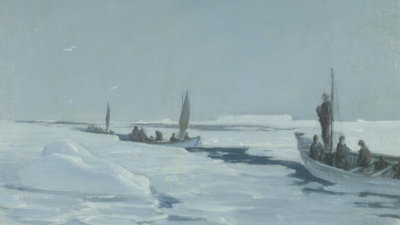
When it comes to visual representations of the Age of Antarctic Exploration, you likely know the legendary black and white photographs of Frank Hurley, taken during Ernest Shackleton’s Endurance expedition – but did you know that both this and Shackleton’s other major expedition, Nimrod, were captured in colour through paintings by George Marston?
Why – despite such striking visual records – has this expedition artist remained unknown, dwarfed by icons Shackleton and Hurley?
This January, at the Royal Geographical Society, a series of Marston’s oil paintings, watercolours and sketchbooks are being displayed in a free exhibition supported by the James Caird Society.
Dr Jan Piggott, curator, polar expert and admirer of Marston’s work for over 26 years, tells us about this remarkable artist.
A bohemian explorer
Born in Southsea, Portsmouth in 1882, from a working-class background, George Marston studied art at Regent Street Polytechnic (now the University of Westminster) before becoming the official artist on Shackleton’s Nimrod (1907-09) and Endurance (1914-16) expeditions.
On the Endurance expedition, Shackleton and his men faced what Jan refers to as “the week of terrible events in open lifeboats on the Weddell Sea” and four and a half months marooned on Elephant Island in 1916. It is here where Marston’s talents – and the strengths of expedition artwork more broadly – are so clear: “There are gaps in the story when Hurley could not use his camera. Marston, on the other hand, sketched and then painted their ordeals, including a whole series he made thirty years after,” says Jan. Marston’s oil and watercolours also depict the dynamism of the Antarctic landscape - the hues of rocks, glaciers, sea and sky - in ways that Hurley’s camera could not.
Jan’s favourite of the works? Sailing to Elephant Island (above): “This is an image that always haunts me – it’s of the three boats in the Weddell Sea. It shows Shackleton standing on the James Caird, looking after his boats and looking for a way through the ice pack. Marston’s sketches show that the conspicuous person in the prow of the boat behind is Marston himself, who seems to be looking at Shackleton.”
As an artist, Marston was considered “bohemian” but as Jan found through reading expedition diaries, he was well-rounded and got stuck in with all aspects of expedition life – he was “plucky and hardy”, a wonderful sledger, oarsman, and craftsman. He was commended by Shackleton and “it was thanks to him that they were able to build the hut out of two upturned lifeboats that saved their lives at Elephant Island in 1916!”. Another instance saw Marston give up his oil paints to help caulk the planks of the James Caird rescue lifeboat to avoid leakage. Marston was also chief entertainer on both expeditions where poetry and music were central to life on board, and he was known for shanties and folk songs: “On one of the worst days when they were being tossed around in the Weddell Sea by appalling snow, churning pack ice, wind and waves, surrounded by killer whales and some men were dazed or half delirious, Marston moved to the front of the boat and began singing a blacksmith’s song, and that rallied their spirits”, Jan says.
Marston’s artwork provides insight into the hardships faced on these expeditions, but also the camaraderie - today it is time to give his paintings “proper recognition”. George Marston, Shackleton’s Artist will bring together the collections of the Marston Family Archive, Royal Geographical Society, Scott Polar Research Institute, Hampshire Cultural Trust and a number of private collections to display over 20 original works and a selection of original objects. The exhibition is free and opens to all, weekdays 11 January-26 March 2027.
- RGS news
Five gifts for the geographer in your life
As we all get ready to enjoy the festive season, we’ve compiled a list of thoughtful and geographical gift ideas to treat someone special.
Thursday 26 Nov 2026 - RGS news

MyCPD back online
We are pleased to announce that MyCPD is now back online following a period of maintenance.
Wednesday 25 Nov 2026 - RGS news
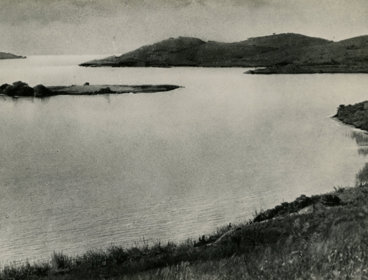
Welcome to Suyin, our new CDA student
We are delighted to welcome Suyin Haynes, our latest Collaborative Doctoral Awards student, who will be exploring one of the Society’s most significant yet under-researched photographic collections, the work of Elizabeth Wilhelmina Ness.
Friday 20 Nov 2026