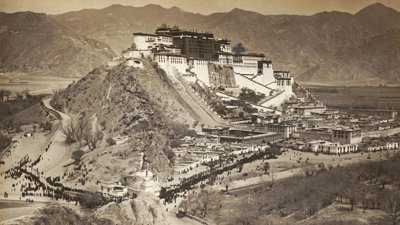
Although chiefly remembered for reaching Lhasa in 1811, Thomas Manning’s deeper ambition lay in the study of China. At a time when the teaching of Chinese in Europe was minimal and institutional support non-existent, Manning engaged seriously with Chinese literature and thought, pursuing language studies as an independent scholar in Napoleonic France and then in China itself.
Drawing on his notebooks, translations, and correspondence, this talk reassesses Manning’s distinctive place in the early history of British Sinology and situates his geographical travels within a larger intellectual project: to encounter China on its own linguistic and conceptual terms.
About the speaker
Dr Edward Weech is the Librarian at the Royal Asiatic Society.
The Royal Asiatic Society was founded in 1823, inspired by the model of Sir William Jones’s Asiatic Society of Bengal. From its earliest days, one of the chief ways the Society sought to promote research and interest into the histories and cultures of Asia was by establishing and making available its historic collection of rare books, manuscripts, and artworks.
Please note: The views of our speakers do not necessarily reflect the opinion of the Royal Geographical Society.
Note on captions
The Society aims to provide automatically-generated captions for all event recordings. The captions appear as text at the bottom of the video which you can toggle on and off.
The accuracy of automatically-generated captions varies depending on the audio quality, any specialist language used and the speaker. They are therefore are unlikely to be 100% accurate and the Society does not edit or correct automatically-generated captions.
- Exhibition
Breaking the ice: art at the edge of a changing world
Bringing together a curated selection of contemporary artists, the exhibition explores ice not only as a physical environment, but as an emotional and symbolic space.
LondonOpen to all19 Nov 2026 - 17 Dec 2026 - Lecture

A Level study day – morning
A Level students will benefit from a series of sessions led by experts that focus on areas of the KS5 curriculum.
LondonTeachersWednesday 25 November 2026 - Workshop

Good COP, bad COP - modelling climate negotiations – morning
As COP31 concludes, A Level geography students can join us for a practical, high energy and fun workshop session that takes us inside the room where it happens.
LondonTeachersWednesday 25 November 2026