Planning an expedition is an exciting phase of the project. You’re playing with ideas, defining your purpose, and imagining the places and people you hope to encounter as you seek to understand the world.
And somewhere along the way, the need to undertake a risk assessment will arise.
For many first-time expedition planners, this can feel like an administrative hurdle – a document to complete for a funder, institutional partner or insurer, then file and forget. Yet an expedition risk assessment is one of the most powerful tools you have for interrogating the finer details of your journey at the planning stage, ultimately making your project more likely to succeed on its own terms.
The Royal Geographical Society has supported expeditions throughout their lifecycles for nearly two centuries. Learnings from the outcomes of thousands of returning projects – including incidents and near misses – have played a key role in our ongoing work to develop field standards and good practice for expedition safety and risk management, including the development of the British Standard BS 8848 for overseas ventures and the Off-Site Safety Management course for those responsible for others in the field.
This article explains what expedition risk assessment involves, why it matters, and how to approach undertaking your risk assessment in a way that is practical, proportionate and genuinely useful, both while developing your plans and once you’re in the field.
What is expedition risk assessment?
At its simplest, risk assessment is a structured way of thinking ahead. Assessing risk involves:
- identifying things that could cause harm,
- considering who might be affected and how,
- deciding what you will do to reduce the likelihood or impact of harm, and
- reviewing and adapting as circumstances change.
In formal terms, a hazard is something with the potential to cause harm, and risk is the likelihood and severity of that harm occurring.
On expeditions, hazards are rarely limited to one activity or moment. They sit across people, places, logistics, health, politics and the unexpected interactions between them.
Good practice risk assessment accepts that risk can never be eliminated entirely. Instead, the aim is to reduce risk to a level that is acceptable for the activity, the environment, and the people involved, all balanced against the potential benefits.
Why risk assessment matters on expeditions
Risk assessment matters because expeditions operate in environments where:
- help may be far away,
- communication can be limited,
- small problems can escalate quickly, and
- decisions often need to be made with incomplete information.
A thorough risk assessment helps you:
- protect the safety of your team and local partners,
- plan realistically rather than optimistically,
- recognise early warning signs of trouble,
- respond effectively when plans change, and
- demonstrate professionalism to funders, institutions and hosts.
Importantly, risk assessment is closely tied to ethical considerations. Taking responsibility for how your expedition affects people beyond your team, including local communities, guides and service providers, and search and rescue agencies and operatives, is also a key part of geographical exploration done well.
Understanding acceptable risk
One of the most challenging concepts for new expedition planners is acceptable risk. It depends on:
- the experience, age and skills of the team,
- the remoteness and environment of the location,
- the nature of the activities being undertaken,
- who you are accountable to, such as participants, universities, parents, funders or insurers, and
- the likely benefits, or positive impacts, of your venture.
A level of risk that may be acceptable for an experienced, self-sufficient team could be entirely inappropriate for a group with limited field experience. A useful question to ask throughout planning is:
'Who needs to be comfortable with this level of risk, and how would we justify our decisions if something went wrong?'
Common categories of expedition risk
Risk assessment works best when you look beyond obvious dangers and consider the expedition as a whole. Though now out of print, the RGS Expedition Handbook groups common risks into broad categories that remain relevant today. These include:
The team
- health and fitness
- preexisting medical conditions
- attitude, behaviour and group dynamics
- experience, training and decisionmaking
- suitability of personal equipment
The environment
- terrain such as mountains, rivers, deserts or jungle
- altitude, heat, cold and weather extremes
- wildlife, insects and disease vectors
Health
- endemic diseases
- food and water safety
- access to medical care
- mental health and fatigue
Local context
- political stability and security
- cultural expectations and local laws
- attitudes to outsiders
- local infrastructure and hygiene
Activities
- trekking, climbing or water-based travel
- technical skills required
- equipment reliability
- cumulative fatigue over time
Travel and camp life
- road and boat transport
- accommodation standards
- fire, cooking and fuel management
- camp location and environmental hazards
Not every expedition will face all of these, but most will encounter several at once, particularly overseas and when remote and challenging environments are involved.
Turning risk assessment into a practical tool
A risk assessment document is only useful if it can be understood and used by the people it is meant to protect. Good written risk assessments are:
- clear and concise,
- proportionate to the level of risk,
- focused on significant hazards, not trivia, and
- easy to review and update in the field.
Overly complex documents are often ignored once the expedition begins. A shorter, well-considered assessment that people understand and actually use is far more effective.
Simple frameworks that work
Although Health and Safety Executive (HSE) guidance is designed for the UK workplace, its five-step approach provides a clear and widely used framework that adapts well to assessing risk for overseas expeditions:
- Identify hazards and associated risks.
- Identify who may be harmed and how.
- Decide on control measures and further actions.
- Record your findings.
- Review and revise regularly.
While developed primarily for expedition providers, rather than independent teams, the British Standard BS 8848 outlines the following minimal considerations of a written risk assessment:
- competence of the participants and leadership team,
- outcomes of a threat assessment,
- analysis of health, safety, environmental and cultural risks,
- potential risks to those on the venture and caused to others,
- identification of the management measures,
- the method used to ensure that safety management measures are effectively communicated, implemented, monitored and reviewed,
- identification of the principal reference sources, author, date compiled and date of any updates.
Control measures: where risk is really managed
Control measures are the actions you take to reduce, manage, or mitigate identified risk. They might include:
- training and skill development before departure,
- vaccinations and medical screening,
- equipment checks and redundancies,
- route planning and contingency days,
- clear roles, responsibilities and decisionmaking protocols, and/or
- daily briefings and dynamic risk assessments in the field.
Many control measures happen long before you leave home. Others only become relevant once the expedition is underway. Both are important.
If a risk cannot be reduced to an acceptable level, good practice is simple: do not proceed with that activity.
What you need before you begin
Don’t make the mistake of assuming you need a finished itinerary to begin a risk assessment. Start once you know:
- your destination or region,
- your broad activities,
- who will be in the team, and
- how long you expect to be in the field.
You can (and should) return to this working document as other elements of your expedition plan evolve.
Involving your team
Risk assessment should never be a solo, desk-based exercise. Involving team members in the process:
- improves the quality of the assessment,
- increases shared ownership of safety management,
- helps align expectations and behaviour, and
- makes it more likely that the assessment is followed in the field.
This might involve collaborative planning sessions, scenario discussions or role-play, or reviewing risks together during training weekends and in the field.
Risk assessment is a dynamic process
Expedition risk assessment does not end when you send the document to your funders, supervisors or insurers. Conditions change. Weather shifts. People become tired or unwell. Political situations evolve. Transport plans fail. Post-expedition reports are littered with such anecdotes.
A useful risk assessment is reviewed:
- before departure,
- at key decision points,
- when conditions change, and
- after incidents or near misses.
Think of your written risk assessment as an evolving point of reference. Print it in case your technology fails, leaving space for notes. Use it to inform daily decisions, but expect to adapt it as conditions change. Make time for short, shared check-ins when plans shift.
Common pitfalls to avoid
New expedition planners often fall into similar traps:
- focusing only on dramatic hazards (bear attack!) and missing everyday risks (taxi from the airport at night),
- copying generic templates without adapting them to specific circumstances,
- underestimating the impact of fatigue and group dynamics,
- treating risk assessment as a oneoff bureaucratic task, or
- assuming others share your perception of acceptable risk.
Awareness of these pitfalls is the first step to avoiding them.
Your expedition risk assessment checklist
Bookmark this article and refer to it as you develop your expedition plans. By the final iteration of your risk assessment, you should have as part of your planning documentation:
- a written risk assessment covering your main activities,
- clear control measures that your whole team understands,
- named responsibilities for safety management where relevant,
- a plan for reviewing risk in the field, and
- confidence explaining your decisions to others.
How the RGS can help
As explained above, expedition risk assessment is a process, not just a document – and it’s not about killing the spirit of adventure, discouraging ambition, or eliminating uncertainty altogether. It’s about understanding what you can and can’t control, preparing thoughtfully, and enabling your team to make good decisions when things change.
Browsing the varied content available in the RGS Explore Resource Hub can help you develop confidence in managing risk responsibly, as well as guiding many other aspects of expedition planning.
And consider attending the annual RGS Explore Weekend, which explicitly exists to help you take your expedition dreams and turn them into reality.
About this article
This article was drafted by Tom Allen FRGS, the Society’s Expeditions and Fieldwork Manager, and reviewed by Shane Winser FRGS, the Society’s Expeditions Advisor. Sections of the article draw upon Chapter 10, Risk assessment and crisis management, of the 2004 Royal Geographical Society Expedition Handbook. The article was last updated in June 2026.
- Article
Getting started: field safety principles for expeditioners
Learn essential safety principles for any expedition, covering risk assessments and emergency planning to ensure a safe and successful journey.
- Video

Expedition and field safety management with Stephen Jones
Discover deep insights into effectively managing safety in the field with RGS Expeditions and Fieldwork Committee chair, Stephen Jones.
- Publication
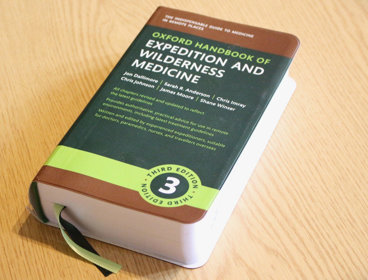
Oxford Handbook of Expedition and Wilderness Medicine
Heading into the wild? Authored by our expert Fellows, this is your essential, pocket-sized guide for remote medical emergencies.
Stay updated
Be the first to hear when new resources are launched by subscribing to our monthly exploration digest. You may also choose to receive other mailings from the Society.
- You will be asked to create a free RGS.org account if you haven't already done so.
- Once logged in, navigate to My preferences and select Exploration news, events and opportunities.