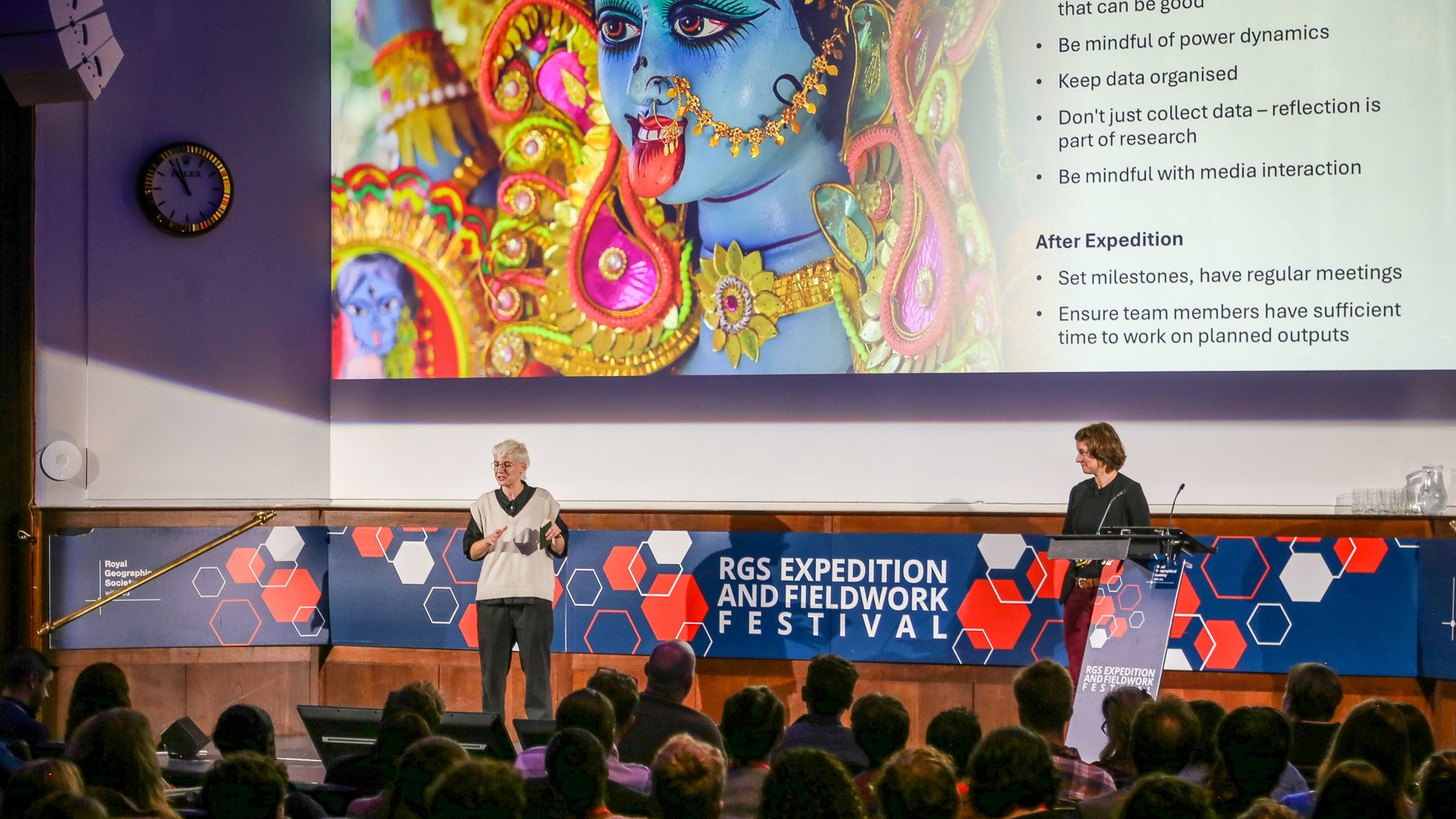
Have you ever considered the full environmental impact of an expedition? After more than 15 years conducting high-altitude medical research on hypoxia and its effects on human biology, Mark Edsell, inspired by a chapter in the Royal Geographical Society Expedition Handbook, wanted to understand how an expedition might reduce its carbon footprint.
In this address, recorded during lockdown for the annual RGS Explore Weekend in November 2021, Mark discusses the environmental costs he and his team incurred on one expedition and how these learnings can help us all reduce those impacts.
What does the video cover?
Focusing on their recent expedition in Sikkim, northeastern India, Mark details their data collection, sustainable practices tested during their fieldwork, and the logistical challenges involved. He also explains why Sikkim is a particularly appealing research location from an environmental impact standpoint.
Mark guides the audience through a detailed exploration of how expeditions affect the environment, raising the crucial question of whether the benefits of a field research project outweigh the environmental costs.
Interested in learning how to operate a more sustainable expedition, estimate your potential carbon footprint, and identify areas for improvement? Applying Mark's valuable insights could result in a meaningful reduction in negative environmental impact for any expedition.
Key moments
- 01:15 – The environmental impact of expeditions
- 03:20 – Getting to know the Birmingham Medical Research Expedition Society (BMRES)
- 06:10 – Methods used in assessing environmental impact
- 06:45 – Sikkim as a destination with high environmental standards
- 09:35 – Results from their survey
- 15:07 – The next steps and the questions raised
Full transcript
Thank you very much, and thank you very much to the Royal Geographical Society for inviting me to speak today. I'm not a Member of the Society, so it's really great, as an interloper, to be allowed in to listen to some of these fantastic speakers.
As Shane said, I'm a full-time working doctor. I'm a consultant in anaesthetics and intensive care medicine at St George's Hospital in London. So my normal day job, before Covid, was looking after patients with heart and lung disease and heart and lung surgery, until the last two years when I've been doing pretty much exclusively Covid on and off. Thankfully, that's sort of dying down and we're getting back to normal.
But my entire career, since I've been a medical student, I've been interested in expedition medicine. I've been doing that for about 20 years now. For about 15 years I've been doing work with a medical research institute, specifically looking at the impact of hypoxia, low oxygen levels, on various different biological systems. There's quite a lot of crossover between that and the hypoxia experience in intensive care, specifically with Covid patients.
But like everyone over recent years, it's become more and more difficult to go on expeditions and do this work without thinking about one's environmental impact. Since the expedition that we did in 2012 to Bhutan, I've really been struggling with the environmental impact of our fieldwork, even though I felt the research output was quite beneficial.
So for our 2019 expedition to Sikkim, I wanted to look in detail at the environmental impact. What started out as just speaking to the expedition leader about maybe getting solar- and battery-powered equipment to run our research projects turned into an entire scientific write-up, a deep dive into the environmental costs of what we were doing.
My other co-authors are Catherine Campbell, who is a junior doctor, and Professor Bradwell, who's the leader of the society, who wrote that book which I very kindly flagged at the beginning of the introduction. The aims of this expeditionary research were to examine the total cost of our environmental research expedition to Sikkim.
That meant calculating the carbon footprint, looking at waste management, as well as looking at the local environmental impacts of our research. We wanted to investigate environmentally sustainable solutions for the expedition's electrical requirements, predominantly looking at battery and solar power and comparing that with traditional fossil fuel-generated power. We also wanted to look at individual participants and their personal impact, in terms of the equipment that they brought along on the trip.
And then once we had all that information, we wanted to look at how to reduce and mitigate this impact.
A bit more about the BMRES, as Shane’s already mentioned. We are an expeditionary society formed in the 1970s by a bunch of junior doctors sitting around the doctors’ mess of the Queen Elizabeth [Hospital in Birmingham], inspired by the great alpine expeditions of the 1950s.
Then in 1960 there was the world-renowned British Silver Hut expedition to Everest, doing medical field research in much more detail. Inspired by that, these young doctors formed their own expedition society and have been going on expeditions ever since.
We're a membership society. The basic model is that if you're keen and want to get involved at medical school, we sponsor medical students to come on expedition with us and help with the research. If you're keen to carry on, you join as a member and then develop your own research interests over time.
About every three years we've done major expeditions. We've done 15 major expeditions to the Himalayas and the other greater ranges, as well as a number of smaller alpine expeditions, predominantly to places like the Margherita Hut, which is a purpose-built research establishment on the summit of Monte Rosa.
The primary medical aims of our research were looking at the effect of hypoxia on kidney function and the development of certain proteins during hypoxic conditions. We were particularly looking at night-time low oxygen levels when sleeping and the impact on the generation of these proteins in the urine.
We were also doing some early fieldwork looking at interoception, which is the body's perception of various different internal sensations, if you like. We were looking at breathlessness perception, and that has direct clinical relevance to asthma and the management of asthma patients.
We were also doing some research looking at gait analysis, looking at fatigue and how your walking pattern changes using biometric sensors.
So those were the three main medical areas we were looking at during the trip, and alongside that we were doing our environmental study.
We started a couple of years before the expedition by contacting the RGS and downloading the Environmental Impact Assessment tool. It's probably been updated in the last five years, but it's a really great place to start if you want to think about all aspects of your trip and look at the environmental impact.
We went through that bit by bit and worked with our local expedition company, who were doing the logistics for our expedition, and saw where in each different area we could reduce our impact.
We used the principles from the environmental impact assessment to inform our choice of destination. One of the reasons we went to Sikkim is that the national park has very high environmental standards and very high environmental taxes associated with it.
When you go into the park, you're paying a significant premium towards maintaining the ecosystem. They don't use single-use plastics, for example, so no plastic bottles are allowed inside the national park. Things like that informed our decision.
But fundamentally, we need to have the right ascent profile for our experiments to occur at the right altitude each time. Over time, we want to be able to compare data from each of our different projects, so we like to have the research done at similar altitudes no matter where we are in the world.
We assessed the carbon footprint by looking at air transport for all of our researchers, expedition staff and porters. We tried to estimate the travel distances of the porters, which is really difficult, plus all the equipment that we're carrying and flying around the world.
We used the ICAO carbon emissions calculator, which is the airline industry calculator. It underestimates compared to many of the commercially available CO₂ calculators, but this one was the most scientifically robust in terms of actual fuel burn.
You can get very granular information from this website. You type in how many passengers and exact flights, and it tells you your carbon footprint. It doesn't take into account things like the impact of airports, which commercial calculators do, but we felt this was the most accurate in terms of fossil fuel usage.
We looked at waste management in detail, weighing all the waste and collecting it, obviously following Leave No Trace principles. Each member of the expedition carried a rubbish bag clipped to their rucksack, essentially a small stuff sack.
We collected rubbish as we walked along, mainly sweet wrappers and rubbish left behind by previous expeditions. This was collected each day. We also cleaned camps at the start and end of each stay.
Looking at the results, unsurprisingly air travel was by far the largest proportion of CO₂ generated. Road transport within country, using Land Rover-type vehicles, was next, and the remaining grey area was fuel from generators.
For our expedition we had to freeze all of our urine samples. Every member collected urine for 24 hours a day, seven days a week. We collected it all and carried it with us, and we also took early-morning first urine samples for processing.
All of these needed to be processed every single day, centrifuged and then frozen in dry ice to maintain sample integrity. That meant transporting 80kg of dry ice, which itself is solid CO₂, and transferring that overland. That equated to around 480kg of CO₂ from sample storage alone.
In terms of solar versus fossil fuel, we used a Goal Zero large battery pack with either two or three 200-watt solar panels. The reality was that the solar did not stack up well versus locally generated power.
It suffered from significant problems related to cold. We were doing our first samples at 6.00am at around 4,000 metres. It's incredibly cold, and the battery couldn't perform well or hold charge, despite charging during sunny afternoons.
We had to keep it warm using hot water bottles, and most importantly there were large transport costs associated with flying batteries across the world. The battery simply did not stack up versus buying a generator locally.
We did investigate buying a battery from China and shipping it into India, but it was logistically impossible. Battery power sounds attractive, but it only really works if your in-country team already has that battery and solar embedded in their everyday expedition practice.
In terms of mitigating our impact, we used tree planting through a charity recommended by our expedition company to make the expedition carbon neutral. Based on our calculations, we offset the expedition by planting 360 trees.
In terms of waste, we carried out 103kg in total: 80kg of non-clinical waste and nearly 20kg of clinical waste. Sharps waste from blood tests has to be disposed of in a particular way, and we paid the local hospital to dispose of it in their incinerators rather than carrying it back to the UK.
Single-use plastics were reduced as much as possible, but with medical equipment this is very difficult.
In terms of personal impact, we made sure everyone used biodegradable soaps and reusable water bottles. We didn't have any single-use plastic or bottled water usage at all. We used tap and local water the whole time and no one got sick.
There really is no need to use plastic water bottles or even boil water when these systems are easy to use and safe. Large solar batteries were not that useful, but individual solar panels worked quite well.
We encouraged participants to bring their own small batteries and mini solar panels. These worked well for powering phones, music players and cameras. They weren't allowed to use the generators to charge personal equipment.
Going forward, the most important thing for scientific research is to ask whether we need to be going at all. Environmental ethics need to be baked into the ethical application right at the very beginning of expedition planning.
As Shane was saying, we need to ask ourselves: can we do this in an altitude chamber? Do we need to travel? If we do need to travel, have we baked carbon offsetting into the funding application from the start?
Ultimately, we are an expeditionary society and our core reason for existing is to undertake field research. We feel we need a more sustainable plan than relying on commercial offsetting companies.
We're investigating the idea of leasing land and managing our own woodland to ensure we have enough carbon sequestration to cover all travel costs going forward.
From this work, we're also helping write local guidelines with the British Mountain Medicine Society, so that we can share this information and ensure that other medical field research operates in the same way.
This transcript has been lightly edited for readability and web publication. The wording has not been substantively changed, and the speaker’s meaning and intent have been preserved.
- Video
Why fieldwork matters: protecting the planet with Dr Niall McCann
Discover the incredible impact expeditionary fieldwork can have on biodiversity conservation with biologist and explorer Dr Niall McCann.
- Video

How to design a successful field research project with Professor Mark Mulligan
Discover the insider secrets to constructing an efficient, impactful and fulfilling exploratory field research project.
- Article
Getting started: field safety principles for expeditioners
Learn essential safety principles for any expedition, covering risk assessments and emergency planning to ensure a safe and successful journey.
Stay updated
Be the first to hear when new resources are launched by subscribing to our monthly exploration digest. You may also choose to receive other mailings from the Society.
- You will be asked to create a free RGS.org account if you haven't already done so.
- Once logged in, navigate to My preferences and select Exploration news, events and opportunities.