Young Geographer of the Year
The Young Geographer of the Year competition is run in partnership with Geographical and is kindly supported by Esri UK, Ordnance Survey and Philip’s.
The 2026 competition is now closed to entries. Winners will be notified by the end of October.
The Young Geographer of the Year is our annual geography competition for students, recognising the outstanding work of the next generation of geographers.
With its age ranges spanning the primary years to A Level, the competition encourages thoughtful and creative responses to a new theme each year.
We encourage schools to run their own in-house competitions before submitting their top 10 entries to the international competition. The Young Geographer of the Year has been running for over 20 years, and each year thousands of children from across the world take part.
2026 competition theme
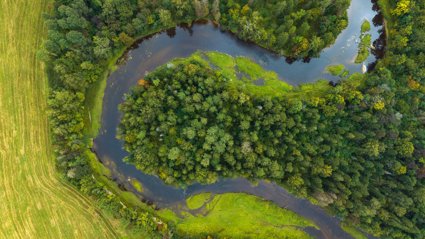
The theme for this year’s Young Geographer of the Year competition is: From Source to Sea.
Let’s explore the world’s river systems
Rivers are the lifeblood of our planet, carrying water, nutrients and energy across vast distances. They sustain communities, support wildlife, and shape the landscapes we depend on to live. From the smallest stream to the widest river, these flowing waters connect mountains to oceans and people to nature.
They remind us that a sustainable and thriving environment is not just a resource, but a responsibility that we all share. As we learn more about the world’s rivers, we also understand that it is our duty to protect them for future generations.
As they transport freshwater across continents, sustaining ecosystems, wildlife, and the billions of people who rely on them for drinking water, rivers also shape our landscapes through erosion and deposition.
Carving valleys, forming striking features, creating fertile floodplains ideal for farming and influencing settlement, rivers provide physical boundaries between places and have also facilitated the growth of many of the urban areas we inhabit today.
Rivers play a key role in the global water cycle, carrying rainfall from source to sea and helping to regulate climate. They provide transportation opportunities, trade routes, tourism, recreation and sustain the lives of a wide range of species, supporting fish, birds, mammals, and countless aquatic organisms.
But rivers can also be a source of conflict: where water is a shared commodity ‘water wars’ can be common. When flood management or hydroelectric power produced by dams happens upstream, dire consequences can fall on countries located downstream.
And who owns this water? Industry and the misuse of rivers can lead to pollution and the degradation of river ecosystems, threatening both wildlife and the communities that depend on rivers to live.
Flooding is a big issue, and the management of rivers to predict, mitigate and prevent the impacts of flooding is essential for protecting communities, safeguarding ecosystems, and reducing long‑term environmental and economic damage.
Show us what you know about rivers
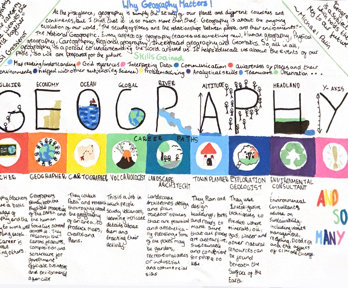
We invited you to create a poster (or Esri StoryMap for KS5) that explored rivers, showcasing the processes that shape them, the features they create, and the many ways they are used by both people and nature.
We were looking for eye-catching, creative and informative posters and StoryMaps that delved into topics such as energy production, conflict, ecosystems, sustainability, trade and more.
We wanted to see you demonstrating your understanding of why our rivers are so important.
Your posters and StoryMaps should have thought about themes across human and physical geography.
Age categories and entry criteria
The competition has four categories:
- Key Stage 2 (pupils aged 7-11)
- Key Stage 3 (pupils aged 11-14)
- Key Stage 4 or GCSE (pupils aged 14-16)
- Key Stage 5 or A Level (pupils aged 16-18)
Please view the competition guidelines (PDF) for full details about entry criteria.
How to enter
Each year, there are two submission pathways: one for UK state funded schools, and one for independent and international schools.
The deadline for receipt of all entries was Friday 2 October 2026 at 5.00pm. The competition is now closed.
Due to the volume of entries, we cannot enter into correspondence about individual entries or provide feedback. We will contact you/your student if you/they are selected as a winner.
Celebrating the winners
We will be selecting one winner and one highly commended entry for each age category from entries from state funded schools, and one winner and one highly commended entry for each age category from entries from independent and international schools.
Winners will be notified by the end of October 2026.
All winners and highly commended students will be invited to an awards ceremony at the Society in London on Friday 27 November 2026.
If you'd like to recognise your own students for entering the competition, please use our certificate of commendation (DOC).
Need help?
If you have any questions about the competition, please refer to the competition guidelines document and our frequently asked questions.
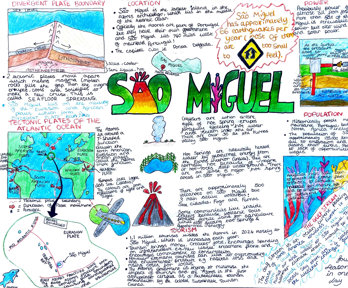
Get inspired: explore our past winners

Thanks to our supporters
The Young Geographer of the Year competition and Rex Walford Award are kindly supported by: