
Aim and introduction
Although the foundations of Artificial Intelligence (AI) go back to the 1950s, the widespread use of tools such as ChatGPT and Microsoft Copilot only really began around 2022. These tools use machine learning which requires powerful computer hardware.
AI systems are stored in data centres, which are specialist buildings that house important Information Technology equipment, including servers. As the use of AI increases, more data centres are needed to support it. The UK aims to become the third largest provider of AI infrastructure in the world (behind China and the United States). To help achieve this, there are plans to build over 100 new data centres to support the ~520 already in place.
Many of these centres will be classed as Critical National Infrastructure (CNI), which means they are considered very important for the country. As a result, planning permission can typically be approved quickly.
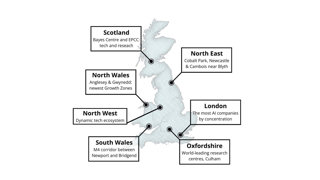
In some areas such as Scotland, the North East, and Wales, there may be incentives, such as reduced costs and local electricity generation to ensure that sufficient power can be provided, to encourage investors to these areas. The Government has called these areas ‘AI Growth Zones’.
Elsham Tech Park
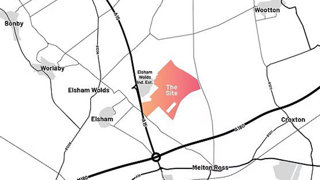
In March 2026, plans were approved for the largest AI data centre campus in the UK. This 176-hectare (435 acre) site is planned to be built on the former RAF Elsham Wolds airfield in North Lincolnshire.
The campus, which is just over 88km (55 miles) northeast of Sheffield and 31km (19 miles) southwest of Hull, is projected to produce up to 1,000MW of computing capacity.
Construction of the first phase of the site is scheduled to start in 2027, with the opening planned in 2029. The cost of the total build is expected to be around £7.5bn. In addition to storage, the campus will house an energy centre which will generate up to 49.9MW to help provide power for the machines.
There are plans for a greenhouse complex to be built next to the campus which will use excess heat generated from cooling the data centre to grow produce.
Greystoke, the developers in charge of the build have said that between 2,600 and 3,600 full-time construction jobs per year could be created over the 10-year window of the build. North Lincolnshire Council have stated that the centre, once completed, could bring in up to £10bn of investment to the area.
Impacts of AI data centres on the UK
| Social | Economic | Environmental |
| AI project applications have been deemed as 'strategically important' and can jump the queue ahead of other developments including houses, hospitals and industrial estates. | In 2024, AI related technologies employed over 86,000 people in the UK. | Data centres are energy intensive causing pressures on the National Grid to deliver enough electricity. In 2025, the demand for electrical connections in the UK grew by 460%. |
| It is estimated that between 120-150 jobs from security to specialist tech jobs could be created at data centres reducing brain drain from rural areas. | British AI companies contributed £11.8 billion to the UK economy in 2024. | To aid the cooling systems, data centres consume more than 560 billion litres of water per year. Much of this water is released as vapour and lost to the wider water cycle. |
Figure 3: Summary table of some of the impacts of AI data centres © RGS.
Sources and further reading
AI is gobbling up water it cannot replace – I’m working on a solution. The Conversation, June 16, 2025.
Prioritising AI data centres could block new homes, builders warn. BBC, March 11, 2026.
Artificial Intelligence sector study 2024. Department for Science, Innovation & Technology, September 3, 2025.
AI and data centres. Business.gov.uk
Could a huge data centre revitalise Ayrshire - or ruin it? BBC, March 1, 2026.
Largest UK AI data centre campus granted planning permission. PBC Today, March 12, 2026.
Regulating AI use could stop its runaway energy expansion. The Conversation, September 12, 2025.
How the UK’s plans for AI could derail net zero – the numbers explained. The Conversation, January 16, 2025.
Artificial intelligence. Our World in Data.
File nameFiles
File type
Size
Download
This resource was first published in May 2026.