The following four posters explore the development of the Environmental Movement in the UK over more than 50 years, demonstrating how scientific understanding, public campaigning and government policy have shaped responses to environmental challenges. Together they provide a valuable perspective on contemporary issues including climate change, pollution and sustainability.
This work supports several areas of the KS3 and GCSE geography curriculum including:
- Environmental change
- Sustainability
- Resource management
- Climate change
- Ecosystems
- The interaction between human and physical processes
Links to A Level Geography Specifications
AQA
3.2.3.6 Urban waste and its disposal
Pearson Edexcel
3.6 The emergence of a global culture, based on western ideas, consumption, and attitudes towards the physical environment, is one outcome of globalisation.
The posters also support the development of key skills by encouraging students to:
- understand how evidence informs environmental policy;
- evaluate the effectiveness of different approaches to environmental action, from grassroots campaigns to legislation;
- analyse continuity and change over time;
- consider multiple perspectives on complex environmental issues;
- and recognise the contribution of individuals, communities and organisations to democratic change.
They illustrate how environmental challenges have evolved while highlighting the continuing importance of informed, evidence-based decision-making when addressing issues from a local to global scales.
A summary of each poster is provided below.
From rubbish dumps to recycling and the circular economy
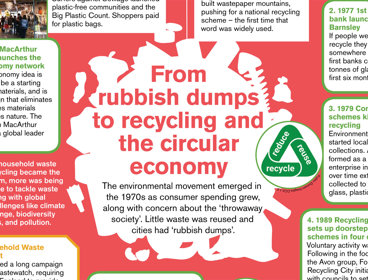
The 1960s was a time of waste, when cities had their own ‘rubbish dump’. Increased consumer spending meant that more waste was produced, very little of which was reused. Various deposit schemes for beer and soft drink bottles were successful - consumers received a small refund when they took their bottle back to the shop. However, this practice declined through the 1970s.
When one bottle deposit scheme ended in 1971, some people got angry. In response, the newly founded Friends of the Earth (FoE) dumped almost 1,000 bottles outside the Head Office of Schweppes. They also built ‘wastepaper mountains’, to campaign for a national recycling scheme. Although the government was slow to respond, the first bottle banks appeared in 1977.
Despite limited government action, public support for recycling continued to grow. Local environmental groups began collecting newspapers and other recyclable materials, with some developing into large community enterprises. By 2002, more than 850 community organisations were providing recycling services to 4.5 million households. Their experience helped shape FoE's Recycling City Programme, which organised large-scale collections of glass, paper, steel and aluminium in four cities.
It was not until 2003, after years of campaigning by FoE, that the Household Waste Recycling Act became law, with most homes getting doorstep recycling collections. However, as larger commercial waste companies entered the market, many of the pioneering community enterprises and innovative schemes were forced to shut down.
There were still plenty of problems, especially with plastic waste, which was being found in oceans and appeared at all stages of the food chain. For many years, higher income countries exported a lot of their waste to lower income and emerging nations until China banned most waste imports, forcing action.
David Attenborough’s Blue Planet II highlighted the impacts of plastic pollution and helped inspire widespread public concern about the devastating effects of plastic pollution. Campaigns such as Surfers Against Sewage's ‘Plastic Free Communities’ and the ‘Big Plastic Count’ encouraged action, while the UK's charge on single-use plastic shopping bags reduced their use by around 80% within two years.
More recently, new approaches have emerged. For example, Extended Producer Responsibility requires manufacturers to add the environmental costs of a product to its market to reduce environmental impacts.
Meanwhile, the circular economy views waste as a starting point for new materials, driven by systems that eliminate waste, circulate materials and regenerate nature. The UK-based Ellen MacArthur Foundation is a global leader in this work.
A future for nature
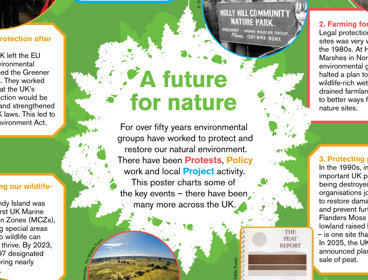
The UK has a long history of caring for nature. The Royal Society for the Protection of Birds (RSPB) was founded in 1889, and the Society for the Promotion of Nature Reserves (now the Wildlife Trusts) in 1912. Such organisations mostly focused on special sites and particular species. By the 1970s it became clear that this approach was not enough, as intensive farming and development steadily reduced the spaces available for nature and wildlife.
There was also the recognition that everyone should have access to green spaces and nature. This led to the formation of urban wildlife groups along with other voluntary conservation bodies that did a lot of work to engage people with the natural world around them.
Voluntary action alone was not enough. Environmental groups campaigned to get the Wildlife and Countryside Act through parliament in 1981. Although it marked an important step forward, the Act arguably did not provide sufficient protection for many of the country's most important wildlife sites. In response, local protests and community campaigns continued, gradually helping to strengthen legal protections over time.
Environmental groups also worked together to protect threatened habitats such as peatlands and ancient woodlands. Alongside this collaborative conservation work, they campaigned - sometimes successfully - against major road-building schemes that threatened to destroy some of the UK's most valuable natural areas.
Much of this work was done as part of European-wide programmes. When the UK left the EU in 2020, environmental groups came together to push for high-quality nature protection which led to the 2021 Environment Act.
Public concern for nature remains strong across the UK. Over half a million people take part in the RSPB’s annual Big Garden Birdwatch, and there are now Wildlife Trusts covering all parts of the UK.
Climate change and energy
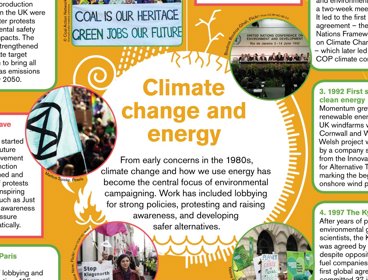
As early as the 1950s, some scientists were becoming concerned about the impact of burning fossil fuels on the climate. In the 1980s, environmental groups started to work on climate change issues and promoting renewable energy. In 1992, at the UN Earth Summit in Rio, 179 governments agreed the United Nations Framework Convention on Climate Change (UNFCCC) – which later led to the annual COP (Conference of the Parties) events where policy has developed ever since. In 1997, governments agreed the Kyoto Protocol – the first plan to tackle carbon emissions globally.
In the UK, environmental groups played a key role in getting support for the first wind and solar projects while campaigning against the continued use of the most polluting form of electricity generation - coal. This led to a phase out of coal and major reductions in the UK’s carbon emissions.
They also pushed for stronger policies. In 2005, Friends of the Earth launched the Big Ask campaign, supported by many other groups, for a clear national plan and target. In 2008, the Climate Change Act was agreed, setting legal targets for cutting UK carbon emissions – the first such act by any government.
Further international progress came with the UN Paris Agreement in 2015 when 195 countries adopted a legally binding international treaty to limit global warming to below 2°C. Frustration with slow progress led to a new wave of protests by the International School Strike movement set up by Greta Thunberg and by Extinction Rebellion.
The UK Government responded by strengthening the Climate Act goals to set a target of net zero emissions by 2050. While there is a new wave of climate denial led by populist political parties, progress to reduce emissions continues. For example, in 2025, over half the UK’s electricity came from renewable energy sources.
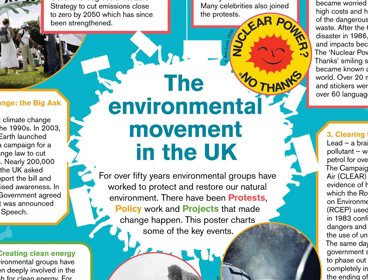
The environmental movement in the UK
In the late 1960s, public concern about the environment began to grow. Rachel Carson’s book Silent Spring set out the problems caused by pesticides, while the Torrey Canyon oil tanker disaster saw crude oil coat the beaches of Cornwall and Devon. At the same time, the world’s great whales were facing extinction due to increasing mechanised hunting, and rising consumerism brought increased litter and pollution. Existing conservation organisations were not equipped to tackle these new environmental challenges, leading to the emergence of campaign groups such as Friends of the Earth (FoE) and Greenpeace in 1971.
The new movement protested about the problems, while also promoting policies to protect the environment. Others worked to develop practical projects to make change happen. National publicity encouraged people across the UK to form local groups to push for action in their communities. Meanwhile, Save the Whale became an international call for action to protect whales from extinction, end commercial hunting and keep the oceans healthy.
In the late 1990s, worldwide concern grew about climate change. Growing scientific evidence showed how fossil fuel use was raising CO2 levels in the atmosphere, causing a slow but steady rise in global temperatures. Groups across the UK joined forces in the Big Ask campaign, calling for legally binding action on climate change. In 2008, the UK Government agreed and passed the Climate Act which committed the UK to legally binding targets to reduce greenhouse gas emissions.
Despite successes, environmental challenges continue to grow. The loss of habitats around the world is driving the decline and extinction of countless plant and animal species. Increasing use of plastics has led to serious pollution problems across the world, and, despite global agreements to tackle climate change, carbon emissions are still rising. The environmental movement has played a lead role in accelerating the transition to renewable energy technologies and continues to campaign for stronger action to protect and restore the natural world.
These posters chart the development of the environmental movement in the UK over the last 50 years. The project that produced this poster involved interviews with 100 people representing the last 50 years of environmental action. Their stories are in the British Library National Sound Archive.
This resource was first published in August 2026.
- Article

Oral histories
Conducting oral history interviews is an excellent qualitative data collection method which helps to gain perspective of people’s interpretation of their own environment
- Podcast
Using Oral Histories for Research
A reflection on the use of oral history interviews as a tool within geography projects
- Podcast

Evolution of the environmental movement
Exploring the history of the environmental movement with Chris Church and Professor Oli Mould from Royal Holloway, University of London
This resource was first published in August 2026.