Geoheritage, cultural heritage, and dark heritage
Jazmin Scarlett has a specialism in the historical and social aspects of volcanic eruptions and has written an Open access paper in the Springer Link journal on a topic that she has a fascination in, and one you may hear more of in the future — ‘dark geo-cultural heritage’.
Definitions
Geoheritage is a term applied to sites or areas of geological and/or geomorphological features with significant scientific, educational, cultural, or aesthetic values. In terms of scientific and educational value, sites would have either distinctive rock or mineral types, fossils or showcase geological processes. Culturally, geological features or landscapes played a role in cultural or historical events. Visually appealing landscapes (due to their geological or geomorphological features/processes) would be considered as holding aesthetic value.
Cultural heritage is an expression of the ways in which societies have lived and developed and are passed on from generation to generation. It is often divided into ‘tangible’ heritage (buildings, artefacts, or landscapes) or ‘intangible’ heritage (traditions, values, customs, oral histories).
The United Nations Educational, Scientific and Cultural Organization (UNESCO), has a database with various geological and cultural heritage sites around the world.
Dark heritage is a subgroup of cultural heritage and is associated with sites of human or environmental trauma. These are locations synonymous with labels such as ‘atrocity’, ‘disaster’, ‘catastrophe’, ‘depravity’, ‘suffering’, ‘tragedy’, ‘barbarism’ or ‘genocide’. Any site that is being using for tourism is termed ‘dark tourism’. Examples include World War Two sites, ghost walks, and abandoned prisons.
Specification links
This topic would fit well into a key stage 3 unit on tourism on an LIC, or at GCSE within the AQA 3.1.1. Section A: The challenge of natural hazards, Reasons why people continue to live in areas at risk from a tectonic hazard.
Activity
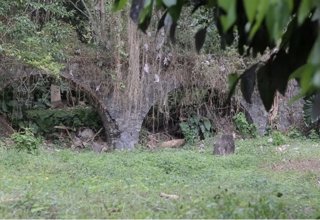
Now you understand the definitions of the above three terms. Below is an image of a plantation ruin that was destroyed by a volcanic eruption from the Caribbean island of Saint Vincent and the Grenadines. Use the image to stimulate ideas for a mind map on how this photograph represents geoheritage, cultural heritage and dark heritage.
Having discussed the above image, try to answer the two questions below.
-
Is heritage about the past or present?
-
Can heritage connect to other natural hazards?
Case Studies
There are four case studies to illustrate this work. These four locations could first be identified using an atlas or using ESRI ArcGIS.
Soufrière Hills Volcano, Montserrat, Caribbean
The 1994 to present day activity of Soufrière Hills Volcano has been a valuable learning tool for volcanologists, anthropology, archaeology, politicians and so on. The destruction of the capital Plymouth is like the 1902 Mt. Pelée destruction of St. Pierre on Martinique as both were a cultural, economic, and political hub of the islands Their ruins leave legacies that have not been forgotten. This has led to interesting ideas of how cultural heritage can be destroyed but also created, due to mass evacuation of people to the UK and the significance of St. Patrick’s Day in connecting the displaced population to the island. But the volcano is not the only source of dark heritage, as the island has a history of using enslaved labour.
La Soufrière, Saint Vincent and the Grenadines, Caribbean
The volcano La Soufrière is one of the most active in the Caribbean, with four recorded eruptions and many geological investigations identifying prehistoric eruptions as well. The eruptions have caused the destruction of plantations and villages, as well as forcing people to leave the island. Across the island, there are many geological sites that showcase volcanic island processes. The island has a rich but complicated cultural history. The island has evidence of indigenous people in the form of ‘petroglyphs’ (rock art), which are popular tourist destinations. Indigenous people still live on the island today. There is also history of French and British colonial occupation which has led to contested cultural heritage, as some people on the island speak English or French. Every year, school children and communities learn from experts about La Soufrière and the volcano, essentially inheriting the heritage of the volcano’s role in society’s life.
Vesuvius, Italy
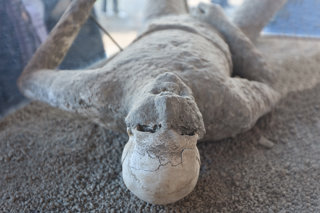
For Vesuvius, the focus is on what makes the sites of Pompeii and Herculaneum destroyed by the 79AD eruption so popular, and how to enhance outreach about risk and vulnerability at these sites. Not only do the sites showcase rich cultural heritage by offering insights to the life of the Romans and long inspired art, theatre and film, every year new insights into the volcanic processes of the event aid the importance of the locations being geoheritage sites. The dark heritage focuses on how death is ‘on display’ for tourists and the ethics surrounding this.
Laacher See, Germany
Approximately 11,000 years ago, near the end of the Last Age, Germany experienced a large volcanic eruption that last several months. The volcanic material erupted dammed the River Rhine, which later burst and caused a large flood. Archaeological evidence has found animal tracks, burned forests, large plant remains and archaeological sites of hunter-gatherers. Today, the site is a ‘Maar Lake’, a site of recreational watersports surrounded by a rich cultural and natural landscape, including Medieval monasteries, beer cellars, organic farms, and vineyards.
Answers
Question 1: Is heritage about the past or present?
This is a complex question, and there is no right or wrong answer. It is entirely dependent on how you understand and define what heritage is to you, and how valuable you consider it to be in the area in question. Once you have considered it personally, then ask: why should we care about heritage and how can we enjoy it? This sequence of questioning is called the ‘Heritage Cycle’. The challenging aspect of dark heritage is that it can be disconnected and uncomfortable, but it can be used to teach us valuable lessons about how to prepare for the future. For example, it is an important element in the management of hazards and disasters. A final difficult question is: how can dark heritage be accepted as part of heritage if people do not want to engage with it or it is unwanted?
Question 2: Can heritage connect to other natural hazards?
It can! But heritage may not be interpreted in the same way as a hazard. This is due to the ways that hazards may (or may not) leave their mark upon the environment and society. If a place has a history of a particular natural hazard, then it will dominate the area’s narrative. For example, the heritage of a UK earthquake e.g. Leighton Buzzard earthquakes in September 2020, might be reduced or even forgotten when there is a dominant association of another natural hazard, such as major flood events e.g. in and round Leighton Buzzard on the River Ouzel. Therefore, UK earthquakes do not connect to heritage in the area leaving neither an environmental legacy nor a mark on the collective memory.
Extension work
In this podcast we talk to Jazmin Scarlett about her work on the dark geocultural heritage of La Soufrière, an active volcano on the island of Saint Vincent and the Grenadines
This resource was first published in 2020.