Investigating superpowers: contemporary geopolitics
This article supports the study of A-level and IB Geography courses, in particular Edexcel’s Specification which includes an entire core topic devoted to superpowers (see below, Edexcel A-level Topic 7 (Superpowers)). Further research links are included throughout in the form of news stories which appeared in the Financial Times during 2020. They help illustrate in greater detail some of the main ideas, concepts and processes which are pertinent to the study of superpowers.
What are superpowers? How have they changed over time?
-
Geopolitical power stems from a range of human and physical of characteristics of superpowers.
-
Patterns of power change over time and can be uni-, bi- or multi-polar.
-
Emerging powers vary in their influence on people and the physical environment, which can change rapidly over time.
What are the impacts of superpowers on the global economy, political systems and the physical environment?
-
Superpowers have a significant influence over the global economic system.
-
Superpowers and emerging nations play a key role in international decision-making concerning people and the physical environment.
-
Global concerns about the physical environment are disproportionately influenced by superpower actions.
What spheres of influence are contested by superpowers? What are the implications of this?
-
Global influence is contested in a number of different economic, environmental and political spheres.
-
Developing nations have evolving relationships with superpowers with consequences for people and the physical environment.
-
Existing superpowers face ongoing economic restructuring, which challenges their power.
Key terms
Superpower
A state that projects well-above-average power and influence on a truly global scale using diverse strategies.
Bi-polar world
When there are two competing superpowers.
Emerging power
States whose economic, political and perhaps military or cultural influence is already large and/or has grown greatly since the 1990s.
Foreign direct investment
A financial injection delivered by a transnational corporation (TNC) into a foreign nation’s economy.
Hard power
Getting your own way through use of punitive military or economic force.
Hegemony
The means by which a major power like the USA builds a global consensus in support of its own dominance, thus becoming a hegemonic power (for instance, using the ‘soft power’ of its media).
Multi-polar world
When there are many competing superpowers and emerging powers each with different regional power bases.
Neo-colonialism
When one state exerts a strong influence over another state’s development or freedom to act on the global political stage. The dominant state uses diverse persuasive means to achieve this, such as lending, investment, media or diplomacy.
Regional power
States that are viewed as powerful mainly in a continental context, for example Australia, South Africa, Nigeria.
Soft power
Non-forceful means by which a superpower maintains a worldwide ‘status quo’ in support of its own continued dominance, such as control or manipulation of global media.
Sphere of influence
The geographical area surrounding a country, over which its government aims to have some control. This can be achieved through the direct colonisation of territories, or via indirect means e.g. military alliances, trade, aid and diplomacy.
1. Which world states are seen as superpowers, and why?
Until relatively recently, the USA was widely viewed as the world's only true superpower. The geopolitically bi-polar world of the Cold War era ended in 1991 with the collapse of the Soviet Union (a communist alliance of eastern European countries which had been centred on Russia). This left the USA standing alone as an unchallenged hegemonic power. During the last decade, however, China has arguably achieved superpower status too - which makes the recent growing political tension between Donald Trump's US administration and Xi Jinping's Chinese government an issue of real global concern.
Alongside these two great powers, other geopolitical ‘heavyweights’ can be identified, although it may be more correct to call them emerging powers, regional powers or (in the case of European countries) ‘ex-superpowers’.
-
The Russian Federation remains a formidable world power under the leadership of Vladimir Putin. In recent years, Russia’s government has behaved in an increasingly antagonistic away towards the USA and European states, notably so with the annexation of Crimea, previously part of Ukraine, in 2014. Russia is the only state with nuclear capabilities rivalling those of the USA (a legacy of the Cold War).
-
Brazil and India are both emerging economies with an important role in global systems. They are the world's eighth largest and sixth largest economies respectively; transnational corporations (TNCs) domiciled in both countries have invested widely across Africa. Along with Russia and China, Brazil and India are sometimes referred to as the BRIC group of countries. The acronym ‘BRIC’ was first used by Jim O’Neill in 2001 to highlight the growing geographical significance of all four countries (collectively, they are home to almost half of the world’s population and account for more than one-quarter of global economic output).
-
Japan is the world's third-largest economy. It is culturally influential too but lacks military might as a legacy of demilitarization after the Second World War ended.
-
The UK, Germany, France, Italy and Spain, along with several other smaller European nations, were major world powers in previous centuries. Even today, they command disproportionate power and influence on the global stage. The UK and France in particular remain formidable military powers. One view is that European countries are able to rival the influence of the USA and China by working together as members of the European Union, thereby giving rise to a multi-polar world order.
Brazil
Incomes in Brazil have risen substantially in recent years, with over 100 million people – more than half the population - now designated as ‘new middle class’. Brazil’s newfound wealth derives in part from the growing global reach of its industries. Brazilian music and art are an important part of global culture.
Russia
Following the collapse of the Soviet Union in 1991, Russia lost much of its global influence. Some status has since been regained on account of Russia’s strategic control of oil and gas supplies. Fuel sales account for around one-third of the country’s GDP, though wealth derived from sales of finite natural resources is not a long-term sustainable growth pathway. Russia is therefore actively forging business partnerships with resource-rich African countries and its own ex-Soviet neighbours.
India
India was home to 1.35 billion people in 2019: that’s more than one-sixth of the whole world’s population! It is a ‘two-speed society’ as half its population still live in extreme poverty, yet India is also home to more than 100 billionaires (US$). One source of this wealth is Indian TNCs such as Tata. India is Africa’s third-largest source of FDI.
China
By one measure, China is the world’s largest economy and the lead exporter of manufactured goods. It projects its enormous power in different ways having steadily built up trade relationships throughout the world since 1978, most recently through the Belt and Road Initiative, a global development plan involving Chinese lending to over 70 developing and emerging countries.
Figure 1 Analysing the characteristics of a superpower state
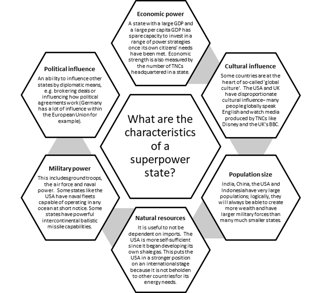
Views differ on issues such as which countries are true superpowers, or the precise moment in the past when the UK ceased to be one. Perspectives are informed by our own biases: for example, people may quite understandably think their own country is especially important in a global context - even when it is not! Also, power can be measured in many different ways, making it hard to compare and contrast the overall geopolitical ‘weight’ of different states. Figure 1 offers a summary of different characteristics of geopolitically powerful countries which might be included in a superpower index. A range of hard power and soft power traits are shown.
The BRIC countries have made rapid economic progress in recent years, building influence around the world in a range of ways using foreign direct investment (FDI), lending and military power. They are sometimes viewed as lacking the soft power that the USA and some European countries possess, however. The West’s soft power is considerable: it derives, among other things, from media institutions such as the BBC and CNN, and the way some Western nations hold sway over international organisations including the World Bank, IMF and other United Nations institutions which they helped establish after the Second World War.
There are signs that China and Russia have begun to challenge Western soft power in a range of ways, though. China has built goodwill throughout Africa and Asia by lending money to developing countries as part of its Belt and Road Initiative. Russia has extended its media influence through the TV network Russia Today. Both countries’ governments are believed to manipulate global social media in ways which may threaten political institutions and elections in rival countries, notably the USA. There is growing interest too in the way China’s so-called ‘wolf warriors’ are working to enhance China’s global reputation online.
Further reading suggestions
‘Wolf warrior diplomats reveal China’s ambitions’, Financial Times, 12 May 2020
‘China-US rivalry and threats to globalisation recall ominous past’, Financial Times, 26 May 2020
‘China’s Belt and Road Initiative’, Financial Times, 25 September 2018
2. What role do superpowers play in global systems, global governance and global environmental protection?
At the time of writing (June 2020), the future of global systems and global governance is harder to predict than ever on account of the Covid-19 pandemic. This section outlines contemporary themes you might want to research further if you are interested in studying the changing influence of China, the USA and other powerful states on the global economy, global governance, and the global environment.
The content below covers several key themes that appear in Edexcel A-level Specification. The content is also highly relevant for the IBDP Global Interactions course and can be used to support aspects of teaching and learning about global systems and global governance for all other A-level courses (AQA, OCR, WJEC and Eduqas).
One conclusion you may draw from reviewing this table is that it is in everyone’s best interests if the world's most powerful and influential countries can work together to provide effective leadership for the safeguarding of human wellbeing and global commons (including the atmosphere and oceans). Now more than ever, in these dangerous and challenging times, we desperately need this.
Superpowers and globalisation
US TNCs, along with US-influenced global economic institutions such as the World Bank, were important for the continued growth of globalisation in the 1990s and early 2000s. But to what extent is this still the case today? Under the Trump administration, the USA has appeared to retreat from global systems. In his rhetoric, the president has advocated the re-shoring of supply chains; he has also used his executive power to impose taxes on Chinese imports, resulting in a so-called trade war between the two countries. Also, the USA and the EU have hardened their stance on attempted inward investments by Chinese-based companies into Western telecoms markets. In particular, there has been opposition against Chinese TNC Huawei becoming a stakeholder in 5G wireless services on the grounds that this constitutes a security risk. Meanwhile, the chaos which Covid-19 has left makes the future of globalisation seem more uncertain than ever. However, it is worth noting that some US and Chinese TNCs have prospered greatly during the pandemic lockdown. They include Microsoft, Apple, Amazon, Facebook and Netflix, along with China’s Tencent and Alibaba.
Further reading
‘Prospering in the pandemic: the top 100 companies’, Financial Times, 19 June 2020
Superpowers and global governance
Escalating tensions between, among others, the USA, Russia and China are symptomatic of a new era of decreasing rather than increasing international cooperation for the world's most powerful countries. The UK's decision to quit the European Union is another sign that influential states may be retreating from intergovernmental organisations. The Covid-19 pandemic has placed further stress on global governance: relations between the USA and China deteriorated after President Trump repeatedly called it ‘the Chinese virus’. Yet there are grounds for optimism too. The search for an effective vaccine, and its subsequent mass production and eventual distribution to 7 billion people could foster a greater sense of shared humanity and global citizenship.
Further reading
‘Cost of vaccinating billions against Covid-19 put at $20bn’, Financial Times, 03 May 2020
‘India rethinks strategic ties following border clashes with China’, Financial Times, 18 June 2020
Superpowers and the environment
The sheer size of their economies means that the world's most economically powerful countries have large ecological footprints.
-
Recently, an oil spill in northern Russia released 21,000 tonnes of diesel fuel into the Siberia wilderness.
-
India and China both struggle with air pollution (although air quality improved briefly under lockdown, the signs are that business-as-usual operations are being resumed).
-
In June 2020, it was reported that hundreds of new coal-fired power stations will open in China over the next few years (this sits uneasily with the Chinese government's pledge to de-carbonise China's economy).
-
You will doubtless be familiar with the controversy surrounding the Paris Agreement following President Trump’s announcement that the USA would withdraw. The Trump administration has also reversed a swathe of progressive environmental legislation introduced under President Obama.
-
In June 2020, record high temperatures of 38C were recorded inside the Arctic Circle, a clear sign that Earth's atmosphere continues to warm irrespective of any temporary emissions reduction under lockdown.
Further reading
‘Siberia fuel spill threatens Moscow’s Arctic ambitions’, Financial Times, 04 June 2020
‘Arctic record temperatures heighten global warming concerns’, Financial Times, 26 June 2020
‘China expands coal plant capacity to boost post-virus economy’, Financial Times, 25 June 2020
- Interview

Superpower geographies
Alasdair Pinkerton, Lecturer in Geography and Geopolitics at Royal Holloway, University of London
- Article
An introduction to Superpower Geographies
An examination of who the superpowers are and how their power develops over time.
- Podcast

What is the relationship between comic books and geopolitics?
In this podcast, we hear from Professor Jason Dittmer about the role of comic books in national identity and superpowers.
This resource was first published in 2020.