Why are soils important?
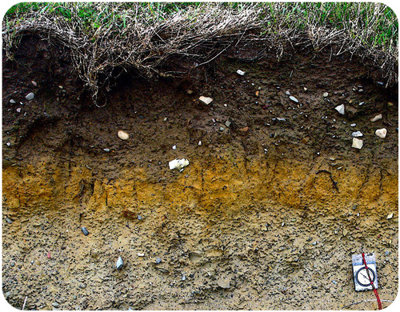
There are about 30 different types of soil in our international soil classification system, and a further 185 different subclassifications within those. Most soil profiles have three distinct soil horizons or ‘zones’ including a topsoil (A horizon) at the soil surface, an underlying subsoil (B horizon), and the parent material (e.g., bedrock, C horizon) from which soils are formed. Each of these horizons comprise living organisms (e.g., earthworms) and non-living solids, liquids, and gases (e.g., minerals, organic carbon).
In the uppermost A horizon, there is often a high organic matter concentration where the majority of carbon sequestration occurs. Carbon sequestration is the process of capturing atmospheric carbon dioxide and storing this carbon in the soil. Soils represent one of the largest land-based stores of carbon. They contain approximately 1,500 billion tonnes of carbon, which is more than what is found in the atmospheric and plants combined (i.e., the atmosphere and biosphere).
Under the A horizon, the subsoil (B horizon) is a paler horizon as a result of having a lower organic matter content.
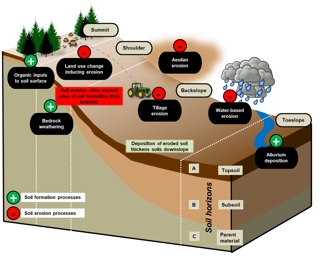
To a large extent, soil formation takes places down at the bedrock (C horizon). This is not a static environment as the rock undergoes physical, chemical, and biological weathering. The bedrock is weakened over time as the glues which hold the rock together loosen, forming saprolite. Saprolite is weathered bedrock and is the first stage of the soil formation process. Worryingly, global erosion rates exceed soil formation rates around the world.
Activity
Study Figure 1. Complete the following questions.
1. Identify the 3 ways soil can form.
2. Listen to the podcast. Explain the challenges of degrading soils.
2a. What practices can help protect and build soils?
3. Explain why the soil thickness is greater at the toeslope than the summit of a hillslope?
Answers
1. Soils can form by organic inputs to soil surface, bedrock weathering, and alluvium deposition.
2. Soil faces growing demands. By 2050 it is expected global population will soar to more than 9 million and global soil resources will need to provide more food, more clean water, and more raw materials. The confounding issue is that one-third of our soils are already moderately or highly degraded with reduced capacity to function. Soil compaction and soil erosion are huge challenges of degrading soils. Erosion is particularly dangerous as soils start to thin, exposing the underlying bedrock material, making it incredibly difficult to salvage original organic content.
2a. Converting arable land to forests is the best way to lengthen soil lifespans. Similarly converting arable land to grassland also improves soil. Cover cropping, grown between harvests, and ploughing across contours (rather than downslope), can reduced erosion rates significantly. Terracing can be beneficial if the aspect of the slope is particularly steep.
3. Erosional processes transport soil from upslope down to the bottom of the slope. The result of this is that the thickness of the soil increases at the toeslope. Often this also means that soil thickness decreases upslope.


This resource was first published in 2022.