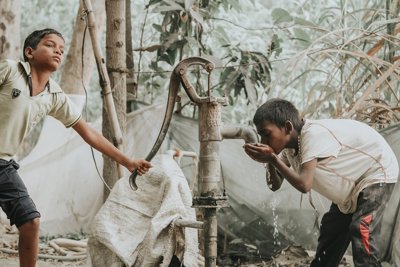
Water access and social inequality in India
July 2015
The author of the paper on which this article is based: Kathleen O’Reilly, Texas A&M University, Texas and Richa Dhanju, St Catherine University, Minnesota
Appeared in: Transactions of the Institute of British Geographers: Volume 39, Issue 3
Reference: O’Reilly, K. and Dhanju, R. (2014) Public taps and private connections: the production of caste distinction and common sense in a Rajasthan drinking water supply project, Transactions of the Institute of British Geographers, 39:3, p373-386
The Our Water project was a scheme that aimed to supply drinking water more reliably to three areas of Rajasthan in northern India (Bikaner, Jaipur and Jodhpur) where groundwater was naturally saline. Prior to 1997, when construction began, the somewhat erratic water supply in these areas largely came through public taps and there were no private connections to individual residences. Previous research into inequality and water provision has focussed on gender, race and social class or indeed a combination of these factors and it has been previously noted that access to water (and who carries it and who does not) can reflect one’s social status (Motiram and Osberg, 2010). One variable that has not been studied in as much detail is caste and its association with poverty in India. With the Our Water project covering 378 villages, each of which had in them representatives of between two and eight different castes, it provided a good opportunity for the relationship between caste, water, and equality to be studied more closely.
The main aim of the Our Water project was not just water provision and an improvement in the health and sanitation standards of the village residents. A key ambition, through greater access to water, was to increase social equality between people of different castes. Increased numbers of public stand posts (taps that linked to mains pipelines) were installed, each serving around 150 people and positioned no more than two hundred metres from any house, increasing the possibility of much more equal access to water (Our Water, no date).
The Our Water project was underpinned by the goals of decentralised management and application of market principles to water, as well as an expectation that this approach would reduce social inequality. Each village, via a village water committee (VWC) was required to manage the selection of stand post locations, their installation as well as day to day operational and maintenance of the village water supply system. The project guidelines advised that all neighbourhoods and castes should be represented on VWCs, and the guidelines further stated that VWCs should also include women. In this sense, the project leaders hoped that the VWCs might act as a vehicle for reducing levels of social inequality by involving people from all castes, genders and neighbourhoods in decision-making. Water was also commodified: villagers were required to pay for the water the village used (where previously it had been free). Each village’s water use was metered and its monthly usage measured, allowing the monthly bill (priced at a maximum of 0.16 rupees per forty litres) to be split evenly between the number of villagers regardless of their individual usage – a measure that was intended to reduce levels of water wastage and increase the feeling of ownership over the resource amongst the villages.
In the post-construction phase it was noted that parts of the scheme had worked very well. In interviews the lower caste groups frequently communicated that they felt their ‘right’ to water was more secure because they were now paying for it. This may account for the very high rates of payment – almost everyone from every caste paid for their water without question (O’Reilly and Dhanju, 2012). The Our Water aim of reducing social inequality through water access however was not met; rather caste and class inequalities were reinforced throughout the course of the project.
Not long after stand posts were installed in some villages, hoses and pipes were attached to them by upper caste villagers. These illegal pipes ran directly into the courtyards of their homes; in some cases closing the stand post to other users and in others separating the original pipeline multiple times so that the whole village suffered from reduced pressure in the system and lower access to water. These measures, due to their cost, were options in which only the upper caste could invest. The satkaa (house connections) sometimes also fed into kunds (underground storage tanks) which allowed the (richer) upper castes to have continual access to water even when the water was not flowing through the stand post directly. Such was their volume that in dry periods some lower castes had to directly ask the upper caste groups within the village to supply them with water from their private kunds (upper caste groups could refuse these requests), this undermined the Our Water project’s goal of equal access to water.
Rather than achieve greater equality, social inequality was maintained and even reinforced, through patterns of water access. Traditional Hindu customs dictate that upper caste groups do not drink from the same sources as lower caste groups (Joshi and Fawcett, 2005) and the ability of some upper caste villagers to secure their own private water supply reinforced this practice. It was also noted in interviews that some upper caste villagers disagreed with the principle of the Our Water project specifically because of the freedom of water access that it gave the lower castes. However a key complaint from lower caste villagers was that through the system of satkaa and kunds they were frequently paying for water they had not used (as wealthier, upper caste households were able to store greater volumes of water) and that the Our Water project only served to actually subsidise the wealthier villagers’ use of water.
The regulation of these illegal fixings to the stand posts was undertaken by VWCs. Although the project leaders had envisioned that these bodies would include representatives from every caste present in a particular village with local people making key decisions about the water supply access in their particular village, upper castes tended to be over-represented in most VWCs and the views of lower caste members were at times trivialised as it was felt they lacked the necessary understanding of the project. As a result, despite all VWCs signing contracts saying they would stop the illegal tapping of stand posts by the upper castes, few did anything to remove the additional fixings once they had been erected.
Moreover cheaper and crudely constructed stand posts tended to be placed in geographical areas associated with lower castes, and were sometimes located further than the maximum two hundred metres from homes that the project required. In fact, the spatial separation of the castes within a village often meant that caste discrimination was not even seen as an issue by the VWCs as few upper and lower caste families had to share the same stand post anyway.
With the lower castes groups having a greater voice within this project compared to previous systems for managing the water supply, lower caste groups were able to draw attention to the inequality that the Our Water project had sustained. Their solution was not to punish the upper caste villagers for their planned division of the communal resource, but to seek to equal them, with individual water connections to each house being provided for all regardless of their social grouping. Poignantly, this move was rejected by most VWCs on the basis that house connections themselves were illegal and too many of them would depressurise the water supply system: a clear indicator that one rule existed for the upper caste groups and another for the lower castes.
The Our Water project shows that, despite the project’s aspirations to improve access to water, introducing neoliberal forms of water management (such as commodification and decentralisation) can compromise water access goals because the local institutions (in this case VWCs) do not emerge from a neutral social or political field. . While technologies such as pipe fixings and kunds, (and one’s ability to afford these) were important for the development of further inequality within Rajasthan, social institutions such as the VWCs reinforced caste divisions. Therefore, future movements that aim to provide greater equality in access to water should look to not only provide structural equality in built forms, but also recognise that (neoliberal) governance reforms are not politically neutral, and can produce unintended consequences such as stabilising and deepening existing inequalities.
References
Agarwal, B. (2001) Participatory exclusions, community forestry, and gender: an analysis for South Asia and conceptual framework, World Development, 29, p1623–1648
Bondi, L. (2005) Working the spaces of neoliberal subjectivity: psychotherapeutic technologies, professionalisation and counselling, Antipode, 37, p497–514
Joshi, D. and Fawcett, B. (2005) The role of water in an unequal social order in India, in Coles, A. and Wallace, T. (eds) Gender, water and development, Berg, New York, p39–56
Motiram, S. and Osberg, L. (2010) Social capital and basic goods: the cautionary tale of drinking water in India, Economic Development and Cultural Change, 59, p63–94
O'Reilly, K. (2006) Women fieldworkers and the politics of participation, Signs: Journal of Women in Culture and Society, 31, p1075–1098
O'Reilly, K. and Dhanju, R. (2012) Hybrid drinking water governance: community participation and ongoing neoliberal reforms in rural Rajasthan, Geoforum, 43, p623–633
Our Water (no date) Handbook on water distribution management, p15–36, Unpublished document
Key Words
Decentralisation
The redistribution of administrative power from central government to local control.
Neoliberalism
A movement which puts the economic governance and decision-making of a scheme into the hands of private enterprise or individual groups of people.
Water Scarcity
A disparity between the supply and demand of water such that the availability of water falls below 1,000 cubic metres per person per year.
Water Stress
A disparity between the supply and demand of water such that the availability of water falls below 1,700 cubic metres per person per year.
Lesson Ideas
To demonstrate the inequality in water supply a class can transform into a VWC meeting with different sized groups of students representing different caste groups. A set of proposals for a fictional village can be drawn up regarding water supply and the VWC can vote on different decisions. After the meeting students can be asked to comment on how it felt to be marginalised and for their good ideas to be undermined by prejudices.
Students can be asked to draw comparisons between the structure of the Our Water project and the VWCs with intergovernmental structures such as G8 and Davos groups. What can the panels on the IGOs learn from the outcomes of the Our Water project?
The article raises issues about whether water supply is a human right or a commodity. Students can explore the ideas of both sides of the argument and discuss the players who would be in favour of one side or the other. The class can then vote on whether everyone should pay for water regardless of their background.
Links
- 60 second guide
Sustainable Development Goal 6: Clean Water and Sanitation
A 60 second guide to Sustainable Development Goal 6: Clean Water and Sanitation.
- Podcast

What are the big challenges for global water security?
We interview UNESCO Chair of Water Science Professor David Hannah at the University of Birmingham
- Interview

The water challenge
Professor Dame Judith Rees, former President of the Royal Geographical Society (with IBG)
This resource was first published in 2015.