Learning to live with water scarcity: stories from migrant households in the UK
Water scarcity is quickly becoming a reality of the climate crisis. This summer has been alarmingly dry with reservoirs now running low, wildfires spreading, and farmers warning of food insecurity. By the end of July, half of England was officially declared in drought, alongside the whole of Wales. How can communities, who usually experience reliable and consistent rainfall, learn to live with limited water?
Louise Turner, Dr Claire Hoolohan and Dr Sarah Mander explore just this in their latest article on water scarcity. The article features a range of stories from Louise’s PhD research, which examines the water practices of migrant households who moved from water-scarce countries to England.
We spoke to Louise to find out more about her research and the sustainable pathways it identifies for the water sector in the context of climate change.
Exploring our relationship with water
Water is fundamental to our existence, yet more than half the world’s population faces water scarcity for at least one month of the year. Extreme weather driven by climate change is altering the availability of water for human use across the globe as droughts and floods increasingly challenge public infrastructure. How we think about and use water will therefore need to change as an important part of climate adaptation; Louise believes that we can learn valuable lessons from communities with experience of water scarcity.
I wanted to build a picture of what lives might look like under water scarcity, from the perspective of people who have lived that experience. This may help us think about how we can use water more sustainably in the UK.Louise
For many of us, it can be hard to visualise where our water comes from. However, the geographical concepts of space and scale can help us follow the water from its source to our homes. The water that runs out of the kitchen tap connects us to other places and scales, from reservoirs and rivers to the waste-water industry and weather patterns.
At the household scale I witnessed micro-practices for reducing and reusing water. Within these micro-practices, there was a larger sense of caring for water and thinking about relationships to water. What we see happening in the household can tell us about relationships to water and possibilities for change.Louise
Louise travelled to 16 migrant households to discuss their past and present water practices. Through this, she was able to explore migrants’ stories of living with water scarcity and how this continued to impact their water practices today.
As well as the availability of water, she found that the social relations and practices we grow up with shape our relationships with water. Louise describes these relationships as “water imaginaries”. For many migrants, their water imaginaries travel with them to the places they now call home.
Stories from migrant households
Louise’s research explored the influences behind her research participants’ relationships with water conservation. In many countries, for example, government regulations dictate when water can be used. One participant, Rima, described childhood experiences of carefully timing water usage in Egypt where the government restricted water use from 3.00pm to 6.00am. Rima’s family used water consciously, storing it in jars to allot fixed, visible amounts to household members for everyday tasks.
When Rima’s son, Malik, visited his grandmother, he witnessed water conservation practices in action. His grandma saved used water in pots around the house meaning that it could be re-used for plants or animals. Malik returned to the UK with this attitude of care, reducing his water use through steps such as turning off the tap whilst brushing his teeth.
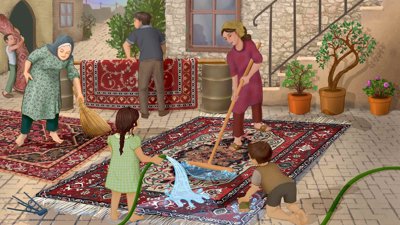
For Elnur who grew up in water-scarce rural Azerbaijan, memories of shared, communal water rituals shape his water practices today. Elnur described how the community came together to wash their rugs in the street once a year. Public water rituals and infrastructure, such as public drinking fountains, can make us more aware of water as a shared, common resource and inspire a more collective and responsible approach to its management.
We need a greater degree of engagement between people and water and a big part of that is the visibility of water. We need to think about how water can be made visible in people's lives to try and foster a sense of connection.Louise
Amira, originally from Syria, noticed this lack of connection when she moved to the UK and was shocked to see a friend pouring away unused drinking water. She described how water saving practices such as bucket bathing could be both enjoyable and useful.
Whilst bucket bathing was used when water or electricity was limited in Syria, Amira continued to use this practice when needed here in the UK – for example at a festival. For Louise, these different ways of imagining and relating to water provide a source of hope, helping us learn how to live with the challenges of water scarcity.
With climate change intensifying there will be a lot of challenges. I want to inject some positivity by looking towards resilience, optimism and hope. I wanted to look for those examples and learn from people's stories of resilience.Louise
Next steps
Louise’s work continues to focus on our relationships with water. Next year, Louise is beginning a Research Fellowship with Cranfield Water Science Institute focusing on shaping water policy with the aim of encouraging practices that are beneficial to both people and nature. She will continue to focus on water imaginaries, infrastructure and practices to take a holistic view on sustainable water management.
- Research and higher education
Mouldy homes: an issue of justice in a precarious housing market
Mouldy homes are more than an inconvenience, they are dangerous. In this research spotlight, we’re featuring Dr Sarah Klosterkamp’s research, published in Transactions, on justice in the German housing market.
Wednesday 9 Sep 2026 - RGS news
Over 2,800 geographers gather at Annual International Conference
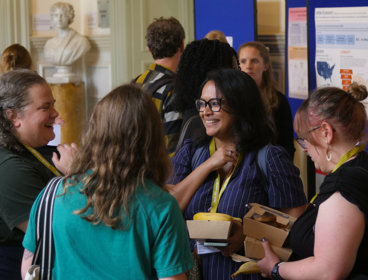
After 600 sessions over four days, the Annual International Conference 2026 has concluded. 2,886 in-person and online delegates from around the world explored the theme Geographies of inequalities: towards just places.
Tuesday 8 Sep 2026 - RGS news

Four new editors appointed to Society journals
We are delighted to announce the appointment of four new editors to the RGS-IBG journal portfolio.
Wednesday 12 Aug 2026