Society response to DfE consultation on new GCSE in natural history
In June, the Department for Education opened a consultation on the proposed subject content for a new GCSE in natural history and invited comment from experts and stakeholders. Many thanks to all those who informed the Society’s response, which you can find below.
The Society welcomes the Natural History GCSE as a qualification which provides an excellent opportunity to engage and connect young people more deeply with the living world around them, helping inspire and enable them to take action.
With regards to the proposed subject content, we:
- Support the way that the subject is designed to complement the study of Geography GCSE, as well as Biology and Science more generally. However, the connections to the arts, and to the wider humanities and social sciences, should be developed more. We appreciate this is a qualification in natural history, but nature has profound cultural and social dimensions. The theme of nature connectedness needs to come through more strongly; humans are part of nature and one of the stated aims of the qualification is for students to “reflect on their connection with nature”.
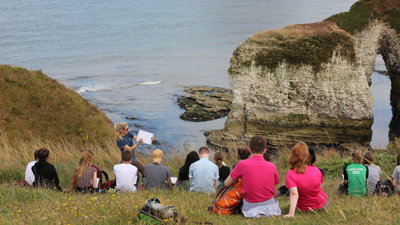
- Have concerns about equity of opportunity and the range of schools that will have the capacity to deliver this qualification. Access to the environment is spatially very unequal; Defra’s latest analysis and metrics demonstrate this clearly. Some schools have extensive grounds with abundant opportunities for fieldwork of the sort expected in the qualification, but many schools, often in more deprived neighbourhoods, do not.
- Are concerned about teacher capacity to deliver this new qualification, recognising the shortages of specialists and the existing demands on teachers which will only be exacerbated by the outcomes of the broader Curriculum and Assessment Review. Significant investment in resources and teacher professional development will be needed before first teaching. The costs of this will be an additional challenge for schools wishing to offer the qualification.
- Highlight the very significant omission of explicit reference to maps, location data of multiple forms and GIS and remotely sensed data – these underpin analysis of the natural world. Maps and satellite imagery are freely available through ESRI’s Living Atlas and UK schools have free access to ESRI’s ArcGIS Online accounts. Defra’s MAGIC map allows students to see the locations of certain habitats and other data about the countryside. Students should be engaging with the Ordnance Survey’s mapping throughout the course.
- Recommend that wider skills such as critical evaluation are explicitly included alongside the range of data skills mentioned, and attention paid to problems which can affect data gathering.
- Would like to see greater attention paid to more recent and historic change. While there is reference to long term (Quaternary) change, which we agree is needed to understand longer term drivers, students will need to understand the rapidity of shifting baselines – particularly changes that have occurred within the lifetime of the students or their parents.
- Recommend that reference to landscape and the processes that shape it (geomorphology), should be more explicit, and not just geology and soils. Geomorphology significantly influences habitat formation and maintenance, shaping the distribution of resources, such as water and nutrients, which affects ecosystem functioning, and by creating barriers to dispersal or providing habitat corridors, affecting species distribution and population dynamics.
- Are concerned that the proposed content for “Human Influences on the Natural World” does not do enough to explicitly link those human influences, both positive and negative, to their impact on UK habitats. In the same way that students will be expected to identify specific wildlife typical of each habitat within the subject content, they should also be expected to identify specific human influences affecting each habitat.
- Hope that any reference to individual scientists who have been influential in the discipline will be appropriately diverse and also representative of Indigenous knowledges.
- Would like to see more attention paid to the role of nature-based solutions (adaptation and mitigation) to climate change. Terms such as natural capital and ecosystem services should be included. This would also make explicit links to some of the types of green careers that studying Natural History might lead to, as well as the importance of considering the natural world in fields such as engineering and architecture.
- Assume that although the draft revised Geography subject contents are not expected to be published within the consultation period of this GCSE, we anticipate that climate change and sustainability education will be strengthened. Therefore, it is important that that the Natural History GCSE builds on, rather than duplicates, learning in Geography (and Science). This summer’s dramatic weather reinforces the need for climate change’s impacts on the natural world to be specifically referenced, and for appropriate and hopeful narratives to be developed about the coming decades.
- RGS news

New range of discounts for RGS School Members
We are delighted to announce that the Society and Field Studies Council are unveiling a range of new discounts for RGS School Members.
Friday 11 Sep 2026 - RGS news

Geography remains sixth-most popular subject as GCSE results released
Congratulations to everyone receiving their geography GCSE results today.
Thursday 20 Aug 2026 - RGS news
Society congratulates geography students on A Level results day
Congratulations to everyone receiving their geography A Level results today.
Thursday 13 Aug 2026