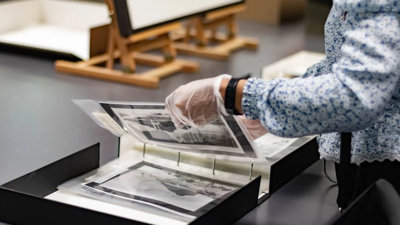
Stories from the Collections: The West India Regiments
The Royal Geographical Society’s Collaborative Doctoral Awards programme provides an opportunity for PhD students to have direct and unlimited access to our Collections and examine interesting, and often unrepresented, stories through extensive research.
One of our recent CDA students is Cat Sharples. Based at the University of Warwick, the RGS and Royal Botanic Gardens, Kew, Cat has been researching the role of military personnel in scientific knowledge-making at the frontiers of the British Empire in the 19th century. In particular, she has been looking at the role of the West India Regiments (WIR) in projects of colonial science (including exploration, botany and ethnology.)
Her project, which contributes to the decolonisation of scholarly collections and academic knowledge, explores how the WIRs occupy a unique place in the history of British Empire; they were a regular part of the British army but were almost entirely comprised of men of African descent.
While CDA students are given a broad topic to research, they are encouraged to narrow the focus. Cat said: “It’s really useful to have a framework built into the project - somebody pointing you in the right direction of where the materials are and how you might want to approach your project really helps in the early stages”.
As time went on, Cat’s focus developed. She adopted a biographical approach to her work, with each chapter focusing on a different person but with the same conflict in common, the Anglo Shanty Anti War of 1873-74: “I wasn’t looking at the fighting side of things, which other people have done, but how that regiment and specifically the character of that regiment, has impacted on colonial scientific research in the 1850s-1890s.”
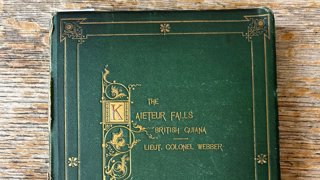
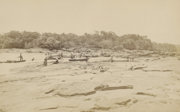
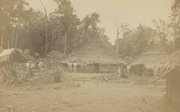
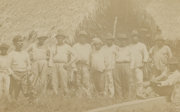
Students undertaking a CDA with the Society have a plethora of unique opportunities, including curating a cabinet display on site. For Cat’s display, she chose to highlight Chapter One of her thesis which centres one book in particular; a journalistic account of the 1872 expedition to the Kaieteur Falls in British Guiana, as experienced by three of the WIR members.
While historians have generally overlooked this expedition, Cat’s research centres it as fundamentally significant for not only documenting the first ever photographs taken of that region but as a means of understanding the role of military personnel in colonial science, their relationships with the natural world and with the region’s Indigenous communities.
In addition to research opportunities, Cat found the placements beneficial for professional development: “At the RGS, I got to work at the annual conference, which meant I could benefit from an academic experience and networking opportunity. PhDs can typically be quite isolating, so having colleagues and getting to work in an office setting was really nice as I wasn’t alone. And I got free toast!”
On advice for prospective students, Cat says: “Everybody’s PhD is individual - if you get halfway through and think you haven’t achieved anything, you will, it’s just not as tangible as you think it is. And for me my PhD really didn’t come together until my third year, progress isn’t always linear”.
Congratulations to Cat who has now passed her viva!
If you’d like to find out more about Cat’s PhD, the 1872 expedition book and related material are currently on display in the Society’s ambulatory corridor until 29 October.
Find out more about the studentships
Credits
Webber E. J., . (1873). British Guiana: the Essequibo and Potaro Rivers, with an account of a visit to the recently discovered Kaieteur Falls. London: Edward Stanford. Control Number: rgs339890
- Events
Last chance to see Gertrude Bell exhibition at the Society
As the Routes, Ruins and Reconnaissance exhibition draws to a close, we’re sharing a timeline of Gertrude Bell’s iconic life and work.
Tuesday 18 Aug 2026 - RGS news
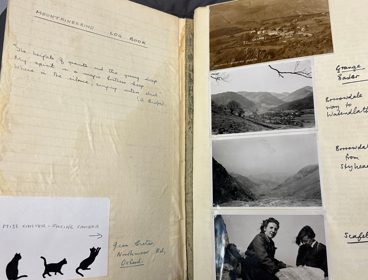
Celebrating International Archives Week: spotlight on the Jean Carter Collection
Wrapping up International Archives Week, the Collections team share a favourite new addition to our archival holdings, the Jean Carter Collection.
Friday 13 Jun 2025 - RGS news
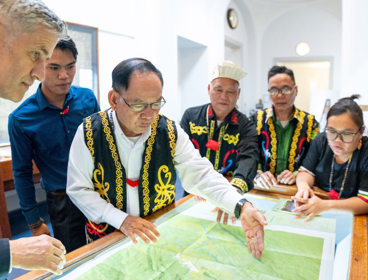
Penan delegation donates maps to the Society
Last month, we were honoured to receive a gift and donation from the Penan delegation of Sarawak.
Friday 16 May 2025