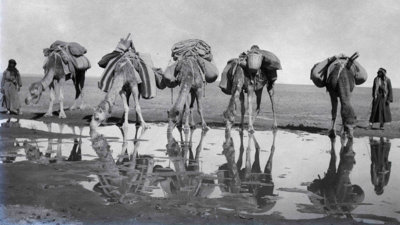
Last chance to see Gertrude Bell exhibition at the Society
Routes, Ruins and Reconnaissance, an exhibition that has been open at the Society this August, is in its final week. The exhibition focuses on Gertrude Bell, an archaeologist, explorer, writer and Fellow of the Society whose name is inscribed in gold in the Ondaatje lecture theatre when it was built nearly 100 years ago, in 1930. She is the only woman to have her name written here.
The exhibition considers Bell’s relationship with the Society, both highlighting the contributions made to the British war effort and showcasing unique photographic and documentary material in one venue for the first time.
The exhibition marks the completion of a 17-month collaborative project between Newcastle University and the Society, generously supported by the Harry and Alice Stillman Foundation. It features some of the 530 newly digitised images created from original negatives held in the Society’s Collections, as well as treasures from the Gertrude Bell Archive, held in Newcastle.
As the exhibition draws to a close, we’re sharing a timeline of Bell’s iconic life and work.
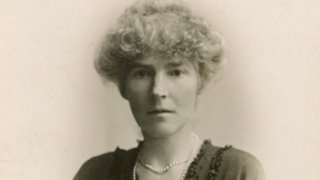
Gertrude Bell, 1868–1926
1868: Bell is born in Washington, North East England
1886–1888: Bell studies Modern History at Oxford, graduating in two years with the equivalent of a First, at a time when women were not awarded degrees.
1899–1914: Supported by family wealth and connections, Bell travels widely in Europe and the Middle East, following her passions for mountaineering, archaeology, and languages, including extensive travel in modern-day Lebanon, Syria, Turkey and Iraq. During these travels through the Ottoman Empire, Bell develops her interest in photography and medieval buildings, early Islamic buildings, and Byzantine buildings.
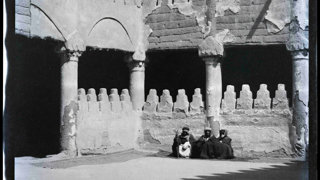
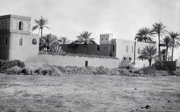
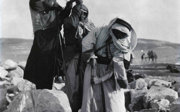
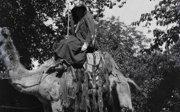
Bell’s images represent a rich record of people and places, many of which have changed radically and many of which are now lostProfessor Mark Jackson, co-curator of Newcastle University’s Gertrude Bell Archive
June 1913: Fellowship of the Royal Geographical Society is opened permanently to women. In that first year alone, 163 women are elected to the Society, including Gertrude Bell. Bell receives the Gill Memorial Prize, undertaking training to use a theodolite and observing maps and photographs.
November 1913: After receiving the prize, Bell travels to Hail, Saudi Arabia to record archaeologic sites. Bell keeps diaries and detailed architectural studies of all she sees – notebooks of which are stored in the RGS. In her diaries, Bell contemplates what purpose keeping these records served: “I am not sure what profit I shall get out of it all”.
1914: Bell works for the Red Cross.
1915: Bell is invited to Cairo to help David Hogarth with intelligence files.
1916: Now considered a specialist on the Middle East, Bell is called upon to assist the British government in Mesopotamia during World War I. She moves to Baghdad, where she becomes the only female political officer in the British forces, working closely with Sir Percy Cox. She is based there for the rest of her life.
In spite of her fears that her journey had been a failure, her records held at the RGS and her knowledge proved useful to the British during the war... now the archives serve as a priceless record for communities around the world and for us as we seek to understand better the story of Bell and her contemporaries during this internationally significant period.Professor Mark Jackson
1918: Bell is awarded the Society’s Royal Gold Medal. After the war ends, Bell has a huge influence on post-WWI Mesopotamia, shaping the country’s spatial and architectural legacies, most notably through her role as Director of Antiquities.
1926: Bell dies in Baghdad, aged 57.
Bell’s story is just one of many women active in geography at this time. As Dr Sarah Evans, Research and Higher Education Manager at the Society, noted:
“I’m really delighted about this collaboration and what it’s going to unlock… encountering Bell as a complex and fascinating figure worthy of further study. But I keep coming back to those other 162 women who were elected to the Society in 1913 and what stories we might uncover about them and their work and lives. But that will have to wait for another day”.
Routes, ruins and reconnaissance is open 10.00am-5.00pm, Monday-Friday, until 24 August.
- Geography news
Dr Katie Parker on the UN’s vote to adopt a new world map
The Society’s Cartographic Collections Manager, Dr Katie Parker, explains the Mercator projection and looks at the UN resolution to formally phase it out.
Thursday 24 Sep 2026 - Collections
Reinterpreting the Collections at Lowther Lodge
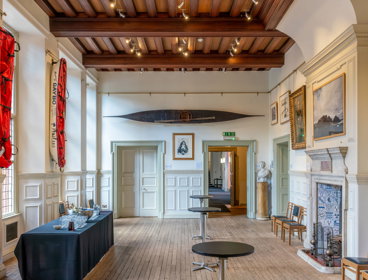
Today we're sharing a behind-the-scenes look into recent work at the Society to reinterpret the spaces throughout the building and tell stories across the breadth of our Collections.
Thursday 27 Aug 2026 - Research and higher education
Stories beneath Greenland’s ice
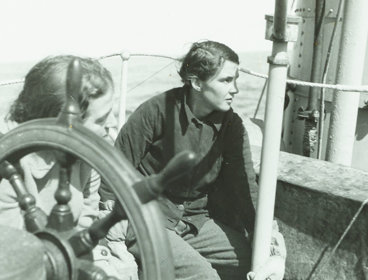
Today, we're sharing a behind-the-scenes look into how hidden stories of UK-led exploration in Greenland have been gathered, curated and disseminated as part of the Greenland Connection project.
Friday 24 Jul 2026