Student food poverty: the role of universities in free food provision
University students are living through a cost-of-learning crisis with many unable to afford basic necessities. In 2023, one in four UK universities was providing free food to students. While we know the significant role of schools and nurseries in free food provision, much less is known about universities.
At Brunel University of London, Professor Emma Wainwright and her colleagues, Dr Ellen McHugh and Mamoon Bhuyan, want to change this. Their research on the topic was recently published in Area, one of the Society’s journals.
Emerging out of COVID-19 and with the cost-of-living crisis, we realised free breakfasts were being offered on campus with plans for a food bank. There hasn’t been research that captures this shift where food banks and free meals are needed by students. This led us to explore how universities are responding to student hunger. – Emma
With the support of the British Academy, they carried out a 20-month ‘University Free Food Project’ exploring free food provision across English universities. This involved a survey of university staff, asking them to describe their institution’s approach to tackling student hunger.
41 universities responded, building a picture of the geographies of on-campus free food provision across England. We spoke to Emma to find out more.
Food poverty in higher education
According to the Trussel Trust, an anti-poverty charity managing a nationwide network of food banks, 6.5 million people in the UK relied on charitable food providers in 2025.
Food poverty – the lack of financial ability to buy food at the quantities and qualities needed – is impacting increasing numbers of university students. Students typically have small financial margins, are reliant on precarious work, and are vulnerable to rising costs of rent, utilities, and food.
Student hunger is a real problem and it's a problem of poverty affecting all kinds of students. Those students who don’t quite qualify for a full maintenance grant, for example, are really struggling because the system relies on parents and carers supporting students. Often that’s not possible and it's just not enough for the costs students incur. – Emma
Emma and her colleagues found that free food is being provided in a variety of forms by universities across England, varying from food banks and food packages to the granting of hardship funds or the redirecting of students to external food charity partners.
Crucially, the researchers found that mechanisms of food support varied with the financial capacity of each university, with institutions with the most limited budgets the most constrained in their ability to support students.
Spatial and temporal patterns in food provision
Emma and her colleagues found that on-campus free food provision is reshaping campus spaces in several ways depending on the type of free food being provided.
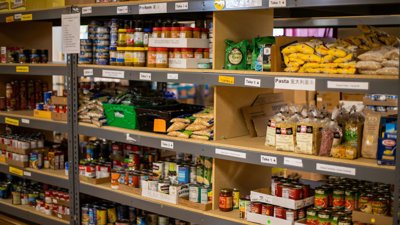
A library pantry, for example, is a highly visible form of free food provision open to all students, whereas a campus foodbank requiring a referral might be hidden away.
We explored how free food provision is located and made (in)visible within campus spaces. Our paper highlights how different provision is differently located. The food bank might often be tucked away, somewhere that is discrete. Free food events, on the other hand, might be celebrated in an open space. – Emma
Food provision also varies temporally, both in terms of the length of support and the periods of provision. Some universities are only able to support students for a short period of time.
As one staff member shared, “We provide a food bank service for students on a short-term basis (a week's worth of food) whilst help is put in place to resolve their financial difficulties, or whilst they are waiting for a grant/loan to come through. We do not support students on a long-term basis and will direct them to local food banks if their situation is likely to be a long-term issue.”
Other staff members describe how their university provides free food when student need is perceived to be greatest: “We offer free fruit (weekly) and breakfasts (daily) periodically throughout the year in the food outlets for all students, particularly around exam times and during the colder months.”
Student food poverty connects to the wider financial crisis occurring across higher education here in the UK. Budgets across universities are increasingly constrained and precarious working conditions are impacting those working and studying in Geography departments and beyond.
Last year, it was estimated that 15,000 jobs were cut across UK universities. For Emma, student hunger needs to be part of a wider conversation around precarity, issues of student finance and how we fund higher education.
The current precarious situation of many universities cannot mean that support for students is stripped away. Universities need to account for the everyday costs of students, from laundry to printing and rent to food. This is about recognising who's in our classrooms and asking what struggles they have to be there. It is also a wider conversation at government level: what are our priorities in higher education and how do we support young people? – Emma
Next steps
Emma and her colleagues continue to share their learnings from the University Free Food Project. Their next paper dives deeper into the different forms of free food provision, exploring what works best for students.
Emma is continuing work in this field with a focus on the precarity of international students.
Read more about the issues discussed in this blog.
This spotlight was written by Safia Bailey (Cardiff University).
- RGS news

Society hosts Climate Adapted Pathways for Education (CAPE) event
The Society hosted the launch of new curriculum guides for primary Science, Geography, and Art by Climate Adapted Pathways for Education.
Monday 16 Mar 2026 - RGS news

Geography for All – one year on
Read our thoughts on the ongoing development of Geography for All—our programme dedicated to building a more inclusive, connected, and equitable future in the discipline.
Wednesday 11 Mar 2026 - RGS news
Society collaborates with Culture& on provenance workshop
Last week, the Society welcomed researchers and museum professionals for a ‘hands-on’ workshop with ‘untethered objects’ in our Collections, organised in partnership with Culture&.
Thursday 5 Mar 2026