English Indices of Deprivation 2025
In 2025, the Ministry of Housing, Communities and Local Government (MHCLG) released the 2025 Indices of Deprivation (IoD) for England. This is the latest release in a series which started in 2000, created to allow decision makers to understand deprivation across England and updates the 2019 IoD.
Issue
Understanding and addressing deprivation in England requires accurate, up‑to‑date, small‑area data that reflects how unmet needs and limited access to opportunities affect communities.
Since the last release in 2019, major societal changes, including the rollout of Universal Credit, the COVID‑19 pandemic, and the rising cost of living have reshaped the landscape of deprivation.
Policymakers, local authorities, researchers, and community organisations need updated evidence to target support, allocate funding, and design interventions that reflect today’s conditions.
Approach
The MHCLG updated the English Indices of Deprivation for 2025 (IoD25) using new and updated datasets and methods.
This consisted of:
- Measuring deprivation across 10 indices (income, employment, health, education, crime, housing barriers, living environment) – using 55 indicators (from 39 in 2019). Further indices include supplementary child and older people income deprivation measures and the Index of Multiple Deprivation.
- Using Lower Layer Super Output Areas (LSOAs) with an average of 1,500 residents to ensure consistent, neighbourhood level insights across each neighbourhood.
- Drawing on 20 new indicators such as Universal Credit claimant data, energy performance (EPC) housing quality measures and noise pollution among others.
- Using 2021 Census boundaries as an updated population measure, incorporating the most up‑to‑date LSOA boundaries together with the latest local authority district configurations.
Impact
The IoD25 offers updated evidence to support targeted policies and is used extensively by local government, councils and third‑sector organisations who rely on the data to understand local conditions and policy interventions.
The dataset supports place‑based funding decisions across government, informing funding allocations to local councils, schools, policing and much more.
The work has led to the development of new outputs such as understanding rural deprivation, enhanced measures of housing, connectivity, and antisocial behaviour which provide more accurate and contemporary insights into the lived experience of deprivation, strengthening informed decision‑making.
The indices’ transparent methodology and published guidance, enables users to tailor analysis to local contexts, and has informed the development of similar approaches in other countries such as Sweden and Thailand.
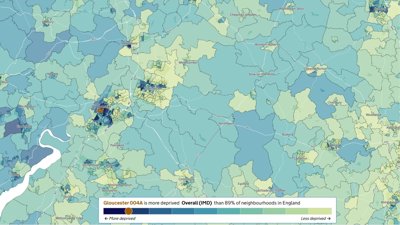
The work has produced an interactive tool, the Local Deprivation Explorer, which help users look up deprivation data for their area and explore comparisons across England across various indices.
More information
Organisation: Ministry of Housing, Communities and Local Government