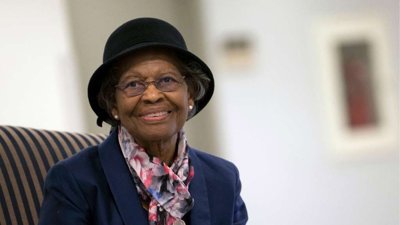
It has been said that Global Positioning Satellite (GPS) technology exists because of two people, namely Albert Einstein and Gladys West. Such a statement may be considered rhetorical but does convey the huge contribution that Gladys West made to geodesy that underpins all Global Navigation Satellite Systems.
Gladys West played a crucial role in developing mathematical models from early altimeter satellite missions that precisely described the Earth as a geoid rather than a perfect sphere. Her work involved complex calculations and early computer programming to process satellite data. These models made it possible to determine locations on Earth with high precision, a core requirement for GPS technology.
Modern GPS systems use Gladys West’s models through updated Earth‑shape and gravity frameworks that underpin satellite orbits, geoid corrections, and global reference coordinate without which today’s centimetre‑level accuracy is not possible.
As she said: “When you’re working every day, you’re not thinking, ‘What impact is this going to have on the world?’ You’re thinking, ‘I’ve got to get this right.’”
This year's EGR Taylor lecture seeks to do justice to Gladys West including her early life and studies, her time at Dahlgren, description of the scientific models she developed, the recognition she received later on and the impact of her work.
About the speaker
Philip Moore is Emeritus Professor of Space Geodesy at Newcastle University, where he spent over two decades as a leading member of the Geomatics group.
His research focused on the mathematical and computational foundations of satellite-based Earth observation, with particular emphasis on precise satellite orbit determination, satellite altimetry, gravity field recovery from missions such as GRACE and GOCE and applications of GNSS and altimetry to sea-level change, inland waters, hydrology, and cryospheric mass balance.
Moore’s contributions to satellite radar altimetry include improving the accuracy, calibration, and geophysical interpretation of altimeter measurements over oceans, coasts, inland waters, and ice‑covered regions. Much of this work is cross-disciplinary involving orbital mechanics, geodesy, and Earth system science.
Booking information
- Advance booking for this event is required. In order to book you will need an account on our website. If you already have an account you will be prompted to log in when you click 'book now'. Please create an account if you do not have one yet (you do not need to be a member of the Society to create an account).
Attending in-person
- We do not issue tickets (electronic or physical) for this event. Instead your name will be on a list at the door. Please use the Society's entrance on Exhibition Road.
Attending online
- If you are attending the event online, the joining instructions will be included in your confirmation email.
If you have any questions or require assistance with your booking, please email events@rgs.org
Venue information
This event will be held in the Education Centre at the Royal Geographical Society (with IBG), 1 Kensington Gore, London, SW7 2AR.
Plan your visit to the Society and find more information about our venue, including our address, accessibility and transport links.
Accessibility at our events
We want everyone to feel welcome at our events. Key accessibility features of this event include:
- Step-free access to the event
- Accessible toilets
- Assistance dogs are welcome
- Hearing loop
For full details, please visit our accessibility page. If you have any questions or specific access requirements, feel free to get in touch with us on access@rgs.org
- Webinar
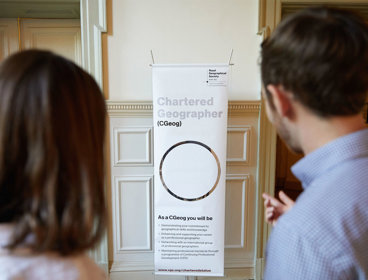
Chartered Geographer introductory webinar - September
Join this webinar on 16 September to learn more about the benefits of becoming a Chartered Geographer.
OnlineProfessionalsWednesday 16 September 2026 - Webinar
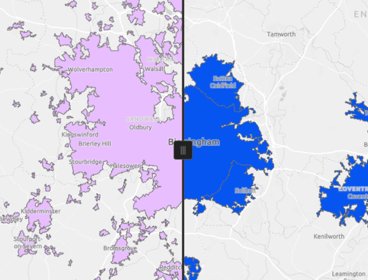
Geography in practice: The open geography portal
Join this webinar to get an early look at the brand new Open Geography Portal being developed by the ONS Geography team. You’ll learn about the datasets available, see demonstrations of key features, and discover how the portal can support your work or research.
OnlineProfessionalsWednesday 16 September 2026 - Guided walk
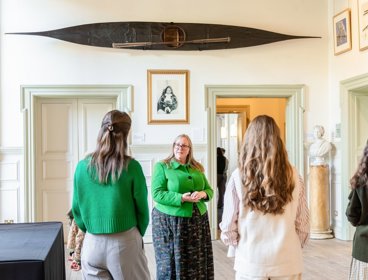
Guided tour of Lowther Lodge - 2.00pm
Join us as we delve into the stories, contexts, and interpretations of the objects on display throughout Lowther Lodge, the home of geography.
LondonOpen to allThursday 17 September 2026