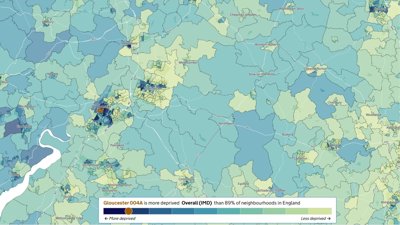
The webinar explored:
- Overview of IoD25 and its purpose: The webinar introduced the English Indices of Deprivation 2025 (IoD25), explaining how deprivation is measured across multiple dimensions and why Lower Layer Super Output Areas (LSOAs) are used to provide consistent, small‑area insights across England
- Breakdown of the indices and structure: It outlined the ten components of the indices, including seven standalone deprivation domains (income, employment, health, education, crime, housing barriers, living environment) plus supplementary child and older people income deprivation measures and the combined Index of Multiple Deprivation (IMD), highlighting how each measure captures a different aspect of deprivation and how these measures support evidence‑based policy decisions.
- Key updates from the 2019 release: It detailed significant enhancements in IoD25, such as the use of new datasets (Universal Credit, broadband speed, antisocial behaviour data), updated methodologies, and improved measures reflecting societal changes since 2019, including post‑pandemic impacts and rural deprivation insights.
- Headline findings and insights: The session highlighted major findings, including the most deprived neighbourhoods in England, the prevalence of high‑deprivation clusters (e.g., Blackpool), and new understanding of how deprivation presents differently in rural versus urban areas. The impacts following the release were discussed, such as supporting funding allocations and targeted policies
- Guidance, tools, and future development: Attendees were signposted to key resources such as the technical report, the Local Deprivation Explorer tool, and the rural deprivation report, along with an overview of ongoing work to improve UK‑wide harmonisation of deprivation measures for future updates.
Watch the full recording below.
Please note: The views of our speakers do not necessarily reflect the opinion of the Royal Geographical Society.
Note on captions
The Society aims to provide automatically-generated captions for all event recordings. The captions appear as text at the bottom of the video which you can toggle on and off.
The accuracy of automatically-generated captions varies depending on the audio quality, any specialist language used and the speaker. They are therefore are unlikely to be 100% accurate and the Society does not edit or correct automatically-generated captions.
- Workshop
Place-based systems change workshop
A workshop for those working within, across and between academia, practice and policy to explore place-based systems change, examine participation and power relations within PBSC, and build community with one another.
LondonProfessionalsThursday 16 April 2026 - Webinar

Professional insights: maximising opportunities for career development
Join this webinar for an interactive lunchtime discussion on maximising opportunities for career development. Gain valuable insights from experienced professionals as they share their knowledge, experiences and practical advice.
OnlineProfessionalsThursday 16 April 2026 - Webinar

Geography in practice: Active Places Power
Hear from Sport England as they discuss their interactive mapping and reporting tool, Active Places Power (APP)—the openly available national sports facilities database.
OnlineProfessionalsTuesday 21 April 2026