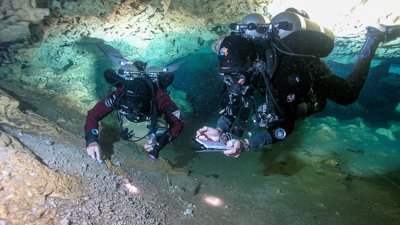
The Royal Geographical Society has supported caving expeditions and subterranean fieldwork for many decades, working alongside expedition leaders, researchers and specialist practitioners operating in some of the world’s most complex underground environments.
This article is informed by the Society’s longstanding expedition advisory role and draws directly on the caving expeditions chapter of the RGS Expedition Handbook and the RGS Caving Expedition Manual, both now out of print. These have been used for generations by expedition planners and field teams preparing for overseas work, and reflect accumulated experience of what enables safe, responsible and successful expeditions in challenging environments.
The guidance below translates that specialist knowledge into an accessible introduction for those considering their first caving expedition, focusing on what makes caving expeditions different, the purposes they are particularly well suited to, and the key considerations you must plan for underground, while signposting other resources where more general expedition planning advice applies.
What are caving expeditions and why do they matter?
Caving expeditions take place in one of the least explored and most fragile environments on Earth. Beneath the surface, teams operate in total darkness, complex three-dimensional terrain, and spaces shaped by water over geological time. Unlike many other expedition settings, caves cannot be navigated using satellite navigation, rarely allow communication with the surface, and offer little margin for external assistance if something goes wrong.
These constraints are precisely what make caves so compelling. Caving expeditions continue to make important contributions to geographical exploration, from discovering and surveying previously unknown cave systems to improving our understanding of water resources, geology, biology, climate, and human history. For many participants, the appeal lies in combining physical exploration with scientific, conservation or documentary outcomes that would be impossible to achieve elsewhere.
What makes caving expeditions different from other environments?
While all expeditions require careful preparation, caves present a specific combination of challenges that shape how projects must be planned and led.
- Darkness and dependence on equipment: caves are lightless environments. Safe movement, navigation and work depend entirely on artificial lighting, with redundancy essential. Equipment failure underground can rapidly escalate into a serious safety issue.
- Complex three-dimensional terrain: cave passages rarely follow a simple horizontal route. Vertical shafts, traverses, unstable boulder piles and confined spaces are common. Rope systems are often a routine means of travel rather than a specialist addition.
- Water as route and hazard: many caves are active systems shaped by flowing water. Streams, waterfalls, sumps and flooded passages may form part of the route. Rainfall on the surface can transform safe passages into dangerous traps, making flood awareness and conservative decision-making central to good practice.
- Navigation without GPS or mobile communication: route-finding underground relies on observation, memory, marking systems and accurate survey. Communication with the surface is often limited or non-existent, increasing the importance of self-sufficiency and clear pre-agreed plans.
- Self-rescue reality: in contrast to many surface environments, cave rescue support may be distant, delayed or unavailable. Teams must assume responsibility for immediate problem-solving, casualty care and assisted self-rescue within the cave. Even relatively minor injuries can become serious underground.
Why do people undertake caving expeditions?
Caving expeditions lend themselves particularly well to forms of exploration and research that cannot be carried out elsewhere.
- Discovery and exploration: even after centuries of cave exploration, many cave systems remain partially or entirely unknown. Small, well-prepared teams can still make genuine first explorations, extending known systems or discovering new caves.
- Survey and mapping: producing accurate cave surveys is a core expedition output. Surveys are not simply records of discovery but critical reference points for future exploration, research and conservation. As a minimum standard, new discoveries should always be surveyed and documented.
- Scientific research: caves provide access to distinctive environments and archives, supporting work in areas such as hydrology, geology and geomorphology, climatology, cave biology and biodiversity, and archaeology and paleo-environmental research. In some regions, expedition teams collaborate with local authorities or researchers where cave knowledge contributes to water management, hazard assessment or tourism development.
- Documentation and communication: photography, film and written reports remain important ways of sharing discoveries responsibly, contributing to collective knowledge and raising awareness of fragile subterranean environments.
Core capabilities and experience thresholds
Caving expeditions require specialist skills that can only be developed through experience. While enthusiasm is important, underground environments demand a realistic appraisal of team capability. Good practice includes ensuring that all participants are competent in:
- basic and, where relevant, vertical caving techniques,
- safe use of ropes, harnesses and descenders,
- underground navigation and route-finding,
- lighting discipline and equipment redundancy,
- first aid with an understanding of cold, immersion and crush injuries, and
- assisted self-rescue, particularly on rope systems
Experience is normally built progressively, starting with caving closer to home before committing to overseas objectives. Many cavers develop skills through local and university caving clubs and structured training offered by national associations before stepping up to expedition-level projects.
Activities such as cave diving represent a further level of specialisation and should only be included where the team has appropriate qualifications, experience and equipment.
Planning for the underground environment
This section highlights cave-specific considerations that must be addressed within your wider expedition plan.
Access, permissions and local context
Caves are often subject to access agreements, permits or informal understandings with landowners, authorities or local caving groups. In most regions, scientific work such as biological sampling requires additional permissions.
It is also important to establish whether other teams are active in your target area. Early liaison helps avoid duplication, conflict and damaged relationships within the caving community.
Equipment and underground logistics
Caving equipment must be selected to match the nature of the cave system, including depth, water, temperature and trip duration. Underground logistics differ significantly from surface travel, with limited shelter options and challenging conditions for rest or extended stays underground.
Specialist items such as ropes, survey equipment, waterproof containers and lighting systems are often major cost and weight considerations. These should be factored into your expedition budget from an early stage.
Safety, risk and rescue planning
Risk assessment for caving must consider flood potential, cold exposure, vertical hazards, falling rock and the feasibility of evacuation from within the cave. There are specific medical risks associated with working in caves and underground, which are outlined in the Oxford Handbook of Expedition and Wilderness Medicine.
Insurance should explicitly cover caving activities, medical treatment and rescue costs, which in some countries may be chargeable or require a deposit in advance. Teams should plan conservatively, assuming limited external assistance.
Read more on incorporating safety and risk management good practices into the planning of your expedition.
Outputs, responsibility and legacy
Responsible caving expeditions aim to leave a positive legacy. This might include:
- accurate surveys and records of explorations,
- respectful treatment of cave environments and life, or
- transparent sharing of findings with local partners and the wider community.
Planning for outputs should begin early, particularly where teams seek funding or external support. Read more about effectively reporting on your expedition.
Common pitfalls for first caving expeditions
- Underestimating the physical and psychological demands of prolonged underground trips,
- treating survey and documentation as optional rather than essential,
- assuming surface rescue support will be readily available,
- including advanced activities without adequate experience or training, and
- failing to engage with local access arrangements or caving communities.
Awareness of these pitfalls – no pun intended – can significantly improve safety, outcomes and relationships.
Want to learn more?
Caving expeditions offer rare opportunities to make genuine discoveries while developing advanced field skills in one of the planet’s most challenging environments.
In the UK, the British Cave Research Association and the British Caving Association are the lead organisations for domestic and overseas cave exploration, while the Ghar Parau Foundation is the leading funder of British overseas caving expeditions.
To learn more about what’s involved in planning any expedition, read our guide to the key elements of a robust expedition plan, which covers budgeting, team roles, resources, timelines and funding in more detail.
About this article
This article was drafted by Tom Allen FRGS, the Society’s Expeditions and Fieldwork Manager, and reviewed by Shane Winser FRGS, the Society’s Expeditions Advisor. Sections of the article draw upon Chapter 21, Caving expeditions, of the 2004 Royal Geographical Society Expedition Handbook. The article was last updated in June 2026.
- Article
Getting started: the key elements of a robust expedition plan
Inspired to plan your own expedition? Ensure your project stays on track with expert planning advice from the RGS.
- Article
Getting started: field safety principles for expeditioners
Learn essential safety principles for any expedition, covering risk assessments and emergency planning to ensure a safe and successful journey.
- Article
Staying safe: how to risk-assess your expedition
Learn why risk assessment is essential and how to do it effectively. This practical guide walks you through identifying hazards, managing risk, and creating safer, more successful field projects.
Stay updated
Be the first to hear when new resources are launched by subscribing to our monthly exploration digest. You may also choose to receive other mailings from the Society.
- You will be asked to create a free RGS.org account if you haven't already done so.
- Once logged in, navigate to My preferences and select Exploration news, events and opportunities.