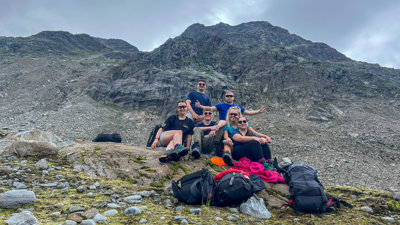
Joining an expedition as a participant, rather than as the leader or organiser, can be an ideal stepping stone into the world of geographical exploration.
This route can seem less daunting and more realistic than planning and leading your own expedition, opening opportunities to participate in activities that would otherwise be unachievable. Chosen well, joining as a team member of an organised expedition offers the chance to grow your skills and experiences, make useful contributions to our knowledge and understanding of the world, have a positive impact on the people you meet and the places you visit whilst doing so – and perhaps lead to you planning your own expeditions in the future.
But where can you reliably find expeditions looking for team members? How should you choose between the different opportunities you’ll come across? And how can you ensure you get the most out of the experience – and that your teammates see the value of your contribution?
These are all natural questions to have when considering joining any kind of organised venture – indeed, finding an expedition to join remains one of the most frequently stated desires of those who come to the RGS for advice or make the journey to the Society’s annual Explore Weekend.
This article is intended to help you navigate the process of finding a suitable expedition to join if you don’t feel comfortable organising and leading your own, by posing some simple questions that it will be helpful to answer at the start of your search.
Why do you want to join an expedition?
First, spend some time reflecting on what you hope to gain from the experience. Is it a personally challenging adventure you are looking for? Or are you also looking to make a positive difference to the world? Are you hoping to develop specific skills or gain new ones? Do your harbour hope that it will help you with career progression?
Often, it’s a combination – but it’s helpful to be clear about your priorities (and to what extent you’re willing to compromise them) when assessing opportunities for their potential to serve your goals.
Motivations for joining an expedition might include:
- visiting a specific region or location, or engaging in a certain activity,
- applying theoretical knowledge in a real-life context,
- pursuing a means of creative expression to help others access a subject or story,
- contributing practically or financially to a charitable cause through travel,
- challenging yourself on an exploratory journey with an uncertain outcome, or
- boosting your employability with the transferable skills that come from successful participation.
With the activities, locations and objectives of organised expeditions being so varied, knowing your ‘why’ is an essential first step when filtering down the many and varied opportunities to those that are a good fit for your motivations, interests, and desired outcomes.
What can you contribute to an expedition?
Every expedition should have a primary aim, and one or more objectives that support that aim, that together define success or failure. Aims might be focused on:
- the personal development of participants (typical of but not limited to youth and gap-year expeditions),
- a physical achievement (e.g., summit a peak, traverse a desert, cross a body of water),
- field science or research (conduct a biodiversity survey or cultural investigation, gather mapping data), or
- outputs and impact (produce and disseminate a documentary work, reach a charitable fundraising goal, raise awareness of an issue requiring action).
When considering any opportunity, identify how you’ll best be able to help the expedition achieve its aim. Some endeavours simply need time, energy, and funding from their participants. All expeditions will be looking for competent team members who are reliable and enthusiastic, eager to contribute to the success of the team, and willing to adapt to the varied challenges, inevitable changes of plan, and inherent discomforts of expedition life.
Some projects may also benefit from specialist skills and knowledge in addition to general suitability. For example:
- you speak the language(s) of the region, have existing local contacts and knowledge, and can help with logistics,
- you have scientific training and can help design or contribute to field research objectives to collect and analyse data,
- you’re a qualified medic who is also competent in the relevant environments and/or activities,
- you’re a media creator able to effectively document and share the story and outputs of the expedition, or
- you have a significant personal or professional profile that unlocks additional funding and resources.
A typical expedition team also includes organisational and logistical roles – project managers, fundraisers, treasurers, caterers, drivers, mechanics, camp managers, and more – to which your skills may also lend themselves.
Whatever contribution you can make, ensure that there’s a written agreement between you and the expedition organiser, or among members of the team, that sets realistic expectations early regarding what each team member (and, if applicable, the organisation providing the venture) is expected to contribute before, during, and after the expedition itself, and where the boundaries of responsibility are mutually understood to lie.
It’s natural to feel a degree of ‘imposter syndrome’ as a newcomer to expeditions, but everyone has something to contribute if the venture has been so designed. And while your expeditionary CV might feel quite slim to begin with, expect it to grow as you learn from valuable and multifaceted experiences – experiences that’ll serve you as well in everyday life as on your next purposeful journey.
How much time can you realistically spare?
It is important to be realistic about the time commitment required to participate in the complete lifecycle of an expedition – which begins months, or in some cases years, before departure, and usually extends for longer after homecoming than many people expect.
Commercial expedition providers tend to follow the travel industry practice of advertising places a year or more in advance, with deposits and balances due during the pre-expedition period and departure only confirmed when the expedition has enough participants to be financially viable.
Many independently-organised expeditions evolve from the motivations of an individual or a group of teammates, being planned collaboratively and with additional team members sought as the project takes shape. As such, pre-expedition timelines can vary from a few weeks for the simplest of excursions to several years to develop and mount a complex, ambitious and expensive endeavour – and even then, the team roster may not be finalised until the last minute. Your ability to participate in such a project will likely depend as much on flexibility and patience as how much time you have to spare.
Most expeditions will require time for meetings, vaccination schedules, general fitness and preparation regimes, and/or specific training for the activities to be undertaken safely and effectively. Once in the field, familiarising yourself with a new cultural context benefits from an unhurried schedule, as does acclimatisation to certain environments (e.g., high altitudes or extremes of cold, heat and humidity). Additional time buffers are sensible for mitigating the impact of delays such as lost luggage, travel-related illnesses, poor weather, and other ‘predictably unpredictable’ hiccups.
Beyond returning home and the reintegration process that follows, you’ll likely be expected to contribute to follow-up activities. For scientific expeditions, time in the field comprises a small part of the project lifecycle, the resulting academic publications not appearing until years later. Those with documentary outputs may be looking at similar timelines as raw material is collated, fashioned into consumable form, and then launched and promoted. Even commercial and charity expeditions often come with post-expedition obligations as the success (or failure) of the venture is disseminated to the various stakeholders and audiences who may be expecting to hear of its outcome.
This matters because accepting a place on any expedition will entail commitments that may not be immediately visible. Being clear about your availability (and making space in your schedule to participate fully) will increase the chances of you finding an opportunity that matches your ability to deliver on these commitments.
Where can you find expeditions looking for participants?
Every year, a vast array of expeditions set off to diverse locations with worthwhile objectives, including:
- expeditions provided and led by charitable and commercial organisations designed to accommodate team members with otherwise busy lives,
- conservation and scientific expeditions specifically to collect field data, organised by independent or institution-backed researchers and often in collaboration with local partners,
- youth development-focused expeditions typically synchronised with the academic calendar,
- student-led expeditions affiliated with and/or supported by university departments or societies, and
- independently organised purposeful journeys of every conceivable scope and scale.
Within and beyond this diverse spread of purposeful journeys lies a wealth of pathways to involvement that suit all ambitions.
For decades, the Royal Geographical Society has maintained a directory of expedition opportunities listing organisations that recruit team members for expeditions and field projects around the world. Originally a printed bulletin, today’s digital listings can be searched and filtered to find opportunities tailored to your circumstances. In a similar vein, the Society’s World Field Centres Register lists research stations around the world that host visiting researchers, many of which also offer field programme placements.
Privately organised expeditions undertaken by independent groups often originate from connections made at the Society, whether at the annual RGS Explore Weekend, through one of the many other events and socials in our London and regional programmes, or via connections made through membership.
If you are a student at a higher education institution, you will likely find that structures exist to provide entry points into geographical exploration. These may include departmental support for expeditions and fieldwork, advocacy and guidance from experienced academic staff, student societies set up to enable exploration (possibly supporting scientific expeditions but more commonly organising adventurous activities closer to home), or cadet units (UOTC/URNU/UAS). Joining such groups provides opportunities to develop skills that translate to more demanding contexts – and if an expedition society doesn’t already exist at your institution, why not start one?
Finally, regular online sources of new opportunities include those submitted by the exploration community in the Society’s monthly email digest; the fortnightly 'Team Mates' bulletin published by Explorers Connect; and the newsletters of many of the organisations listed in the Society’s directory of expedition opportunities.
Will you have to pay to join an expedition?
Whether commercial, charitable, or privately organised, almost all expeditions not taking place in a professional context will ask for financial contributions from their team members. This is often necessary to satisfy the minimum viable resources for a project to take place, even if external funding sources are later found and personal contributions are returned.
Some organisations will give advice on how to raise funds to join their projects. Others may offer bursaries to increase access to the opportunities they provide. There may be exceptions if you have specific skills that would make you eligible for paid employment or ‘payment in kind’ (i.e., subsidised participation costs in exchange for your services). It is essential that you find out exactly what is or is not included in any financial contribution you will make. You can read more about expedition fundraising in this introductory article.
How can you assess the trustworthiness of a particular opportunity?
When assessing the trustworthiness of a particular expedition opportunity, there is no substitute for doing your own due diligence. Research the outcomes of previous expeditions organised by the group or organisation, including contacting members of past expeditions if it seems necessary. Find out about the experience and qualifications of the team leader, the composition of the group, and the details of what you will be doing in the field. You should aim to gather enough information to be able to assess the competence and philosophy associated with a venture and decide whether it is an expedition you want to be part of.
The RGS has been heavily involved in developing good practice guidelines and standards in the UK expeditions industry, including the British Standard for organisations offering overseas experiences, BS 8848. Organisations self-certify against this standard and may choose to advertise compliance. In any case, you may freely download and use the Consumer Guide to British Standard BS 8848:2014 to help establish if good practices are being followed. Don’t be afraid to ask questions; it is in a provider’s interests to assure potential team members that a venture is competently organised, and that the expectations of potential participants are met.
How should you choose a gap year expedition provider?
There is little difference between choosing a gap year expedition provider and choosing a provider for any other kind of commercial or charitable expedition, and so the Consumer Guide to British Standard BS 8848:2014 remains equally relevant here. The Society has also developed a gap year toolkit specifically to support potential participants (and their parents or guardians) considering a gap year expedition or similar activity. The Year Out Group have compiled a list of questions to help choose a gap year provider.
For school groups, the website of the Expedition Providers’ Association lists UK-based member organisations who have been awarded the Learning Outside the Classroom Quality Badge for risk management and educational provision on overseas expeditions.
What will you gain from joining an expedition?
Unforgettable experiences, an appreciation of unfamiliar cultures and environments, and hopefully some lifelong friendships! You will also develop your ability to overcome both mental and physical challenges, work as a team, and be organised and resourceful – essential skills that you can add to your CV and apply in all walks of life.
You may even be inspired to plan your own expedition in the future. If that’s the case, our annual Explore Weekend takes place each November in London and is designed specifically to help you turn your ideas into achievable, actionable plans.
About this article
This article was drafted by Tom Allen FRGS, the Society’s Expeditions and Fieldwork Manager, and reviewed by Shane Winser FRGS, the Society’s Expeditions Advisor. It was last updated in June 2026.
- Download

Gap year explorers: introducing the RGS Gap Experience Planning Toolkit
Transform your year out with our gap year planning toolkit. Develop life skills, your CV, and prepare for university with a purposeful geographical experience.
- Video

Explore what matters with Scotty Johnson
You never know who you might meet at the RGS Explore Weekend. Scotty discusses how forging meaningful connections can lead to unexpectedly valuable results.
- Article

Getting started: the key elements of a robust expedition plan
Inspired to plan your own expedition? Ensure your project stays on track with expert planning advice from the RGS.
Stay updated
Be the first to hear when new resources are launched by subscribing to our monthly exploration digest. You'll also receive relevant news and events from the Society.
- You will be asked to create a free Society account if you haven't already done so.
- Once logged in, navigate to My preferences and select Exploration news, events and opportunities.