
This resource contains key data on how many people study geography at university in the UK and what they go on to do after graduation.
Accepted applicants
First-year acceptances for geography at university have varied slightly over the last six years.
|
|
2019 |
2020 |
2021 |
2022 |
2023 |
2024 |
2025 |
|
(CAH26) geography, earth and environmental studies |
9,800 |
9,655 |
9,610 |
9,805 |
9,835 |
9,645 |
9,665 |
|
(CAH26-01-01) geography (non-specific) |
1,185 |
1,150 |
1,085 |
1,125 |
1,205 |
1,170 |
1,230 |
|
(CAH26-01-02) physical geographical sciences |
2,220 |
2,385 |
2,435 |
2,405 |
2,395 |
2,365 |
2,355 |
|
(CAH26-01-03) human geography |
3,400 |
3,090 |
3,010 |
2,940 |
3,110 |
2,955 |
2,865 |
|
(CAH26-01-04) environmental sciences |
1,215 |
1,345 |
1,345 |
1,465 |
1,370 |
1,375 |
1,310 |
|
(CAH26-01-06) earth sciences |
1,780 |
1,685 |
1,735 |
1,875 |
1,765 |
1,780 |
1,00 |
Source: UCAS.
Total students currently enrolled on a geography programme
Data on the total number of students by subject (across all levels) are available from HESA. In 2024-2025, the figure for geography (CAH26 combined) was 43,955. Of these, 33,140 were undergraduate students. In 2023-24 the total number of geography students was 45,775, with 33,575 undergraduate students. Changes in the way geography is classified, and the transition from JACS to HECoS codes, make precise documentation of changes through time difficult.
Total UK geography applications
The total number of geography applications increased between 2020 and 2023. In 2025, applications dipped slightly but remain above 2020-2021 levels.
|
Subject group HECoS |
2020 |
2021 |
2022 |
2023 |
2024 |
2025 |
|
(CAH26) geography, earth and environmental studies |
48,885 |
50,670 |
53,250 |
54,920 |
53,235 |
51,815 |
Source: UCAS.
Between 2020 and 2023, most of the increase in geography applications came from an increase in the number of geography application by men, though the number of applications by women remains higher.
Applications by men
|
Subject group HECoS |
2020 |
2021 |
2022 |
2023 |
2024 |
2025 |
|
(CAH26) geography, earth and environmental studies |
21,820 |
23,240 |
25,690 |
26,690 |
25,020 |
24,345 |
Applications by women
|
Subject group HECoS |
2020 |
2021 |
2022 |
2023 |
2024 |
2025 |
|
(CAH26) geography, earth and environmental studies |
27,020 |
27, 355 |
27, 495 |
28, 230 |
27,325 |
26, 615 |
Source: UCAS
Student satisfaction
In the 2026 National Student Survey (NSS), geography's satisfaction rates remained strong. In many areas, student satisfaction was higher than in 2025; satisfaction with academic support increased from 90.4% in 2025 to 92% in 2026. The survey also indicates that geography students are highly satisfied with specific elements of their university experience:
- 95.8% of geography respondents agree that their teaching staff were good at explaining things, which is higher than the average rate for all subjects (93.6%).
- 89.4% of geography students were satisfied with the teaching on their course.
- 92.1% of geography students were satisfied with how easy it was to contact teaching staff when they needed to.
Graduate destinations
Geography graduates have high employment rates, according to 2026 HESA data, covering those who graduated in the 2023/24 academic year. For example, 58% of Geography, earth and environmental studies graduates (social science) graduates were employed 15 months after graduating. 7% were in full time further study, and 11% in part time employment, and just 6% unemployed.
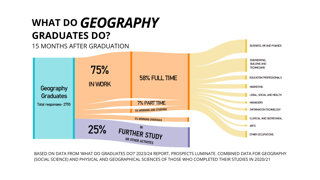
Human and physical geography graduate careers
The specific figures for human geography and physical and geographical sciences graduates differ slightly. But both show high employment rates and high rates of further study. Fifteen months after graduation, geography graduates who left university in the 2022-2023 academic year had employment rates comparable to, or slightly better than, the average for all degree subjects. Geography graduates also show a balanced spread across different post‑degree pathways.
|
|
First degree graduates (all subjects)
|
Human Geography
|
Physical and Geographical Sciences
|
|
Working full time
|
56.4% |
55.7% |
56.7% |
|
Working part time
|
12% |
7.5% |
9.6% |
|
Further study (full time)
|
6.6% |
8.9% |
9.1% |
|
Working and studying |
10.9% |
9.9% |
9.7% |
|
Unemployed
|
6.2% |
7.8% |
6% |
Human and physical geography employment rates.
Source: What Do Graduates Do? 2025/26.
Further study destinations of 2023 geography graduates (15 months after graduation)
|
|
First degree graduates (all subjects)
|
Human geography
|
Physical and geographical sciences
|
|
PhD or equivalent |
9.3% |
5.1% |
9.2% |
|
Postgraduate cert/dip (including PGCE) |
15.3% |
16.5% |
15.4% |
|
Masters |
44.9% |
55.8% |
55.8% |
|
Professional qualification |
22% |
17.4% |
14% |
Percentage of 2023 geography graduates entering further study (excluding 'other' category).
Source: What Do Graduates Do? 2025/26.
Top 10 professional jobs held by first-degree human geography graduates
- Environment professionals
- Chartered architectural technologists, planning officers and consultants
- Construction project managers and related professionals
- Chartered and certified accountants
- Secondary education teaching professionals
- Management consultants and business analysts
- Finance and investment analysts and advisers
- Advertising and marketing associate professionals
- Business associate professionals
- Social and humanities scientists
Top 10 professional jobs held by first-degree physical geography graduates
- Environment professionals
- Secondary education teaching professionals
- Civil engineers
- Chartered surveyors
- Business associate professionals
- Estimators, valuers and assessors
- Data analysts
- Management consultants and business analysts
- Chartered and certified accountants
- Chartered architectural technologists, planning officers and consultants
Source: What Do Graduates Do? 2025/26.