Idea 1: Make it a model
This is a creative method to help your learners visualise the GAC in context to other factors such as solar radiation, the location of the equator etc. It will take a bit of setting up and an element of pre-learnt knowledge and understanding for pupils to work independently therefore, freeing you up to help support and challenge the class where needed.
Starter
Use a quizzing site such as Quizlet, Seneca learn, Kahoot or create your own using your school’s quiz app (most likely MS or Google Forms) to test pupils current understanding of High and Low-pressure. You could develop this with including questions about biomes.
Main
You will need the following items per group / pair for your class to use.
- Small box: shoe box size
- wooden / plastic doweling or a pencil
- self drying clay / play dough / plasticine: small hand full per group or pair (to make the Earth)
- x2 pipe cleaners: one to represent cold air, the other warm air
- scissors
- a torch (one on a phone can be used if school policy allows)
- a tool to draw on the earth. A sharp pencil will suffice.
- parcel labels cut to size depending on the size of the box
- an elastic band / hair band
1. Provide your class with information on how the GAC works. How you choose to deliver this will depend on your class. Please see ideas from the ‘suggested teaching materials’ above. For this activity, it might be worth giving it to them before the lesson i.e. previous lesson or homework.
2. Take or cut off the top of the shoe box or remove the side of a box so that the widest part is on view.
3. Turn the box on its side with the open part facing you.
4. Make a hole big enough to fit the pencil / dowel in the centre of the top of the box.
5. Make a similar sized hole on the right-hand side of the box – this will be where the light from the torch comes through.
6. Make a ball (roughly tennis ball size + a small additional piece) with the clay / play dough / plasticine to represent the Earth. You can also mark where the UK would be with a dot for reference (but not necessary).
7. Using the drawing tool, mark on the equator, and lines to represent 30o and 60o north and south of the Equator.
8. Draw arrows to represent the easterlies and westerlies.
9. Cut approximately 1.5 cm length of pipe cleaner in both colours.
10. Twist the last 0.5cm of the ends together then the same on the other side but leaving a short stump so that the cleaner will be able to be stuck into the clay. You should be left with a ‘p’ shape with an oval top and short length. A bit like the image below:

11. Repeat step 9, five more times.
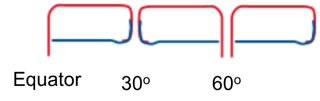
12. On the left-hand side of the model, starting at the Equator line and moving in a straight-line north. Place the open end of the pipe cleaner into the clay. Then place the next ‘cell’ at the point of the 60o N line and turn it towards the first cell.
13. Place the final cell at the pole and turn it towards the last cell. If you were to look at it as a cross section, it will look a bit like this:
14. Repeat steps 12 and 13 but starting on the right-hand side of the model moving south from the Equator.
15. Using a separate parcel label for each, name the different cells and leave to one side.
16. On other parcel labels, write annotations to describe and explain the GAC. A challenge task could be to explain how the cells affect the weather and the role of the easterlies and westerlies.
17. Push the dowel / pencil through the hole at the top of the box.
18. Ensuring that the clay Earth is at a slight angle to represent the tilt of the real Earth (i.e. 23.5o) push the top of the Earth into the end of the pencil / doweling which is inside the box.
19. Position the earth so that the equator is in line with the hole on the side of the box. Your model Earth should be suspended roughly in the centre of the box and can spin (gently) in its space.
20. Once you have the right height, secure the dowel / pencil where it comes through the top of the box with the elastic band. This should stop it slipping but allow it to rotate.
21. Stick the labels and annotations to the back wall of the box so that they are visible and line up with what is happening in the model.
Plenary:
Pupils use their diagrams to tell their peers how the GAC works and / or complete an examination question on the GAC.