CCS stands for Carbon Capture and Storage. Although CCS is not a power-generating technology, it is described as being a component in the future of energy resources.
Direct Air Capture (DAC) is a very effective way of reversing carbon dioxide (CO2) emissions. However, it is yet to function at scale and only a fraction of the industry is profitable.
-
To understand more about Climeworks read our 39 Ways to Save the Planet worksheet on Climeworks, and listen to the BBC Radio 4 episode on the company
-
For a quick initial understanding of DAC the International Energy Agency (IEA) have a Direct Air Capture webpage on the technology, saying it is ‘expected to play a key role in the transition to a net-zero energy system’
-
It is important to note that both CCS and DAC technologies are technological ‘fixes’ and it is far more effective (and urgent) to focus on quickly initiating long-term behavioural change.
As of 2020, there were 65 CCS commercial facilities around the world, with 26 operating. These 26 CCS facilities currently in operation capture and permanently store around 40 Mt of CO2 every year.
In Europe, the largest and arguably most promising example of CCS is the Norwegian Northern Lights project, which aims ‘to manage the carbon cycle’ by being the world’s first open-source CO2 transport and storage business,
Some analysts argue that DAC will be a key component of the effort to reach net-zero by 2050. As of 2021 it is yet to be installed in a country’s energy system at a scale which will herald significant reductions in CO2 but there is cause for optimism. Christoph Gebald, co-founder of Climeworks in Switzerland, states in 30 years the CCS industry could be worth between $2 and $4 trillion, the size of today’s tech industry, in the world’s pursuit of net-zero by 2050. The Swiss company has 150 employees, 14 direct air capture facilities and the world’s first commercially viable facility in Hinwil, Switzerland. In September 2021 it opened the Orca plant in Hellisheiði, Iceland, which is the world’s largest ‘climate-positive direct air capture plant’.
Why is DAC so important?
DAC is increasingly seen as a key component of the fight against climate change. In 2019, the global average amount of carbon dioxide hit a new record high with 409.8 parts per million (ppm). Human activities have rapidly increased the concentration of CO2 in our atmosphere, amplifying the Earth’s natural greenhouse effect and causing climate change. The highest ever previous concentration of CO2 was 300 ppm.
-
To visualise the rapid rise beyond 400 ppm of atmospheric carbon dioxide create a line graph using the data below. To be able to answer question 2 run the x axis up to 2040.
|
Date |
Atmospheric carbon dioxide ppm |
|
1959 |
315.98 |
|
1961 |
317.64 |
|
1963 |
318.99 |
|
1965 |
320.04 |
|
1967 |
322.18 |
|
1969 |
324.62 |
|
1971 |
326.32 |
|
1973 |
329.68 |
|
1975 |
331.12 |
|
1977 |
333.83 |
|
1979 |
336.84 |
|
1981 |
340.11 |
|
1983 |
343.05 |
|
1985 |
346.12 |
|
1987 |
349.18 |
|
1989 |
353.12 |
|
1991 |
355.61 |
|
1993 |
357.1 |
|
1995 |
360.82 |
|
1997 |
363.73 |
|
1999 |
368.38 |
|
2001 |
371.14 |
|
2003 |
375.8 |
|
2005 |
379.8 |
|
2007 |
383.79 |
|
2009 |
387.43 |
|
2011 |
391.65 |
|
2013 |
396.52 |
|
2015 |
400.83 |
|
2017 |
406.55 |
|
2019 |
411.43 |
Table 1 CO2 ppm source
On our current trajectory the IPCC warns that 430 ppm (or even 450 ppm) is likely to be reached sometime before the late 2030s, leading to a 1.5°C (or 2°C) rise in global temperature — the global limit agreed upon in the 2015 Paris Agreement.
-
Extrapolate your graph to estimate when 450 ppm will be reached.
Northern Lights
Northern Lights is a landmark project which will transport the CO2 by tanker ship (see Figure 1) from capture locations to a purpose-built receiving terminal near Bergen on the west coast of Norway.

Figure 1 an illustration of a Northern Lights carrier transporting CO₂ © Northern Lights
The Northern Lights project aims to be the first CCS facility to benefit from economies of scale by being a hub to aggregate, compress, dehydrate and transport CO₂ streams. The company aims to both tackle climate change and commodify CO₂. Northern Lights is not yet open, but in its first phase (from 2024) it is anticipated that the company will transport and store up to 1.5 million tonnes of CO₂ a year.
It is an independent joint venture owned by Equinor, Shell and Total Energies, and is expected to cost €1.4 billion over the next 10 years.
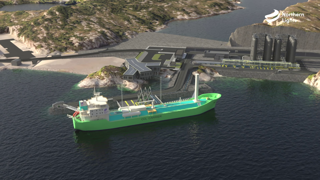
Figure 2 an illustration of a Northern Lights vessel transferring CO₂ to a receiving terminal © Northern Lights
The process involves the capture of CO₂ from combustion fuel or industrial processes, such as steel, cement, and chemical industries and is an important CO₂ reducing technology. After the CO₂ is delivered to the receiving terminal (Figure 2), it will then be piped 100 kilometres offshore to be pumped underground and trapped in subsurface storage, under the North Sea. The CO₂ will be held at a depth of over 2600 metres.
Watch this value chain animation to understand how the company intends on transporting and storing CO₂.
The company is targeting a start 2024 start date and is building in future capacity to expand the site due to anticipated high demand. Work at the Øygarden receiving terminal began in January 2021.
There are many opposition groups which oppose CCS development claiming it is a distraction from the overall goal of eradicating fossil fuel use (and the emission of CO₂ in the first place). Critics have labelled the technology ‘a mask’ to disguise the continuing destruction of the natural world and it has become a politically sensitive topic.
Others say CCS is well-placed to remove emissions from key industries that will struggle to decarbonise, such as cement production and the steel industry.

Figure 3 the Northern Lights value chain for CO₂ © Northern Lights
Climeworks
Climeworks is a Swiss environmental company which has produced a technology to directly reverse
some greenhouse gas emissions by direct air capture of CO₂. In 2017 Climeworks unveiled the world's first commercial direct air capture plant in Hinwil, Switzerland. At the launch Christoph Gebald reiterated that highly scalable negative emission technologies are crucial if we are to stay below the 2°C target of the international community.
Figure 4 explains how carbon is first captured as air is sucked into giant fans, before being deposited on a filter. It is then heated to 100°C before the pure carbon dioxide is released and collected to be sold to paying customers (within a short radius as the gas is piped from source).
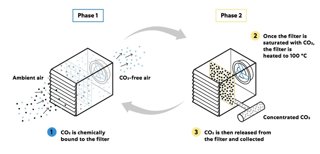
Figure 4 how the Hinwil DAC plant works © Climeworks
In a similar vein to Northern Lights, Climeworks views CO2 as an asset. Out of a total of 14 DAC plants Climeworks successfully launched the Hinwil to provide a continuous supply of CO₂ through an underground pipeline to a greenhouse 400m away, operated by Gebrüder Meier Primanatura AG, to help grow tomatoes and cucumbers. The facility is now supplying 900 tonnes of CO₂ annually to the greenhouse.
The air is also carefully monitored by Climeworks to ensure that the air-captured CO₂ can be used for food-grade purposes. In 2019, as a result of the high purity standards, Valser, a Coca-Cola HBC Switzerland subsidiary, used the carbon dioxide to produce the fizzy drink in an achievement described as ‘the world’s first water bottled with carbon dioxide pulled directly from the air’. In the future Valser hope to source 25% of their CO2 used in the carbonisation process from Climeworks.
Hinwil is limited by the operating costs of purification and liquefaction as it is a small plant (when compared to plants with high CO2 concentration feed gases, or room to install lots of heat exchangers for energy recovery). However, there is hope that this venture might spark interest from other industries, such as farming. In the agricultural industry flue gas might in the future be replaced by DAC CO2 to help grow produce in greenhouses and boost crop yields.
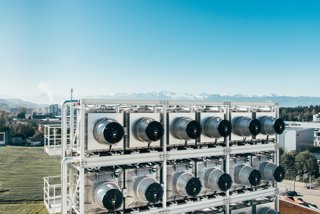
Figure 5 the Hinwil Climeworks plant (more images in Appendix A)
Climeworks, Orca
On 8 September 2021, Climeworks opened their new large-scale carbon dioxide removal plant in Hellisheiði, Iceland. The facility captures CO2 directly from the air, using a combination of technology and the underground storage of CO2 provided by Carbfix.
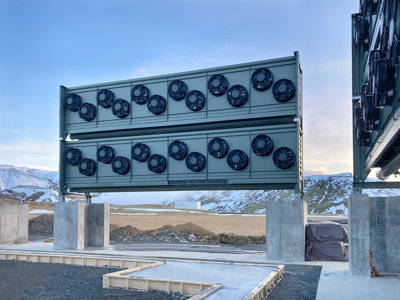
The Orca plant plans to capture 4,000 tons of CO2 per year, making it the world's ‘biggest climate-positive facility to date’. Figure 6 shows Orca’s 8 oblong collectors, each with 12 fans, which are designed to suck in ambident air and remove CO2 (see Figure 4 for the two-phase process).
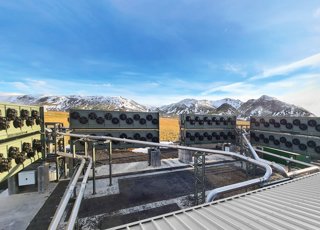
Figure 6 Orca, Hellisheiði, Iceland © Climeworks
Carbfix are Climework’s partner in the Orca project, responsible for the mineralisation of the captured CO₂. In January 2020 Sandra Ó. Snæbjörnsdóttir et al. published a paper explaining the process, called Carbon dioxide storage through mineral carbonation. In the paper it explains that Carbfix store captured carbon ‘through injection into reactive rocks’ (e.g., mafic igneous rocks which are dominated by silicate minerals and high in magnesium and ferric oxides; examples include basalt and gabbro). This injection provokes a mineralisation of the CO₂ within 2 years, trapping it underground and returning it into the lithosphere. This process of ‘fixing’ CO₂ into the ground is seen as likely to achieve large-scale implementation because the underground CO₂ reservoir at Hellisheiði does not require an impermeable cap rock to prevent the CO₂ from migrating to the surface (unlike most other CCS projects).
You can read scientific papers from Carbfix on their technology webpage.
The Orca is entirely carbon neutral in its processing of CO₂, being described as a positive-climate plant. This is largely due to another partnership with ON Power, the Icelandic geothermal energy provider, which delivers geothermal heat and power from the ON Geothermal Park (where Orca is situated).
Watch this video How does Carbfix and Climeworks work? to understand the mineralisation process by Carbfix in Hellisheiði.
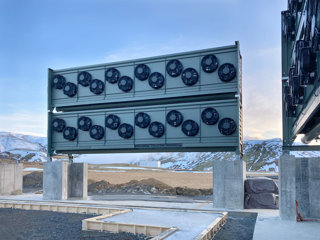
Figure 7 Orca, Hellisheiði, Iceland © Climeworks
The future
The future problems facing DAC are scale, time, and cost.
The International Energy Agency said in a 2020 report that 15 DAC plants were in operation in Europe, the United States and Canada, capturing more than 9,000 tonnes of CO2 per year. This only equates to the emissions of 600 individuals producing 15 tonnes of climate-changing pollution. Currently, the scale of DAC companies, such as Climeworks and Thermostat, is simply not large enough to significantly lower CO2 levels.
Climeworks have the aim of capturing between 30 and 50 million tonnes a year by 2030 however this ambition will rely on investment. Elon Musk’s tweet in 2019 announcing the donation of $100 million towards a prize for the best carbon capture technology helped the industry to gain public attention and now big names like Microsoft, who want to remove their emissions by 2030, are investing in the technology.
Many target deadlines for greenhouse gas (GHG) reduction are being brought forward with timescales shortening. This is due to many early warning signs of climate change beginning to emerge. Events such as the 2019-2020 Australian Black Summer, extensive Californian drought 2011-2019, and excessive European heat have increased in occurrence and severity. Thermostat co-founder Professor Peter Eisenberger explains that the Earth’s global ‘tipping points’, where a changing climate could push parts of the Earth system into abrupt or irreversible change, are approaching the planet. You will find more information and activities about global tipping points in our resource What is the Anthropocene? During the COVID-19 pandemic Professor Peter Eisenberger said:
“I have really become radicalise about the need to introduce another variable into this [climate change] equation — called time. What we’ve learned from the pandemic is you can’t wait until the threat is upon you.”
Time is the most crucial factor in the fight against climate change. The challenge of climate change requires both mobilisation and cooperation between DAC companies. It is collaboration which will be the key to future DAC expansion (allowing the industry to upscale to gigatonnes of CO2 removal per year) as it will overcome the main limitation facing the industry: expense.
Jane Zelikova, a climate scientist at the University of Wyoming, is quoted in the BBC article The device that reverses CO2 emissions as predicting a need to remove 10 gigatonnes of CO2 per year by 2050. This will need to increase further still to 20 gigatonnes per year by the end of the century.
There is cause for optimism. Crucially, DAC technology facilitates a more sustainable ‘materials related economy’ (one based on ground extraction of raw materials) by breaking the negative feedback loop of energy use, CO2 emissions, and global warming. In the current global economy, the more energy is used the more the natural world is destroyed. However, when taking CO2 from the air via DAC (or hydrogen from water or watts of energy from the sun) climate change is addressed, and the economy grows through innovation. This increases the rate CO2 sequestration and produces products of energy and materials that are useful at the same time. If DAC technology is built to scale it has the potential to mitigate climate change, propel the economy on, provide jobs across the world, and increase living standards. It is potentially the transformation of a negative feedback loop into a positive one, as shown in Figure 1 below.
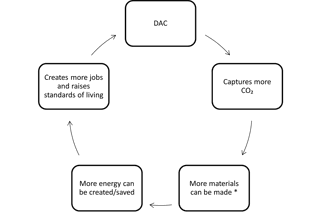
If DAC carbon fibre is used in the future it will save energy by avoiding the need, during steel (and aluminium) production, to separate iron from oxygen (and aluminium by electrolysis). Both processes are energy intensive.
Further work
- The Northern Lights project
- Climeworks Hinwil facility
- Climeworks Hellisheiði Orca
- CCS Norway CO2 transport and storage
- CNBC carbon capture companies
- Engineers have built machines to scrub CO₂ from the air
- Another DAC company, Global Thermostat
- Is carbon capture and utilization a lifeline for oil and gas?
- The Elephant podcast, Peter Eisenberger on The Promise of Direct Air Capture
This resource was first published in 2021.