China Africa relations: the Great Power Competition
The rise of China
The rise of China as a global economic power and its growing assertiveness since the beginning of the twenty-first century continue to elicit concerns in Western countries. These concerns have been further heightened by China’s Going Global Strategy. The Going Global Strategy explicitly outlines China’s desire for global leadership and influence underpinned by massive strategic overseas economic investments and aid distribution to developing countries.
Accordingly, China has positioned itself as an alternative to a hitherto Western-dominated aid and development partner space. In 2002, U.S-Africa trade was nearly double China’s trade with the continent: $21 billion, compared to $12 billion. By 2008, U.S-Africa trade had surged to $100 billion. By 2019, however, it had dropped to $56 billion. Meanwhile, China-Africa trade rose from $102 billion to $192 billion within the same 11-year period. Today, no other single country comes close to matching China’s investments across Africa (see Figures 1 and 2).
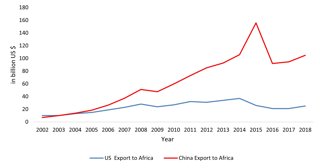
Figure 1: China and U.S export to Africa from 2002-2018 compared. Source: UN-Comtrade data (2019)
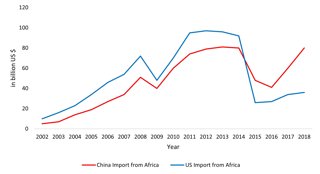
Figure 2: China and U.S imports from Africa from 2002-2018 compared. Source: UN- Comtrade data (2019)
In this resource, we will examine how China could be strategically outcompeting the U.S and other Western countries in Africa and its implications on the ongoing Great Power Competition.
Great Power Competition is a loosely defined term whose meaning is still evolving. It refers to the competition between established superpowers mainly the U.S, Russia, and rising powers such China to influence international norms, win influence, and shape international discourses and practices.
Debating China-Africa relations: Dragon Fruits or Panda Huggers
The emerging trajectory of China in Africa has produced a polarising dichotomous debate with scholars split into Dragon Fruits or Panda Huggers.
Dragon Fruits argument
Proponents of this view base their arguments on two intersecting points namely economic exploitations and promotion of ‘bad’ governance. Far from helping Africa to develop, the dragon fruit scholars argue that the influx of cheap Chinese goods is hurting budding business on the continent. Beyond the influx of cheap goods, Chinese construction companies often import labour from China rather than use local workers because local labour laws do not favour them.
In effect, there is little transfer of capital and technology after such construction projects are done. Such a system of exchange according to Huang and Chen (2016) breeds suspicion that China is only interested in exploiting Africa’s resources to the benefit of itself and at the expense of Africa. Indeed, it is not only Western scholars who have sounded the alarm on the exploitative nature of Sino-Africa relations with neo-colonialist intonations. African politicians have reinforced these concerns. For example, former South African president, Jacob Zuma, according to Reuters news warned that “Africa's past economic experience with Europe dictates a need to be cautious when entering into partnerships with other economies" (Blanchard, 2012), referring mainly to China.
Beyond economic exploitation, China has also been accused of being the chief patron of “African misgovernment” and supporting dictators with no consideration for human rights protection. China has been a strong ally of dictators like Robert Mugabe of Zimbabwe and Omar al Bashir of Sudan. By selling weapons and training military forces loyal to authoritarian governments, China legitimised these oppressive governments on the international stage. Recent arms deal with Angola have buttressed these concerns. Unlike Western aid, China does not condition its aid to good governance principles, transparency, or rule of law. Consequently, China’s unrestricted lending in Africa is regarded as a threat to democracy and participatory governance across the continent. Supporters of this argument specifically fear the exportation of the Chinese model of governance to Africa, which according to them does not promote democratic governance.
Panda Huggers argument
The panda huggers turn the argument of the dragon fruits on its head by claiming that Western relations with Africa have been no better. They argue that the West continues to be the patron of some of the most brutal dictators in Africa including Paul Biya in Cameroon, Denis Sassou Nguesso of the Republic of Congo, and Teodoro Obiang of Equatorial Guinea. These dictators have historically benefited from grants and investments from western countries (especially the U.S) despite their repressive human rights records.
Beyond the gulf between Western values and some practices on the continent, pro-China scholars argue that China is helping to build the much-needed infrastructure in Africa. Currently, the Export-Import Bank of China (Exim Bank) is the largest financier of infrastructure on the African Continent. While the U.S share of infrastructure constructions has declined from 21% in 2002 to 6.7% in 2011, China’s share has grown more than four-fold from 9.9% to 40.1% within the same period (Huang & Chen, 2016). With declining trade comes a declining influence. Other scholars have insisted that China is more ‘Africa-friendly’ due to its principle of non-intervention. This contrasts sharply with the West’s incessant interference in Africa, the most recent poster child of which is the Libyan civil war.
From a political perspective, panda huggers argue that China’s growing presence in Africa would enable African countries to break away from centuries of asymmetric relationship with the West. Consequently, Africa would be in a good position to renegotiate a more equal relationship with the West. In other words, the Beijing consensus provides a counterweight to the neoliberal Washington consensus which African countries have long railed against.
Implication for Great Power Competition
Arguably, China’s rise in Africa will shape discourse in geopolitics for the foreseeable future. Indeed, its carefully crafted development-oriented narrative is a huge concern to some Africans and African observers alike.
However, the Sino-Africa relations should not just be viewed from a dichotomous standpoint of exploitation versus a generous development partner. Rather, China’s growing foothold in Africa should be viewed as part of its long-term strategy in the Great Power rivalry with the U.S. By increasing its influence in Africa, China is seeking to simultaneously increase its influence within international organisations and strategically position itself as a responsible global leader. It does this by strategically leveraging its economic and infrastructural developments in Africa to maximise its geopolitical interest. At the beginning of 2000, more than a dozen African countries recognised Taiwan as an independent state. Through a mix of economic, infrastructure investments, and manipulative diplomacy, now only Eswatini maintains diplomatic ties with Taiwan in Africa.
Dreher et al. (2018) note that African countries’ voting at the United Nations increasingly favour China over the United States in recent times. Given that a Great Power such as the U.S’s international standing is very much related to the number of countries it can influence, a rising China will have a long-term impact on global balance of power. Indeed, the establishment of a Chinese military base in Djibouti and the increasing sale of Chinese military weapons will shape the future of Sino-African relations in profound ways that may be of strategic disadvantage to U.S interests.
While the U.S has a cultural and historical advantage over China in influencing hearts and minds, the recent posture of U.S officials could undermine such prospects. As Caverley and Dombrowski (2020) have warned, Great Power competition is “too important to be left to the admirals” alone. In fact, the 2018 U.S National Defence Strategy recognises that “inter-state strategic competition, not terrorism, is now the primary concern in U.S national security” (U.S Department of Defence, 2018, p. 1). Military approaches may not win the strategic rivalry with China on the global stage. President Biden’s Build Back Better World (B3W) policy with the G7 highlights U.S recognition of China’s success in the continent. More importantly, this reaction by the G7 may also be an acknowledgment of China’s new agency in shaping international politics, especially with developing partners.
Unlike the U.S and other G7 nations, China has viewed Africa as a partner and collaborator in its geostrategic efforts. This concept, arguably novel to African diplomacy, is certainly changing the landscape in international relations. This new arrangement was fuelled by Donald Trump’s America First policy which catapulted China into entrenching this relationship with Africa.
Activity
-
What is China’s Going Global Strategy and why does it matter?
-
What is the Great Power Competition and why does it matter?
-
What two areas do the Dragon Fruit scholars base their arguments on?
-
In no more than 3 sentences, summarise the 3 points put forward by the Panda Huggers.
-
How is China strategically leveraging on its relationship with Africa to out compete the West in the Great Power Competition?
Further reading
-
The Conversation China’s ‘mask diplomacy’ wins influence across Africa
-
Blanchard, B. (2012). China strengthens Africa ties with $20 billion in loans. Retrieved December 7, 2020, from Reuters website
-
Caverley, J. D., & Dombrowski, P. (2020). Too Important to Be Left to the Admirals: The Need to Study Maritime Great-Power Competition. Security Studies, 29(4), 579–600.
-
Dreher, A., Fuchs, A., Parks, B., Strange, A. M., & Tierney, M. J. (2018). Apples and dragon fruits: The determinants of aid and other forms of state financing from China to Africa. International Studies Quarterly, 62(1), 182–194.
-
Huang, Z., & Chen, X. (2016). Is China Building Africa? European Financial Review, 7–13.
-
US Department of Defense. (2018). Summary of the 2018 National Defense Strategy of the United States of America. Source
Answers
-
It is a document that outlines China’s desire for global leadership and influence underpinned by massive strategic overseas economic investments and aid distribution to developing countries.
-
It is a loosely defined term whose meaning is still evolving but it basically refers to the competition between established superpowers mainly the U.S, Russia, and rising powers such China to influence international norms, win influence, and shape international discourses and practices.
-
Economic exploitations and promotion of ‘bad’ governance.
-
They argue that the West continues to be the patron of some of the most brutal dictators in Africa. Pro-China scholars argue that China is helping to build the much-needed infrastructure in Africa. China is more ‘Africa-friendly’ with its non-interventionist policy.
-
By increasing its influence in Africa, China is seeking to simultaneously increase its influence within international organisations and strategically position itself as a responsible global leader. It does this by strategically leveraging its economic and infrastructural developments in Africa to maximise its geopolitical interest.
This resource was first published in 2022.