
Natural hazards and disaster risk
Introduction
Natural hazards are defined as ‘extreme events created by nature which could impact human health, disruption to activities, damage to property and potentially loss of life’. In essence, a natural event which impacts humans.
When studying disaster risk, it tends to fall into one of two categories: the physical processes or human factors. There is limited research linking these two aspects together. Given that communities manage disaster risk in various ways based on their unique needs, it is important to explore this area further.
Risk can be calculated by the following equation:
Risk = probability of hazard X degree of vulnerability x exposure (situation of the individual)
Although it is not an exact science, this equation highlights that there are multiple factors to understanding how at-risk certain populations are. The main idea behind this is that the risk from a disaster. In addition, one must also consider hazards which are difficult to define such as the impact of climate change.
Small Island Nations
Small island nations are often the first to experience the impact of natural hazards as well as the associated hazards, such as contaminated freshwater risk or increased risk of malaria from sea level rise. Being isolated, independent islands with limited resources in comparison to more advanced states can mean that the have an increased level of vulnerability.
Already, our membership is being adversely impacted by climate-related extreme weather events. This year alone, deadly typhoons and cyclones in the Pacific, hurricanes in the Caribbean, record tide and floods in the Indian Ocean, and other life-altering changes have struck our shores, while slower onset events like sea level rise and ocean acidification continue to assault our small states. Climate change in all its forms is a new, harsh, reality for us and it is getting worse.An excerpt from the opening statement of the Alliance of Small Island States (AOSIS) to the COP21 President
An excerpt from the opening statement of the Alliance of Small Island States (AOSIS) to the COP21 President, Paris 2015, highlights the severe and worsening impact of climate change on small island nations.
However, this increased level of vulnerability does not necessarily mean that every hazard event will lead to a higher risk to humans. In fact, with the right level of education and support, these island nations can demonstrate to the rest of the world methods to mitigate them.
For example, the images below show the extent of the ash fall from the 2014 eruption of Mount Tavurvur in Rabaul, Papua New Guinea, Indonesia. Twenty years earlier, 17,000 people evacuated the region after being educated on recognising the signs of volcanic activity the previous decade. Then, both Mount Vulcan and Mount Tavurvur erupted simultaneously however, the quick evacuation of the population meant that only 5 people lost their life.
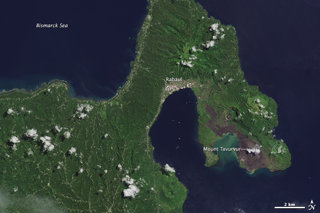
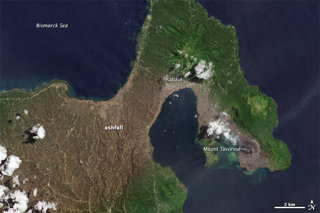
Figures 1 and 2: Landsat images of the Rabaul region in Papua New Guinea showing the extent of ashfall before and after the eruption of Mt Tavurvur in August 2014 © NASA Earth Observatory.
Volcanoes are like children
Volcanoes, by their very nature, can generate a variety of hazards. Those which are formed from basaltic lava tend to erupt in a far less energetic manner than those from subduction and therefore the islands which form because of these eruptions can provide a wonderful opportunity to explore and experience these places firsthand.
Additionally, many volcanic islands are ideal tourist destinations, not only for the chance to witness eruptions but also for their unique landscapes. These include by-products such as hot springs and the distinctive flora and fauna that thrive on the minerals provided by the volcanoes.

Figure 3: Fissure eruptions in Iceland © Sparkle Motion Flickr
However, it is also important to remember that volcanoes have the power to destroy as well as create. It is with this destruction that people need to be mindful as the hazards they can bring would not only impact the local area, but they could have a potential to impact on a regional or global level.
Therefore, it is essential to continue studying hazard risk and management at all levels of education. This will ensure that future leaders are equipped with the necessary tools to effectively communicate and manage these events, thereby reducing the risk to people.
Disaster risk education
The understanding of disaster risk is still limited to a few certain circles. Particularly, within the field of geography education. As a result, unless leaders have a background in this area, their focus often shifts to other priorities.
However, it has been seen time and again that with preparation, the impact on humans and therefore the hazard is reduced.
The power of education has been felt in many circumstances one of particular importance is that of 10-year-old Tilly Smith, who on 26th December 2004, saved the lives of 100 beachgoers at Mai Khao Beach in Thailand. Tilly recognised the signs of a tsunami after learning about them in her Geography lesson only weeks previously and managed to get them all to higher land before the 9-meter wave hit the shore resulting in one of the only beaches on the island with no reported fatalities.
In response to the Boxing Day Tsunami, the Hyogo Framework was established to foster international collaboration in disaster risk management. Although the following Sendai Framework placed less emphasis on preparation, the Hyogo Framework is still the foundation stone in reducing losses from disasters and building a more resilient future for vulnerable communities.
On a more localised level, simulations that can help people make decisions about actions from natural disasters for example the Disaster Simulation Exercise at Manchester University or can lead to greater understanding on how to communicate and mitigate the risks of natural hazards.
Small island nations have valuable insights to offer the global community, having experienced numerous natural disasters. Their lived experiences can help experts better understand and address the impacts of these events.
Further reading
Disasters: Deconstructed Podcasts explaining the concepts and examples of disasters
IPCC AR6 Report for policy makers, 2023
Met Office – Volcanic Ash Emergency Coding Activity
UNDRR website Prevention Web – definition of disaster risk
Prevention Web – key concepts of disaster risk
Action of community in disaster management – Introduction parts 5&6
British Geological Society – different volcanic eruption types
How volcanoes can erupt differently, GNS
Whakaari (White Island) volcano and the interaction with tourism, Netflix
Whakaari (White Island) volcano case study, Earthdate.org
Why is disaster risk important, UNESCO
Why children should learn more about disaster risk reduction, UNICEF
International Disaster Management course, University of Manchester
File nameFiles
File type
Size
Download
This resource was first published in 2024.