Old coal mines in the UK: could they heat our homes?
The purpose
Heating, both for individual households and for industry, is regarded as one of the hardest sections of the economy to decarbonize. Currently, heating in homes, businesses and industrial processes is responsible for a third of the UK’s greenhouse gas emissions (GHGs). However, in the UK there is growing optimism that naturally heated water in old disused coal mines can be extracted for geothermal energy. This could be a significant milestone in decarbonizing the UK economy. It is significant because the UK Climate Change Act of 2008 (which committed the UK to reducing greenhouse gas emissions by 80% relative to 1990) was updated in 2019 to target a 100% reduction in GHGs by 2050, otherwise known as ‘achieving net zero’. In April 2021, this target was further strengthened by Prime Minister Boris Johnson legislating for 78% reduction in emissions by 2035.
It is hoped that geothermal energy from abandoned coal mines could be used to heat homes and other buildings with minimal carbon emissions thereby reducing UK reliance upon electricity, natural gas, and other fossil fuels for heating. If successful it would be both local and low cost.
The specification
AQA 3.2.5.4 Energy security strategies to increase energy supply (oil and gas exploration, nuclear power, and development of renewable sources).
Edexcel Topic 6: The Carbon Cycle and Energy Security 6.6 There are alternatives to fossil fuels, but each has costs and benefits.
OCR Topic 3.1 – Climate Change 4.c. Mitigation and adaptation are complementary strategies for reducing and managing the risks of climate change.
Eduqas 3.4 Energy Challenges and Dilemmas 3.4.2 Physical factors determining the supply of energy. Geological factors including physical reserves of fossil fuels and active areas for geothermal energy.
What is geothermal energy?
Geothermal energy is renewable energy which does not involve the combustion of fossil fuels. It refers to any heat extracted from the ground from low-grade heat stored in shallow subsurface deposits of less than 200m to primordial heat from below 500m (plus heat emitted from within the Earth’s crust by radioactive decay). The British Geological Survey (BGS) quote the UK upwards heat flux as 27°C per kilometre (but locally it can be in excess of 35°C per kilometre). Using 12°C as a starting point for ambient surface temperature BGS estimate the UK geothermal gradient to increase from 39°C at 1,000m to 89°C 3,000m to 139°C at 5,000m. This is called the geothermal gradient.
-
Plot a scatter graph to depict the UK geothermal gradient.
Interpolation involves estimating an unknown value from within a data set. Extrapolation involves estimating an unknown value that is outside the data set. Interpolate the UK subsurface temperature at 500m and extrapolate the trend to calculate the temperature at 7000m.
Enhanced UK subsurface temperatures are found in areas underlain with granite, this is because granite has natural radioactivity. It is mainly concentrated in SW England, N England, Scotland, and N Ireland. You can look further at the exact location of granite areas using the BGS iGeology app (only available on iOS, but a new android version is reportedly in development).
Over the next decade, new technology and innovative breakthroughs are forecast to herald a big increase in geothermal energy throughout Europe. Geothermal technology is already well understood and utilised in Iceland.
-
Watch this Euronews briefing from 1:00 to 4:00 minutes on geothermal energy. What is a major issue in the geothermal industry, and what has been designed in Reykjavík to solve the problem?
-
Iceland has the most geothermal energy in Europe and is a world leader in using this energy source for heating (industry, swimming pools and households) and electricity. Using table 1, draw 2 pie charts for the energy mix of Iceland and the UK.
|
Electricity generation by source 1990-2019 (GWh) |
||
|
|
Iceland |
UK |
|
Coal |
0 |
7692 |
|
Oil |
3 |
1041 |
|
Natural gas |
0 |
132458 |
|
Biofuels |
0 |
32870 |
|
Waste |
0 |
8924 |
|
Nuclear |
0 |
56184 |
|
Hydro |
13459 |
7715 |
|
Geothermal |
6019 |
0 |
|
Wind |
7 |
64134 |
|
Solar PV |
0 |
12677 |
|
Tide |
0 |
13 |
Table 1 www.iea.org/countries (Note - this is for electricity generation not total energy supply)
-
Annotate around your 2 pie charts the differences in energy mix between Iceland and the UK.
a. Specifically, how does the UK compare on geothermal energy?
b. Use the article by DW news Geothermal energy: Why hasn't it caught on yet? to add detail.
The potential of coal mine heat
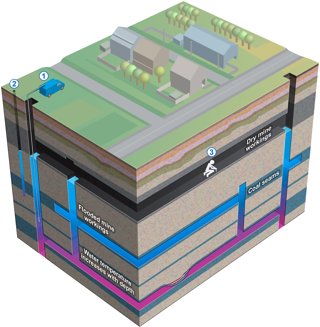
The Coal Authority, in collaboration with the British Geological Survey, have created a visualisation to depict how Britain’s old coal mining infrastructure could be used in the twenty-first century for low-carbon heating and cooling. You can read about the visualisation on the RGS-IBG webpage Unlocking heat stored in Britain’s abandoned coal mines.
Coal mine heat increases with depth due to the natural heat flux mentioned previously. As a result, residue water in disused collieries has accumulated and has been naturally heated by geological processes. This could provide a sustainable heat sources for decades to come across many parts of Britain, especially as round 25% of the UK’s population live above abandoned coal mines.
Image 1 shows how to extract geothermally heated water from a disused UK coal mine. Make a sketch of this diagram and annotate with the 3 comments below:
1. Geothermally-heated water can be extracted whilst dry mine workings continue above the water table.
2. Water is extracted from the flooded mine, which is warm because it has been naturally heated by geothermal energy.
3. New boreholes may need to be drilled to access and extract naturally heated groundwater.
Add onto your sketch the additional labels 4, 5 and 6 listed below.
4. 10-15°C water is pumped into a home water tank (heat pump) and a refrigerant extracts heat, turning it into a gas
5. >Buildings are connected in a heat network (when heat is transported from multiple sources to more than one end user).
6. Cooled groundwater can be returned back underground to create a cyclical process.
Spennymoor case study
Mining production peaked in the UK in 1913 with 292 million tonnes of coal being mined, and it continued to be the country’s primary source of fuel until the 1960s.
As environmental awareness rose, and other forms of energy production emerged, coal rapidly declined from this point onwards adversely affecting mining communities in Wales, Scotland, and the north of England. In 2019 annual production dropped to only 2 million tonnes — now only sourced as opencast coal (the last deep coal mine closed in 2015 in the UK).
The Spennymoor Pit, also known as the Merrington Colliery, can be seen in a reproduced OS map from the Durham Mining Museum webpage. The town was built on mining coal with the first shaft sunk at Whitworth Park Colliery in 1839 and the first Merrington Colliery coal extracted in 1841. It was a linked industry with the Tudhoe ironworks nearby (for the production of iron and steel) which also opened a shaft in 1864. During the industrial revolution of the nineteenth century the town grew considerably as migrant labour flowed in to work in the pits. Local mining success was relatively short-lived as a serious explosion at Tudhoe Colliery, a trade depression, and declining miners’ wages led to the Merrington Colliery closing in 1928. Since then, Spennymoor like many other northern mining towns ‘is still scarred by the past’ with high unemployment and ill health.
-
Go to the Consumer Data Research Centre maps and search for DL16 7SE (a central Spennymoor post code). Consider Spennymoor to be the entirety of the small urban area above the A688. Describe the level of deprivation in the town in 2019? Make sure the slider at the top of the screen is pulled across to 2019.
After the discovery of hundreds of millions of litres of water travelling around the network of old mines underneath Spennymoor, with temperatures of between 12 and 20°C, there is widespread hope that renewable energy might be engineered in Spennymoor, with infrastructural investment. With 2,000 more homes planned for construction in Spennymoor (which may benefit from heat pump technology), an ageing population and increasing fuel costs, renewable energy could transform the local economy and improve the lives of town inhabitants in the future.
-
Watch journalist Amy Lea in her report Could abandoned coal mines be used to heat homes? Describe how the process might work in Spennymoor.
Further reading
-
Heat from beneath: how the UK could heat homes from old coal mines - Geographical Magazine
-
Timeshift: when coal was king (from 09:45 to 13:20 there is excellent commentary on the dangers of working ‘at ‘the coalface’)
Answers
2. Extreme heat can damage equipment. In the geothermal industry you need to cool down the drilling wells which can create a high equipment costs. Iceland GeoSurvey ÍSOR in Reykjavík has designed flexible coupling to minimise thermal expansion. The casing is flexible and is designed to expand when it warms up, without generating plastic strains.
4. The UK has no geothermal energy compared with Iceland’s 6019 GWh, which accounts for 31% of electricity production in Iceland. Iceland has an excellent, almost fully sustainable, level of renewable energy however the UK mix offers energy security as it is diverse and draws from a number of sources. The DW article explains that ‘the two main hurdles have been geographic and financial’ for countries such as the UK.
5. The County Durham town of Spennymoor is within the Coal Mining Reporting Area.
6. Many of the mine entry points are now in residential or built-up areas. There are a cluster of mine entrances around Misty Blue Farm to the south of the town that are removed from the urban area, but this is designated a Development High Risk Area. The only viable entrances are either west of Victoria Jubilee Park, within the town, or to the north adjacent to the B6288.
7. 100m Equilibrium Mean (°C): 11.5 200m Equilibrium Mean (°C): 16.2
10. Deprivation remains high in Spennymoor with extreme deprivation in Middlestone Moor. Most wards are in 3, 2 or 1 deciles for the Index of Multiple Deprivation. There is a small pocket of wealth between Victoria Park and the River Wear.
11. Durham University Energy Institute is focusing on new developments for the process. Water from flooded mines will be pumped out of the ground to power a generator, that generator will then provide power for nearby homes for clean and efficient energy. Energy bills might become cheaper for local residents.
This resource was first published in 2021.