The purpose
Rewilding is a term we increasingly hear, but what does it mean and how can it deliver successful, sustainable protection for nature? In this teacher resource we will discuss the definition and different types of rewilding, what outcomes this movement might achieve, early adopters and case study examples and why some conservationists err on the side of caution. This resource has been written for the GCSE curriculum but can also be used to help structure a Key Stage 3 unit.
The specification
AQA 3.1.1.4. Managing climate change involves both mitigation (reducing causes) and adaptation (responding to change). Adaptation – change in agricultural systems, managing water supply, reducing risk from rising sea levels.
Edexcel 3.3. The UK has its own variety of distinctive ecosystems that it relies on. Distribution and characteristics of the UK’s main terrestrial ecosystems (moorlands, heaths, woodlands, wetlands).
OCR 2.1.5. Bio-diverse ecosystems are under threat from human activity. Threats to biodiversity and attempts to mitigate these through sustainable use and management.
Eduqas 5.4.3 How can ecosystems be managed sustainably? Coverage to include zoning within National Parks and creation of wildlife corridors.
Classifications
There has a recent and gradual evolution of the rewilding concept since the early 1990s. The scientific term began in 1991 with the Wildlands Network (formerly the Wildlands Project), which identified one of the main causes of North America species extinction being the lack of connectivity between conservation areas.
The primary goal of the Wildlands Network became the need for ‘networks of people protecting networks of connected wildlands’. Below are the four major stages of definition for rewilding in recent decades.
Four major stages of definition for rewilding
Rewilding: Restoring big wilderness based on regulatory roles of large predators. 1998 Soule and Noss
Pleistocene rewilding: Aims to restore some of the evolutionary and ecological potential that was lost 13,000 years ago’ (introducing relatives or functional equivalents of extinct taxa. 2005 Donlan et al.
Passive rewilding: Passive management of ecological succession with the goal of restoring natural ecosystems processes and reducing human control of landscapes. 2011 Gillson et al.
Translocation rewilding: Seeks to restore missing or dysfunctional ecological processes and ecosystem function via a process of species reintroduction. 2014 Seddon et al.
Key idea
George Monbiot first brought the theme of rewilding to many people’s attention in the UK with an eye-opening TEDx talk describing how he was ‘ecologically bored’. He describes pining for a richer and rawer life in a post-industrialised Britain. Monbiot states, in his opinion, there are two central tenants to the concept of rewilding: the mass restoration of ecosystems and the rewilding of humans.
The mass restoration of ecosystems involves the discovery of ‘trophic cascades’, interactions that control entire ecosystems from the effect of predators on their prey, propagating down food webs is a major line of argument in the rewilding movement. Ultimately trophic cascades highlight the complexity of the natural world and underscore the need for the reintroduction of predators in both the terrestrial and aquatic ecosystems.
An often-cited example of predator reintroduction is the return of grey wolves to Yellowstone National Park in 1995. Before this moment Yellowstone Elk were pushing the pushing the limits of the Yellowstone’s carrying capacity. Transformation came about due to two reasons: firstly, the wolves killed and ate some of the elk and secondly, they prevented the elk from moving freely throughout the park in large numbers. By driving the deer out of some areas, the cascade effects were enormous and are still being monitored to this day. The U.S. National Park Service even claim that rivers have changed course in this video. The underlying argument is that the natural world has great complexity. The following quote from chapter 1 of Monbiot’s rewilding book Feral neatly defines the term in his eyes:
Rewilding, to me, is about resisting the urge to control nature — and allowing it to find its own way. It involves reintroducing absent plants and animals (and in a few cases culling exotic species which cannot be contained by native wildlife), pulling down fences, blocking the drainage ditches, but otherwise stepping back. At sea it means excluding commercial fishing and other forms of exploitation. The ecosystems that result are best described not as wilderness, but as self-willed.
Rewilding is not limited to the terrestrial landscape. The planet’s oceans also rely heavily on the concept of trophic cascades. In our oceans the impact of whales is also becoming apparent. As the largest mammals on Earth, whales are incredibly important for the recycling of organic matter via their faecal plumes, representing an oceanic trophic cascade. The cycle starts with tiny marine plants, called phytoplankton, which grow and absorb carbon dioxide near the ocean surface. Phytoplankton is eaten by krill. Death, faeces, and migration move organic, carbon-rich organisms towards the ocean floor. Mammals such as the Blue whale then consume krill and defecate. These are long, flocculent (loosely clumped together) excrements, in the photic zone (the upper part of the ocean where photosynthesis takes place). Whales release excrement rich in nutrients which stimulates microscopic plant growth, called phytoplankton. Eventually this becomes a circular process known as the ‘whale pump’ — an example of recycling in the natural world. This biological cycle in the hydrosphere also underscores, in Monbiot’s words, the importance of ‘stepping back’ from certain areas to allow nature to recover i.e., by limiting krill fishing in the Southern Ocean and by enforcing fishing quotas in British territorial waters.
George Monbiot’s second central definition of rewilding is to rewild human nature itself. He describes himself as ‘ecologically bored’ from the humdrum routine of modern life and, along with many other environmentalists, argues we need to re-engage with nature for our own good, to fill our lives with adventure and surprise once more. We have arrived at the crossroads of both ideological thinking and possibility. As rewilding has grown in public awareness so too have our capabilities of turning the concept into reality. In Europe rural-to-urban migration is continuing to empty the countryside, leaving large swathes of land vacant. 30 million hectares of land in Europe will be vacated by farmers between 2000 and 2030. It is a tantalising prospect for those who argue for a wild future. However, one question sharply divides people: should we really contemplate the return of some our natural megafauna (hippopotamus, lions, hyenas) from the last great interglacial period?
Rewilding a farm
Another key book in the rewilding literature is Wilding by Isabella Tree. This take on the topic is very focused in space and place, as it is essentially a personal tale told by the Burrell family about the rewilding of the Knepp estate, from 2001 to present-day. Isabella Tree starts off with a stark summary of the last 50 years of intensive agriculture:
The number of Britain’s most endangered species have more than halved since the 1970s, with one in ten species overall threatened with extinction within our shores. The abundance of all wildlife has fallen dramatically. Insects and other invertebrates have been particularly badly hit, more than halving since 1970. Moths have declined by 88%, ground beetles 72% and butterflies 76%. Bees and other pollinating insects are in crisis. Our flora is also failing. Seed-bearing weed species — upon which turtle doves and countless other bird depend — declined by 1% every year during the twentieth century since records began in the 1940s.
The combination of expanding urban areas, roads severing animal movements, exploitation and climate change has led to the current emergency of both a climate crisis and a biodiversity crisis. Climate change is only just starting to show visible, long-lasting changes to our UK weather, making farming a very difficult industry to survive in, let alone profit from. Here are some climate facts for 2020 to underscore the challenge facing us:
- The last six years have been the hottest six years on record
- The last decade was confirmed by climate scientists as the warmest on record
- The Met Office says 2019 was 1.05C above the average for the period from 1850-1900 (calculated using the HadCRUT4 temperature data)
- May 2020 was the sunniest and driest calendar month ever
- Conversely, February 2020 was the wettest February on record (and the 5th wettest of any calendar month since 1862)
These records support a warning from the Environmental Agency (EA) in 2018 in the press release: ‘climate change means more frequent flooding, warns the Environmental Agency’, which scientists believe is due to changes in the Jet Stream. To learn more watch this Met Office Jet Stream YouTube video. Rewilding, it is hoped might not only protect our flora and fauna but might also be able to alter the land to absorb more surface water in the future. In Wilding there is a whole chapter devoted to the importance of ‘Rewilding the River’ and the advice from Hans Kemp, a senior policy advisor on Ecosystems and the Environment to the Dutch government, to ‘fill in the canal…and return the river to its floodplain.’ Han’s experience working with large scale ecological networks across Europe and his involvement in the Oostvaardersplassen — a rewilding project in Holland set up by the ecologist Frans Vera, made him ‘both a thinker and a doer’ with a ‘profound understanding of the behaviour of water.’
Oostvaardersplassen comes up regularly in the book and would make an excellent case study for rewilding, you can learn more about it from the Dutch website on ‘pioneering nature’.
Once the decision is made to backfill the canal on Knepp estate there is instant success. The river takes a more natural form with a shallow riverbed, banks soften to allow water to readily spill over in heavy rains and a wetland expanse full of egret, mallards, mandarin ducks, lapwings, fledglings, heron and even sea trout springs up. River re-naturalisation, as a wing of the rewilding argument, is of particular importance to the UK as the economy spends £1.1 billion a year on flooding with one in six properties in the country now at risk of flooding. This natural form of soft engineering is cheaper, safer and more resilient than hard engineering in the long-term.
In a very similar vein to the episode Siberian rewilding from the radio show 39 Ways to Save the Planet (a collaboration between BBC Radio 4 and the RGS-IBG), the big scientific ‘closed canopy’ debate is central to much of how we perceive the natural landscape (and what we should do/return it to, going forward). In the ongoing pursuit of funding from English Nature, Isabella Tree explains that the prevarications of civil servants were rooted in the controversy surrounding Frans Vera’s theory about the origins of ‘wildwood’ explained in the following perplexing paragraph:
…was Britain in the pre-Neolithic, Atlantic era, about 7,000 years ago, closed-canopy forest? Or was it a more open landscape, a mosaic of grassland, scrubland, groves and solitary trees, grazed by large numbers of herbivores? Correctly identifying Britain’s ecological past was clearly fundamental to considering how conservation should proceed…
Reintroducing key stone species
If the conclusion is that our temperate ecological zone was in the past more mosaic-like and open (which the light-demanding tree species of hazel, oak and birch all seem to suggest) then the argument for reintroducing predators arises too. Simply put, this is so that herbivore numbers are kept in check. In the UK as the appetite for hunting has slowed the deer population has become artificially high. There are 1.5 million red, roe, fallow, sika, muntjac and Chinese water deer in the UK which, without culling, are colonizing the country and preventing vegetation recovery. Two species have been suggested for reintroduction: the wolf and the lynx, both natural predators of roe.
The grey wolf has very successfully been reintroduced to Yellowstone National Park, Wyoming. It is an 8,991 km² wilderness recreation area and since the return of wolves there has been a ‘trophic cascade of ecological change’. Watch this video on How wolves change rivers to understand the impact on beavers and elk in the National Park.
The beaver is already a success story of the UK rewilding movement. It was first successfully released in Scotland, in Argyll and around the Tay and Forth river catchments between 2009-2014. This was followed in England by the River Otter Beaver Trial (ROBT) in the lower reaches of the river Otter, Devon. Robin and Merlin Hanbury-Tenison have also been fundraising since April 2020 to return beavers to Bodmin Moor through the Cabilla Beaver Project, supported by the Cornwall Wildlife Trust and the Cornish Beaver Trust. In total 6 young beavers will be released to a tributary of the Warleggan River, Cornwall. Their reintroduction is widely celebrated as beavers help mitigate against river flooding due to their dam-building and channel-digging. They have been absent from the UK for 500 years.
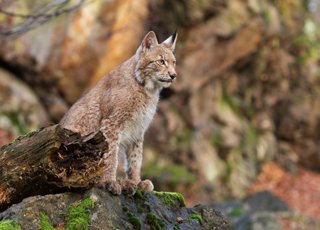
Lynxes are also being considered for UK reintroduction, and arguable are more likely to roam this island again. A Scottish forest near Loch Lomond is gathering momentum as a potential site for lynx reintroduction with a year-long study of Scottish public attitudes to the suggestion commencing in 2021, reports the New Scientist. In 2018 the UK government turned down a bid to release 6 lynxes to Kielder Forest, in Northumberland. You can read the letter from Michael Gove to the Lynx UK Trust from DEFRA online, to understand why the proposal was rejected.
All three of these animals (wolves, beavers, and lynx) are UK keystone species, meaning they have a disproportionately large and important effect on their surrounding natural environment.
George Monbiot suggests the ancient character of the land with open forests and wolves, bears, lynx, wildcats, boar, and beavers has ‘been forgotten almost everyone’. He reminds us that some UK ‘wilderness’ is in fact devote of nature, describing Claerwen natural reserve in Wales as ‘a bare sheep-scraped misery’. This is highlights ‘Shifting Baseline Syndrome’ — when people consider the ecosystem of their childhood as normal.
Challenges
Wildlife corridors and the state of our soils are major challenges for the 21st century.
The current patchwork of habitats divides and isolates species. Isolated protected areas, SSSI (Sites of Special Scientific Interest), National Parks, protected habitats, AONB (Areas of Outstanding Natural Beauty) and individual conservation projects fail to recognise that some species need to be linked through exchange and interconnection, termed meta-populations, i.e., colonies connected system of habitats. There is a ‘desperate need’ to connect pockets of nature in the British landscape as refuges like the Knepp estate in West Sussex or the Cabilla Farm in Bodmin Moor are dislocated from one another. The importance of connectivity was underscored in Making Space for Nature: a review of England’s Wildlife Sites and Ecological Network report which was submitted to DEFRA in 2010. It calls for an urgent improvement in the overall state of nature in England by connecting existing wildlife sites and building resilience to restore biodiversity and improve species’ chances of surviving climate change. A small example of a met-population affected by a fragmenting landscape is the water vole which, since Roman times, has suffered from expanding farmland and wetlands being drained - originally beginning in England under Roman rule. Now water voles must cross vast hostile landscapes with new efficient killers such as the mink. This meta-population is therefore very vulnerable to ‘breaks in the chain’ of interconnected habitats.
Alongside the rewilding of fauna (with the return of mega-fauna) and the rewilding of waterways the rewilding of UK soils also needs to take place. The main case for returning soil to a more nature state is that currently 2.2 million tonnes of topsoil is eroded every year in the UK, with over 17% of arable land shows signs of erosion. This is both incredibly damaging to the nature environment but also a threat to domestic food production. Fertiliser overuse is largely to blame. Whilst artificial fertiliser has increased the potential of soil with only the 3 basic elements of nitrogen, phosphorus, and potassium it has been applied to soil ineffectively, at the wrong times of year. Chemical phosphorus also binds quickly to minerals and unless there are micro-organisms present it becomes unavailable to plants. Runoff during rain events also causes algae blooms as chemicals are washed in rivers, suffocating aquatic life. The knock-on effect is also seen in the quality of our agricultural produce. For example, a study of The Composition of Foods data by UK government biochemists found the level of nutrients is declining in our food:
We would have needed to eat ten or more tomatoes in 1991 to receive the same amount of copper as we have derived from one tomato in 1940. Yet another study calculated we have to eat eight oranges today to receive the same amount of Vitamin A as our grandparents did from eating one.
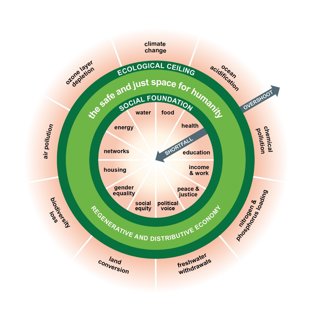
David Attenborough states clearly that alongside reversing greenhouse gas emissions we must also end our overuse of fertilisers. In order to achieve this aim ‘we must halt and reverse the conversion of wild spaces to farmland, plantations and other developments.’ Kate Raworth, a University of Oxford economist, goes further to clarify that a greater level of equality is required in the twenty-first century as the top richest 16% of the human population account for 50% of humanity’s impact on the living world. In her doughnut diagram (Figure 1) Raworth has drawn a minimum requirement line for human well-being: good education, housing, healthcare, safe food, water, access to energy, income, a political voice and justice with a maximum ‘ceiling’ line which we must remain below to sustain a stable and safe planet. The doughnut model, Attenborough claims, is ‘our compass for the journey’ towards a sustainable future.
2021 might be the year that brings substantial change as the EU’s Common Agricultural Policy (CAP) is replaced in the UK with a new post-Brexit tier system called the Environmental Land Management scheme (ELM). From 2021-onwards farmers will essentially be paid for providing ‘common goods’ such as woodlands or restoring peatlands. It is expected to herald ‘really significant land use change’ in the coming years. Upland farms might choose to turn land back over to nature (currently 42% of farms would make a loss without government subsidies, according to the National Audit Office), some golf courses could be repurposed (due to a declining clientele — they also cover 150,000 hectares) or moorland peat restoration.
Further reading
-
Rethinking Rewilding abstract by Dolly Jørgensen in the ScienceDirect online journal
-
Climate change: Last decade confirmed as warmest on record - BBC News
-
May 2020 becomes the sunniest calendar month on record - Met Office
-
For the counter rewilding argument Rewilding — does it need a rethink? | Financial Times (ft.com)
-
The Environmental Land Management scheme policy discussion 2020 ELM Policy Discussion Document 230620.pdf (defra.gov.uk)
Appendices A
This resource was first published in 2021.