
Social and racial inequalities from COVID-19 in São Paulo, Brazil
How can social and racial inequalities be linked to COVID-19?
In Brazil there are structural inequalities. Structural inequality refers to the disparity in wealth, resources, and other outcomes that result from the discriminatory practises of institutions. Extreme Brazilian social inequality is a legacy of Portuguese colonialism and years of historical accumulation of exclusionary political and social institutions.
Across Brazil there are indigenous people living in every state representing 305 different ethnic groups and 274 indigenous languages.
Social and racial divisions stem from Brazil being the last nation in the Americas to abolish slavery (in 1888), and from the late recognition of people’s right to vote (not granted until 1988).
Between 1501 and 1888 slave trading brought an estimated 3.6 million enslaved people from Africa to Brazil. Out of the current Brazilian (214 million) population ~50.7% consequently identify as Afro-Brazilian (including both preto (black) or pardo (mixed ethnicity)). Ethnicity in Brazil has continued to diversify. For example, in the early twentieth century, a wave of Japanese migrants arrived due to bilateral government policies, restrictions on US Asian immigration in the 1920s, and economic hardship in Japan due to modernisation. Many of these workers suffered the same social prejudices as freed slaves and have remained a large ethic group, the largest Japanese diaspora anywhere in the world outside of Japan.
Modern-day division persists affecting Afro-Brazilians’ access to healthcare, education, employment and wealth. For example, throughout the twentieth century people of colour suffered discrimination with job adverts including the phrase “boa aparência” (“good appearance”), meaning that only light-skinned people need apply.
A huge wave of rural to urban migration, which began in the 1970s, has cemented inequality as people of colour still lack landownership and remain concentrated in urban favelas.
In these informal settlements poverty rates are high and young black men are the most vulnerable to violent crime. In terms of the absolute number of murders per year, Brazil has the highest homicide rate in the world.
In 2020, COVID-19 disproportionally affected particular groups in Brazilian society due to extreme differences in income (affecting access to healthcare) and social differences between different barrios (districts). Often, in these areas, there is a high occurrence of comorbidity.
One of the outcomes from the pandemic has been the reaffirmation of data as a crucial to understanding the spread of disease. Datasets, such as the Johns Hopkins’ COVID-19 dashboard, can advocate for equity by identifying the pre-existing social determinants of health.
Case study São Paulo
Sabrina Li et al. researched the differential effects from COVID-19 on disadvantaged groups in São Paulo. The research uncovered social and racial inequalities in the risk of hospitalisation and death by COVID-19.
Through analysing mobile phone data, it was observed that individuals in wealthier neighbourhoods (predominantly white residents) self-isolated to a greater extent, did so earlier, and sustained that isolation for a longer period of time.
Whereas people from the poorest 40% of census tracts had an 8% higher risk of hospitalisation and were 60% more likely to die from COVID-19. The research concluded:
-
Income is negatively correlated with risk of hospitalisation
-
People that travelled to and from the greater metropolitan region of São Paulo were at a higher risk
-
There is a racial disparity in risk of death when looking at death among patients by hospital type (public vs. private)
Due to income inequality and poor health, disadvantaged areas such as Vila Andrade, suffered more than the wealthy centre of São Paulo. The map below shows that in 2016, before COVID-19 struck, residents in the outer districts already died younger due to lower life expectancy.
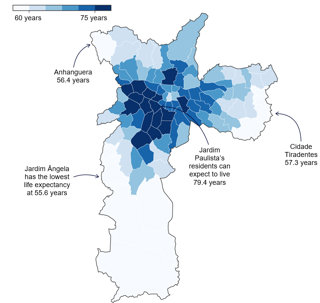
In 2020 this meant the preto and pardo groups suffered disproportionately high hospitalisation rates, underscoring how impoverished high-density districts of São Paulo were particularly vulnerable to the virus.
Activity
Study Figures 1 and 2. Complete the following questions.
-
Research what the term “comorbidities”’ means?
-
Explain why some districts in São Paulo suffered higher hospitalisation rates than others. Use the Further reading list to inform your answer.
-
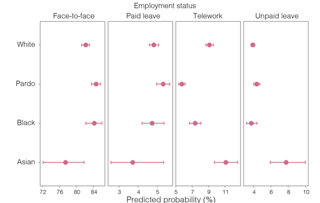
Analyse Figure 2. With reference to a specific group in São Paulo explain how they were disadvantaged during COVID-19.
-
Read the conclusion of the BMJ article on São Paulo. What needs to be done to reduce inequalities in COVID-19 related health risks in the future?
Answers
-
Comorbidity describes a patient presenting with two or more diseases or medical conditions. The diseases can emerge coincidently, or as a cause of one another. Comorbidities require “polypharmacy” – the prescription of many medications – which can involve complicated medical regimes and drug interactions.
-
Pre-existing socio-economic issues in São Paulo exaggerated the effects of COVID-19 for particular districts. Brazil is a deeply unequal country with large differences in income and health. The 2022 Gini coefficient places Brazil as the 9th most unequal country in the world with a score of 53% (0% being absolute income equality and 100% being the most unequal with one person earning all the income). This points to a lack of land ownership, political polarisation, and pockets of extreme poverty in marginalised outer districts. For example, in districts such as Vila Andrade half of all households are in favelas. This financial inequality is also linked to rates of comorbidities and unequal access to healthcare (isolated communities, out of reach health centres, a lack of private healthcare) resulting in higher hospitalisation rates for these communities.
-
Figure 2 shows that the preto and pardo groups in São Paulo had higher rates of face-to-face employment, typically in employment without unpaid leave. This type of work could be in private security, construction, or working in a centro commercial. Afro-Brazilians are paid less than similarly qualified white men, and wage discrimination remains a problem. During COVID-19 this meant that the preto and pardo groups were more likely to lose their face-to-face (often temporary) work as quarantines were imposed and foreign air travellers were prevented from entering Brazil.
-
Action needs to be taken to reduce the factors that contribute to health inequalities. The pre-existing living conditions of disadvantaged groups (such as poor education, precarious work, residential segregation and inadequate housing) must be improved if access to quality healthcare and a reduction in comorbidities is to be achieved. More data on social safety nets programmes is required. Vaccination efforts should focus on disadvantaged groups in São Paulo.
Further reading
-
Migration Policy Institute Migration in Brazil: The Making of a Multicultural Society
-
Harvard Divinity School Japanese Brazilians
-
Policy Commons Social and racial inequalities as contributing factors to COVID-19 vulnerability in São Paulo, Brazil
-
Harvard Political Review “Equal Before the Law,” But Not in Practice: Brazil’s Social Inequality Crisis
-
Minority Rights Brazil
-
Minority Rights Afro-Brazilians
-
LSE Impact Blog The need for open data sharing in the era of global pandemics
-
The Health Foundation Social determinants of health
-
The Guardian Living on the edge: São Paulo’s inequality mapped
-
BMJ Higher risk of death from COVID-19 in low-income and non-White populations of São Paulo, Brazil

This resource was first published in 2022.