Global distribution of tectonic activity
By mapping the locations of volcanic activity and earthquake events, scientists started to realise that, by and large, they were not occurring in random places; there was a pattern. Not only this but other features such as particular coastal islands and mountain ranges also correlated with certain tectonic events. It was then that scientists realised that these were all associated with tectonic activity along plate boundaries.
Additionally, certain tectonic events took place in specific places, thus linking the understanding about the two different plate types: continental and oceanic. Oceanic plates, without continental crust, are characterised by their denser, younger, thinner composition and primarily consist of a rock called basalt. Continental plates on the other hand are older, thicker, relatively lighter, and predominantly made from a rock called granite. A continental plate is one where some of the area of the plate is composed of continental crust but in most cases a single plate is composed of both continental and oceanic lithosphere. Interactions between these plates give rise to certain tectonic activities.
There are, however, some exceptions to this rule. Some earthquakes occur far beyond plate boundaries, these are often attributed to ancient plate boundaries and subducting plates. Additionally, hotspot volcanoes can be found in the middle of plates. These volcanoes occur because of a continuous rising plume of heat from within the mantle, melting the lower part of the lithosphere creating magma which rises through cracks in the crust forming volcanoes. In such cases, if the resulting volcanoes reach the sea surface, they create a chain of islands as the plate moves over the hotspot. Examples of oceanic volcanic hotspots are the Hawaiian, Canary, and Galapagos Island chains. There is also evidence of hotspot volcanoes forming on continental plates. The most famous example of this is Yellowstone.
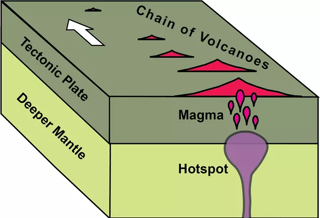
Figure 2: Diagram of a volcanic hotspot © National Park Service