Hazards, effects, and responses to tectonic hazards
Volcanoes can unleash a variety of hazards that impact people in numerous ways. Primary hazards stem directly from volcanic activity itself, while secondary hazards arise indirectly from these primary events.
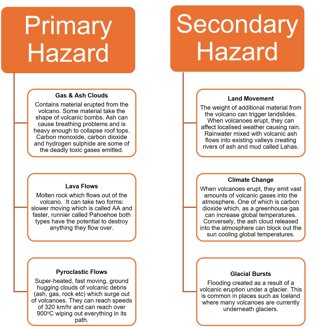
Figure 3: Primary and Secondary Hazards of Volcanoes © RGS
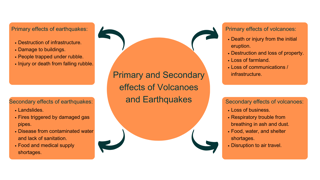
The primary hazard of an earthquake is the ground shaking, which in turn can trigger secondary hazards (see Figure 4) such as:
- Liquefaction: intense shaking transforms the ground into a liquid-like state, similar to quicksand. Anything on the ground can then sink into it.
- Landslides: the shaking of the land dislodges the ground causing it to move down the side of a slope.
- Tsunamis: earthquakes occurring beneath the sea can displace water above the epicentre, resulting in the formation of tsunamis.
Hazards stemming from tectonic events can vary depending on factors such as the type of volcano, earthquake intensity, and the location of the event.
For instance, stratovolcanoes, also known as composite volcanoes, may not erupt frequently but have steep sides with cooler, less viscous lava which tends to trap gases and in turn, result in more explosive and violent eruptions. In contrast, wider shield volcanoes have a runnier lava which does not trap gases or result in hazardous large explosions; however, these volcanoes often erupt more frequently, and are hazardous from the perspective of their lava destroying everything in its path.
Regarding earthquakes, it is often the case that those of higher magnitude can cause stronger ground vibrations therefore potentially more damage. Sometimes however, a weak earthquake can cause huge amounts of damage if the epicentre is within an area of high population density, whilst in contrast, a strong earthquake might be less destructive if it occurs deep in the crust, as the energy released is lost by the time it arrives at the surface.
Even in countries that have enough wealth to help mitigate the impact of an earthquake, the challenge in managing all foreseeable hazards is still a complicated business. For example, the tsunami generated after the Tohoku earthquake in Japan in 2011, caused immense destruction and loss of life even though the area had what they thought were sufficient tsunami defences.