Plate tectonic theory
Alfred Wegner, widely regarded to be a pioneer in this area of earth sciences, presented a paper on the theory of continental drift in the 1920s. It was based on evidence from the distribution of fossil organisms found on different land masses and now separated by vast distances across oceans. He theorised that this was evidence of a large supercontinent, called Pangea, which allowed these species to live together before the continents broke up and drifted apart.
In the 1950s, geologists examining the direction and strength of the Earth’s magnetic field, as recorded in a specific mineral (magnetite) found in rock on the ocean bed, observed that there were variations in the directions of the magnetic fields that had been preserved in these minerals over time. By linking the location of these rocks with Wagner’s continental drift theory, it showed that the hypothesised pathways of these rocks had been very similar, therefore, supporting the theory of continental drift even further. In addition, the work of Marie Tharp in the 1970s helped map the oceans to reveal a network of ridges and trenches along the ocean floor. This, together with the jigsaw fit of continents, heat flow measurements and the age of the ocean floor, provided evidence for the theory of Plate Tectonics.
Key words
Continental plate
Average 40 km thick, made mainly from granitic rock, up to 4 billion years old.
Oceanic plate
Average 6km thick, made mainly dense basaltic rock, up to 200 million years old.
Slab pull theory
Colder and denser oceanic plates sink into the mantle at ocean trenches pulling the plates down.
Ridge Push
The force of gravity acting on the higher mid-ocean ridges causes them to spread outwards from the ridge.
Convection currents
The circular (heat rising and cold falling) movement of the mantle which is heated as a result of the intense pressures at depth, and also by radioactive decay within the mantle.
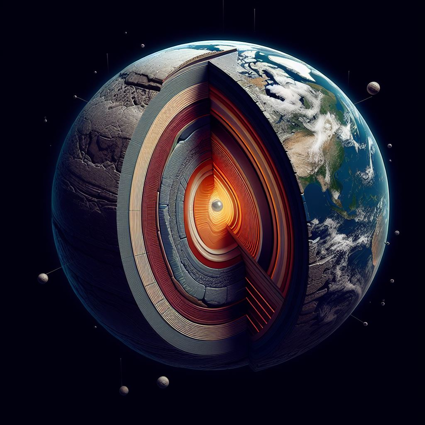
The Earth has a concentric structure that is divided into the crust, mantle and core, based on its chemical composition and characteristics of the rock. Together, the crust and the upper part of the mantle form a solid, cold, outer mechanical layer, called the lithosphere, which is broken into a series of large and smaller sections that form the lithospheric (or tectonic) plates which are in constant relative movement.
