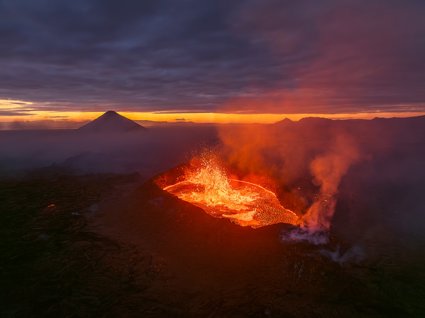
Processes at plate margins
Given that not all tectonic events happen at all plate margins, the relationship between continental and oceanic plates also must be considered. The table below details what happens at each plate boundary with a link to an animation that demonstrates the movement at the plate boundary in detail.
|
Convergent (destructive) plate margin |
||
|
Name (with video link) |
Description |
Examples of where to find them |
|
At converging oceanic and continental plate boundaries, the denser oceanic plate is pulled beneath the continental plate, in a process called subduction. This is driven by slab pull forces. This process forms a deep ocean trench at the edge of the continental plate and can generate earthquakes from friction and from the subsequent release of pressure. The water held in the subducting plate heats up. This causes the mantle above to melt forming magma. This magma, upon reaching the surface, releases gases and may cause volcanic eruptions. The explosiveness, and in-turn hazardousness, of the volcano depends on the viscosity (a fluid’s resistance to flow) of the magma erupting. |
Nazca and South American plate. Láscar volcano in Chile. Last erupted 1993. |
|
|
In most cases, these colliding plates are of similar density and so, when such plates meet, neither subducts. Instead, these plates crumple, pushing the Earth’s crust upwards creating fold mountains. As they push together, pressure builds up and is released in the form of earthquakes. Volcanoes do not tend to occur at this boundary as the compressed crust is too thick. |
Indian and Eurasian plate. Himalayan mountains are examples of fold mountains. Gorkha earthquake in Nepal, 2015. |
|
|
|
When two oceanic plates converge, the denser and cooler of the two subducts beneath the other. During subduction, and because of the curvature of the Earth, a semi-circular chain of volcanoes is formed on the overlying plate; we call this an island arc. A similar process to subduction zones takes place here generating earthquakes under the sea, and explosive volcanic eruptions. |
Pacific and Philippine Sea plate. Mariana trench. |
|
Divergent (constructive) plate margin |
||
|
|
As the cold, denser plate is pulled under at a subduction zone, it pulls the whole plate sideways, including the remainder at the surface. This creates tension at other parts of the plate making areas thinner. As the plates continue to pull apart, the area between depresses, and sometimes cracks and sinks, creating a rift valley. Magma forms in the mantle as it partially melts and injects itself into the thinner area of the plate, forming volcanoes in some parts and therefore, a new part of the plate. The magma moves upwards to form a ridge. If the rift valley is filled with ocean water, this raised area will create a mid-oceanic ridge. |
The African Rift Valley is an example prior to flooding with ocean water. The Mid-Atlantic Ridge is a more mature example, with the rift valley long gone (and now the Atlantic). Iceland is a landmass atop of the ridge created by repeated volcanic activity. |
|
Transform (conservative) plate margin |
||
|
|
Transform margins happen when plates move past each other. This can either be in opposite directions or in the same direction but at different speeds. Their passing is not smooth and therefore pressure builds up when they get stuck. The release of this pressure generates earthquakes. |
North American and Pacific plates. San Andreas fault in California. |