The Arctic: Heatwaves and habitat destruction
Where is the Arctic?
The Arctic is defined by the Arctic circle which wraps around the world at 66.5° north of the equator. It is the northernmost region of the Earth with the North Pole at its centre. Contrary to what some people mistakenly believe, the Arctic is not a continent – there is no land at the North Pole – it is a frozen wilderness of sea ice. Worldwide it is estimated that there is a glacierised area of 726,000 km2 with the Arctic holding 44% of that total (Dr Bethan Davies). It is therefore an incredibly important part of the cryosphere. Eight countries are found within the Arctic circle: the US (Alaska), Russia, Finland, Sweden, Norway, Canada, Denmark (Greenland) and Iceland. This zone is called a polar region.
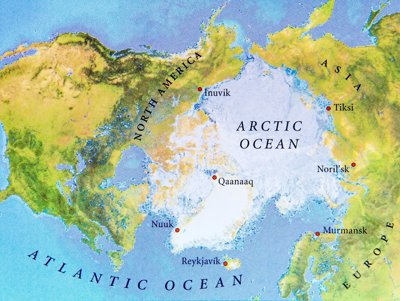
The map below shows the nearest major cities to the North Pole: Qaanaaq ‘the city on top of the world’ and the capital Nuuk – both in Greenland, Inuvik the major Inuit city of the Northwest Territories, Reykjavík the capital of Iceland, Murmansk the major Russian fishing port, Norilsk the home of Norilsk Nickel – the world’s leading producer of nickel and palladium and Tiksi the old Soviet town with no land connection and fierce Arctic winters.
At present there are only 4 million people living in the Arctic, but this number is predicted to rise throughout the twenty-first century as more ice melts on land and in the Arctic Ocean.
Why is the Arctic so important?
Sea ice and a deep blanket of snow in the Arctic both act to moderate the Earth’s climate. These surfaces are white and very bright, resulting in a high albedo. Roughly 80% of the sunlight that strikes sea ice is reflected back to space. In contrast dark surfaces, such as the ocean, absorb up to 90% of incoming solar radiation. Albedo is an important mechanism for the planet to maintain climatic equilibrium. In June 2020 Arctic sea ice – and therefore the Arctic albedo – was at its second lowest extent on record with roughly 1,940,000 km² less sea ice than the mean decadal amount for the 1980s (Zach Labe, atmospheric climate scientist).
Glaciers are also melting in the Arctic Circle. Glaciers that end in the ocean are called tidewater glaciers which, due to increasingly warmer saline water contact, literally ‘unzip’ causing large pieces of ice to fracture, separate or ‘calve’ forming icebergs. The rate of Arctic glacier melt is therefore steadily increasing as the glacial equilibrium tips away from accumulation towards ablation. Arctic glaciers are therefore retreating up their coastal valleys, as the balance between the amount of input versus the amount of output is switching to a sustained negative balance. This is having a particularly severe effect on Greenland which has 79% of its surface covered by ice sheets – the second largest body of ice in the world.
In general, the bigger the glacier the longer the lag for response. However, the key to Arctic glacial survival is the ice shelf. If the ice shelf disappears a greater flux of glacial ice is released into the ocean, resulting in extensive collapse of the ice sheet behind. Atmospheric change and more marine water have both caused glacial disintegration and a rapid loss of ice shelves around the world. Essentially tidewater glaciers are being melted from the top-down and bottom-up. As ice shelves start to fragment, they are also thin, and the grounding line retreats in a landward direction. The grounding line is the point at which a tidewater glacier starts to float. The retreat of such a line is significant because it can dramatically accelerate the demise of the glacier.
In July 2019, lead-author David Sutherland published research on the LeConte glacier in Alaska, identifying tidewater glaciers as melting 100 times faster than previously thought when compared to valley glaciers (National Geographic). This is largely from ‘plumes’ of more buoyant freshwater surface melt entering the fjord close to the glacier face, which it then undercuts and erodes. While Alaska has only 50 tidewater glaciers out of a total of 100,000 Greenland has around 200 outlet glaciers which are susceptible to the same dangers.
What is the jet stream?
Jet streams are fast flowing currents of air in the atmosphere with wind speeds of up to 200 miles per hour. They are often described as ‘ribbons’ because jet streams can be hundreds of miles wide. The main jet streams are the Polar Front jets and the Subtropical jets – both found in the northern and southern hemisphere. Changes to the Polar Front jets have created the 2020 Arctic heatwave. The Arctic Polar Front jet is a type of thermal wind which normally rises due to the strong temperature contrast in the mid-latitudes.
Theoretically, in the northern hemisphere high-pressure warm air would move northwards towards the cold low-pressure polar air – this process is called the Pressure Gradient Force. However, the Earth’s Coriolis Effect from the Earth’s rotation causes air to move to the right (in the northern hemisphere) in the direction of motion.
The Arctic Polar Front jet tends to be further south in the winter since the northern hemisphere tilts away from the sun. In 2020 this natural pattern was severely altered with the jet stream retreating northwards.
An excellent summary and definition of the jet streams can be found on the Met Office YouTube channel.
The heatwave
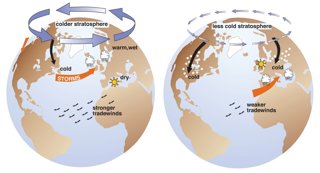
The Arctic is a meteorologically varied area as it experiences alternating warm and cold air bringing high and low pressure. Below is a diagram by Professor John Wallace, explaining the Arctic Oscillation of pressure when compared with the northern mid-latitudes. It is an opposing pattern: if the Arctic experiences high pressure – it is low in the northern mid-latitudes of North America and Europe, described as the negative phase. This pattern reverses in the positive phase of the oscillation. In 2020 the Arctic became ‘stuck’ in a positive phase creating a stable period of unusually warm weather, like a heatwave.
The positive phase of Arctic Oscillation has brought storms across the Atlantic Ocean and wet weather to places like Scotland, Alaska and Scandinavia. This movement and the unusually high temperatures in the Arctic are due to the ring of strong winds circulating around the North Pole acting to confine colder air to the upper polar region. Low pressure within the Arctic Circle has pulled warmer air northwards from the lower latitudes. This is otherwise described as a ‘northward swing of the jet stream’ which allows warmer air into the region, raising surface temperatures.
This positive pattern dominated in the 1980s and 1990s but since 1997 it has fluctuated, switching between positive and negative phases repeatedly. Despite the seesaw nature of Arctic Oscillation, the general trend has been of continued warming with a spike of both very warm and very dry weather across Siberia this year.
On Thursday 25 June 2020 it was 38°C in Siberia which shocked people around the world. The Arctic is now warming twice as fast as the global average. This is due to an increase in CO₂ emissions over time and the increasing effect of a positive feedback loop.
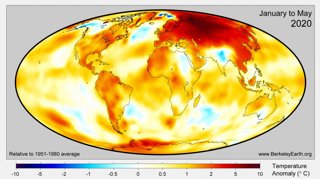
As a result of a high-pressure system moving up and over parts of the Arctic, particularly over Siberia in Russia, an extended period of exceptionally warm weather has afflicted the region. The heat map below shows high temperatures appearing over the Arctic, Antarctica, west Africa, South and Central America. Exceptionally warm weather dominates Asia.
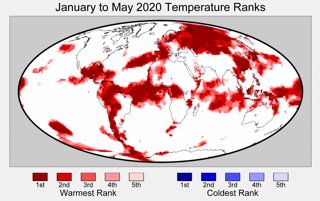
The cause of such a sudden change in climatic conditions is thought to stem from the disappearing contrast of a cold-north and the warm-south in the northern mid-latitudes, which has created a wobbling, meandering polar jet stream. Dr Tasmin Edwards explains this has meant loops might ‘break off like the oxbow lakes of school geography lessons’ stranding particular weather patterns, like the current warm one, over one particular place.’
The effects
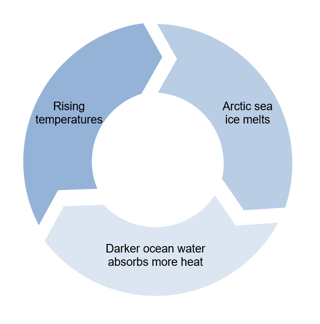
The main and most obvious effect is the dramatic loss of ice due to climate change occurring at an increasingly rapid rate. The concerning element of climate variation in the Arctic specifically is the removal of sea ice as this initiates a positive feedback loop.
Feedback loops can either enhance (positive) or nullify (negative) changes to a system. Increasingly human impact on the global climate has led to a positive feedback loop in the Arctic – a form of amplification which will ultimately become uncontrollable. Many climate scientists explain that a tipping point is approaching as current atmospheric carbon dioxide levels will now lead to future increases in CO₂. This will be a spiralling feedback loop of decreasing sea ice and increasing temperatures. This is called human-induced ‘runaway global warming’ and without mitigation, is unstoppable. Below shows a dangerous diagram of the positive feedback loop for the Arctic sea ice.
Permafrost is also melting in the Arctic. Permafrost is the permanently frozen ground which has a temperature of 0°C or colder. There is a thin top layer that melts and refreezes, called the ‘active layer’. Permafrost constitutes almost a quarter of the northern hemisphere land surface – although it is not always covered in snow. Due to climate change Arctic heatwaves are becoming more recurrent and extreme – and as a result permafrost is thawing. Thawing permafrost has several major effects which have only recently been realised.
Thawing permafrost releases carbon from organic carbon previously trapped in the ground. It is estimated that permafrost holds twice as much as the atmosphere does, a total of 1,600 gigatons. In the past, when frozen this organic carbon hasn’t been able to rot away however with increasing rates of melt microbes have begun decomposing the material. This will lead to a further increase in the emissions of greenhouse gases.
Virologists anticipate a release of ancient bacteria and viruses from the increasing exposure of previously frozen soil. Scientists have already discovered microbes more than 400,000 years old in permafrost. There is serious concern about new viruses and increased human and animal activity in areas that have long been sparsely populated. In 2016 for example thousands of reindeer succumbed to a bacterial outbreak of anthrax within the Arctic Circle.
Finally, structural damage to buildings is increasing throughout the Arctic as many northern villages and towns succumb to ground movement and collapse. Roads, telegraphs poles, buildings and electricity pylons are just some of the examples of damaged infrastructure from melting permafrost. In a region which has many months of total darkness and extreme temperatures from not receiving direct sunlight this can have serious knock-on consequences for isolated inhabitants.
In summary
Wired reported 6 things you should know about the 2020 Arctic heatwave:
-
The Arctic is facing its highest-ever temperatures
-
Arctic sea ice hit its second-lowest recorded level in 2019
-
The Arctic is heating at more than twice the rate of the rest of the globe
-
Melting sea ice triggers even more warming
-
‘Zombie fires’ might be smouldering under the snow
-
Melting permafrost could release huge amounts of methane into the atmosphere
The Arctic is an ocean surrounded by land, therefore it is very vulnerable to warming. Scientists now agree the effects of climate change will be felt faster and more acutely in the Arctic than anywhere else in the world. Unlike Antarctica, which sits on a frozen continental landmass, the Arctic does not have high altitude mountains or deep ice sheets with high elevations (creating exceptionally cold temperatures at the south pole).
The effects of climate change will have devastating consequences for the Arctic dynamic equilibrium. A global temperature increase leads to rising oceanic temperatures causing sea ice melt and ultimately more dissolved CO₂ being released by the ocean. This will have geopolitical significance as new sea routes open through the Arctic Ocean, heralding huge changes to the inhabitants of the Arctic.
Further reading
A photo essay by Elena Chernyshova of Norilsk
Twitter graphic from @m_parrington
Siberian heatwave: why the Arctic is warming so much faster than the rest of the world
Arctic Circle sees ‘highest ever’ recorded temperatures
Tasmin Edwards. The Arctic heatwave: here’s what we know
Parts of Siberia are hotter than Washington, with temperatures nearly 40 degrees above average
Six facts that show how bad the record-breaking Arctic heatwave is
Climate change made the Siberian heatwave 600 times more likely
- Case study
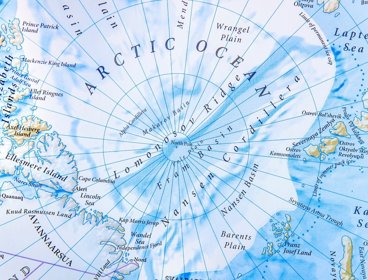
Climate change and the Russian Arctic
Activities focused on Climate change and the Russian Arctic developed with University of Birmingham and WWF
- Resource
Discovering the Arctic
A guided tour across the top of the world - refreshed for 2025
- Article
Arctic Governance and the Arctic Council
There are approximately 4 million people living in Arctic circumpolar region, around 10% are Indigenous. In this teaching resource, we will examine how the Arctic is governed, and how the Arctic Council functions in light of global geopolitics.
This resource was first published in 2020.