
The World Cup in Qatar: what is the Kafala system?
The specification
AQA A Level 3.2.4.4 Population change. Demographic, environmental, social, economic, health and political implications of migration.
Edexcel A Level Option 8A: Health, Human Rights and Intervention. 8A.5 There are significant differences between countries in both their definitions and protection of human rights.
OCR A Level 2.2.2 Global Systems: Option B – Global Migration. 2.a. Global migration patterns are influenced by a multitude of interrelated factors.
WJEC A Level 3.2.1 to 3.2.5: Processes and Patterns of Global Migration. 3.2.2 Causes of international economic migration.
What is the Kafala system?
The Kafala system is a legal framework for employers in the Middle East to source international labour and to bring foreign economic migrants into a country. Over the past decade it has been exposed as exploitative and prone to abuse. The work is usually manual and short to medium-term, often for largescale construction projects. The physical labour is typically very hard, hence the lack of domestic uptake by the local population.
Kafala legislation provides private businesses (sponsors) with the right to use migratory labour from abroad, and gives them total control of employment, immigration status, and even physical movement. Indeed, employees are normally required to sign a ‘no-objection certificate' (NOC) to resign from their contract once they are in-country, effectively tying them to their sponsor.
Employers often use a third party or foreign subcontractor to source labourers. These workers initially borrow money for their flight and accommodation, which they then repay from their earnings
Over recent decades the Kafala system has widely been used in the Gulf states of the Middle East (Bahrain, Kuwait, Oman, Qatar, Saudi Arabia and the United Arab Emirates) to fulfil a huge labour shortage in the construction industry. It is estimated that there are over 40 million migrant workers in the Gulf, mainly from Asia and Africa, with 8 countries using the Kafala system.
Qatar
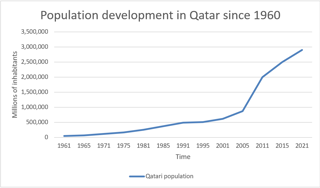
Since the year 2000 the population of Qatar has been rapidly expanding. It has swollen by a record 40% largely due to the influx of migrant labour into the construction industry. The population now stands at 2.9 million people.
|
Year |
Population 000s |
Change % |
Birth rate % |
Death rate % |
|
1961 |
50,000 |
8.53 |
41.7 |
8.9 |
|
1965 |
70,000 |
8.98 |
39.6 |
7.0 |
|
1971 |
120,000 |
9.03 |
35.5 |
5.0 |
|
1975 |
160,000 |
6.96 |
34.9 |
4.1 |
|
1981 |
250,000 |
10.89 |
34.5 |
3.1 |
|
1985 |
370,000 |
8.68 |
29.2 |
2.5 |
|
1991 |
490,000 |
2.33 |
21.8 |
2.1 |
|
1995 |
510,000 |
1.26 |
20.4 |
2.0 |
|
2001 |
620,000 |
3.81 |
18.8 |
1.9 |
|
2005 |
870,000 |
14.88 |
15.3 |
1.6 |
|
2011 |
2,000,400 |
9.67 |
10.9 |
1.2 |
|
2015 |
2,500,700 |
4.33 |
10.0 |
1.1 |
|
2021 |
2,900,300 |
1.72 |
N |
N |
Table 1 the population of Qatar source: worlddata.info
From 2010 onwards, after the announcement that Qatar would host the 2022 football World Cup, there has been a large influx of migrants. Most of these workers are from Uganda, Kenya, Pakistan, Nepal, Bangladesh, and India. They have faced extreme heat when working on the seven new stadiums of the 2022 FIFA World Cup, all around the country’s capital, Doha. An eighth building, the Khalifa International Stadium, has been extensively redeveloped (first built in 1976).
Migrant workers have worked during the day throughout the year in Qatar. In the summer, temperatures regularly reach 40 to 45°C with peak temperature sometimes being as high as 50°C. With labourers under the Kafala system feeling powerless and obliged to work long hours in manual work this has led to reports of heat stress, heat exertion, and heat stroke.
The Guardian newspaper estimates that 6,500+ migrant workers have died in Qatar since it won the right to host the World Cup (this figure is a not categorised by occupation or place of work), largely due to the country’s intense summer heat.
In 2017, after sustained criticism of the Kafala system, Qatar committed to a number of initiatives and pieces of legislation to benefit migrant labourers. They were:
-
A non-discriminatory new minimum wage
-
The domestic workers law, which stipulates how many hours can be worked, and makes daily breaks, a weekly day off, and paid holiday mandatory
-
A committee for the settlement of labour disputes, to enhance judicial access for workers
-
Ending the NOC requirement for workers who wish to change jobs or leave Qatar
-
A fund to support payment of unpaid wages
-
A ratification of the International Covenant on Civil and Political Rights (ICCPR) and the International Covenant on Economic, Social and Cultural Rights (ICESCR) which should oblige Qatar to respect and protect the rights of everybody within its territory, without discrimination
A NOC is now not required to change jobs however many workers still report requests to provide one when they attempt to change employment. The ability to move is therefore still restricted for many people in Qatar. Movement, and the freedom to choose your employer, are vital for workers to avoid abusive circumstances.
While leaving the country has been made easier, in practice migrant workers are still reporting multiple hurdles like passport confiscation and retaliatory measures such as cancelling visas or sponsors filing absconding reports.
Migration
Multiple changes in the 21st century have increased the complexity of global migration. For example, new environmental hazards from climate change, such as drought and water risk, have led to environmental migration. While the key driving forces behind immigration are still categorised as environmental, social, and economic, the simple “push-pull” migration model (which assumes a simple linear relationship between the environment and movement) is outdated.
There are many reasons why some choose to migrate, some of which overlap and interconnect. The social influences of conflict, declining agricultural production, and low employment run parallel to the psychosocial reasoning of an individual’s intentions, perception of benefits and barriers, cues to action, self-efficacy, and the perceived threat to living conditions. Interwoven with environmental stress and social influences are economic drivers. It is these economic drivers, of better pay and improved living standards, which are commonly cited as reasons for migration.
It is, therefore, best to consider migration as a complex interplay between different environmental-societal factors which some academics call the “poverty-climate-migration nexus”.
Sri Lankan workers are an example of a migratory workforce. Sri Lankans have suffered from extreme economic hardship in 2022, due to an unstable government and poor leadership. Sri Lanka has defaulted on debt repayments this year and is struggling to attract foreign investment from a combination of COVID-19 (reducing visitor numbers) and economic mismanagement. One consequence has been an inability to buy key imports, such as agricultural fertiliser. In 2021 this led to declining agricultural production and widespread crop failure forcing many farmers to migrate and look for construction work in places like Qatar.
Economic globalisation has led to the emergence of new source areas of labour and new host destinations. Indian has the largest number of migrants living abroad of any country in the world. Many of whom left due to the perceived benefits of foreign employment in places like Qatar. Whilst the Indian government has lifted millions out of poverty, with the Indian middle class recently growing by 400 million, low standards of living persist in rural areas where 65% of the country still live. Across India 10% of the population still earn less than $2.15 per day (~130,000,000 people).
The Indian Multidimensional Poverty Index rank (MPI) by Niti Aayog (the government public policy think tank) finds the highest levels of poverty in rural Bihar, Jharkhand, and Uttar Pradesh. The main industries of these states are agriculture, mineral extraction, and livestock respectively. All three states are constrained by small landholdings and insufficient invest in technology, leading to outmigration. In contrast, rapid development across the Gulf has created a polarisation in wealth between the Gulf states and the Indian subcontinent which has encouraged Indian (and Nepali, Bangladeshi and Pakistani) workers to migrate in search of a better job, regular income, and the ability to support family back home, via remittances.
Is the FIFA World Cup in Qatar sustainable?
No, it is not. When addressing COP26 the FIFA President Gianni Infantino controversially claimed the Qatar World Cup would be carbon neutral. Overall, the tournament is certainly not carbon neutral because visitors have booked accommodation as far away as Muscat in Oman and Dubai in the UAE (with the intention to fly into the small host country for the tournament). The statement has been reported as disingenuous because the calculation does not consider the 12-year build-up of construction (involving lorries, cranes, diggers, sand, cement and steel). Nor does the commitment acknowledge the only viable way into and out of the country (for the majority of people) being air travel which is dominated by the tournament sponsor, Qatar Airways.
In response to the FIFA President’s claim a Reuters article stressed the high level of resource-consumption to deliver the tournament:
An elite corps of groundskeepers now maintains 144 green, lush fields – eight stadium pitches and 136 training grounds. They blast chilled air through nozzles directly at the turf, tending luxuriant patches of green dotted amid the dun or grey of Qatar’s desert and concrete. Qatar flies in 140 tonnes of grass seed annually from the United States on climate-controlled aircraft and pitches are watered with desalinated seawater, in an energy-intensive process burning the country’s wealth of natural gas. Each pitch requires 10,000 litres of desalinated water daily in winter and 50,000 litres in the summer.
Andrew Mills
However, once spectators and players are in Qatar, they will find the tournament has been designed around the concept of sustainability with all 8 stadiums lying within 21 miles of the capital, Doha, in a compact design linked by metro and tram services. Some stadiums will be powered by solar panels and all bar one (the Khalifia International Stadium) will be dismantled for the site to be reused and repurposed as hotels, community spaces or smaller sporting venues.

Activity
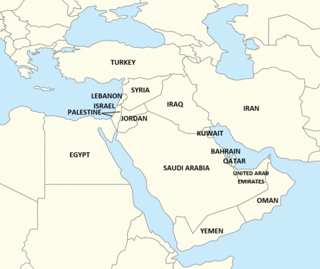
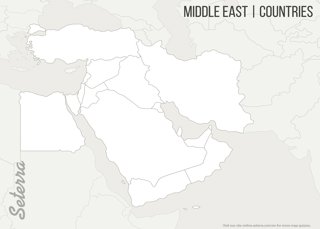
1. List the countries of the Middle East and the Gulf states within the region. Annotate map 1 in Appendix A.
2. Annotate onto your map which Middle Eastern countries are using the Kafala system.
3. Using Table 1, draw a line graph for the population of Qatar.
4. Draw a climate graph for Doha using Table 2.
|
|
Jan |
Feb |
Mar |
Apr |
May |
Jun |
Jul |
Aug |
Sep |
Oct |
Nov |
Dec |
|
Av. temp °C |
17.7 |
18.8 |
22.2 |
26.9 |
32.1 |
34.2 |
35.4 |
35.2 |
33.1 |
29.8 |
24.7 |
19.7 |
|
Min temp °C |
13.7 |
14.4 |
16.9 |
21.2 |
25.8 |
27.7 |
29.3 |
29.3 |
27.2 |
24.3 |
20.5 |
15.9 |
|
Max temp °C |
21.7 |
23.4 |
27.3 |
32.3 |
37.8 |
40.1 |
41 |
40.7 |
38.7 |
35.1 |
28.8 |
23.6 |
|
Rainfall mm |
12 |
12 |
12 |
4 |
0 |
0 |
0 |
0 |
0 |
0 |
7 |
15 |
|
Humidity % |
65 |
60 |
51 |
45 |
38 |
38 |
44 |
53 |
53 |
56 |
60 |
67 |
|
Av. sun hrs |
8.9 |
9.8 |
10.7 |
11.4 |
12.0 |
12.3 |
12.1 |
11.6 |
10.9 |
10.1 |
9.5 |
8.7 |
Table 2 weather by month for Doha, Qatar source: en-climate-data.org
5. Using your graph from question 4 explain the meteorological problem facing this football tournament.
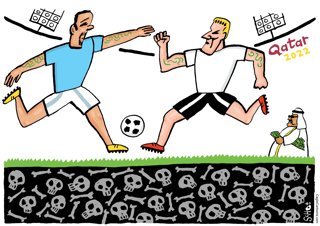
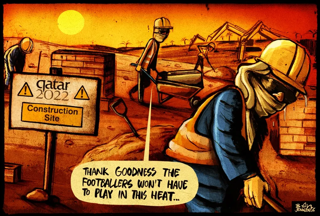
6. Study Appendix B. What are the messages about the FIFA 2022 world cup in Qatar?
7. What are the reasons to celebrate this World Cup?
Further reading
-
Council on Foreign Relations What Is the Kafala System?
-
DW Business Beyond FIFA World Cup worker deaths: Is Qatar making good on its promise to change?
-
Business and Human Rights Resource Centre Qatar: Population of migrant workers swells to 2.1 million ahead of 2022 FIFA World Cup
-
Harvard Kennedy School The Incredible Development of the Gulf States
-
BBC News World Cup 2022: A guide to the eight World Cup stadiums in Qatar
-
The Guardian Revealed: 6,500 migrant workers have died in Qatar since World Cup awarded
-
European Parliament News Exploring migration causes – why people migrate
-
IOP Science Global migration is driven by the complex interplay between environmental and social factors
-
Wiley International Migration Psychosocial Factors of Migration: Adaptation and Application of the Health Belief Model
-
BBC News Sri Lanka: Why is the country in an economic crisis?
-
France24 ‘Just hell’: New book shines light on migrant deaths ahead of Qatar World Cup
-
The Guardian Will Qatar really produce ‘the first carbon-neutral World Cup in history’?
-
The Telegraph Qatar World Cup stadiums: Your guide to the eight venues
-
Reuters Qatar's World Cup turf needs chilled stadiums, desalinated water to thrive
Answers
1. The Gulf economies of the Middle East are: Bahrain, Kuwait, Oman, Qatar, Saudi Arabia and the United Arab Emirates. The countries of the Middle East are labelled below.
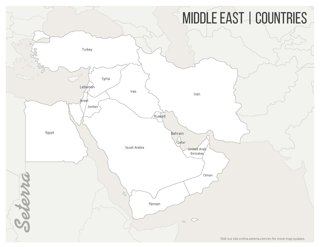
2. The Kafala system is used by many employers in Jordan, Lebanon, and all Arab Gulf states bar Iraq.
3. The population of Qatar is graphed below.
4. Doha’s climate graph is shown below.
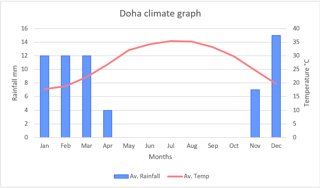
5. The meteorological problem facing the FIFA World Cup in 2022 is extreme heat. Qatar is classified as a desert and is a country which receives less than 250mm or rainfall per year. Normally the World Cup is played in June or July, but it has been moved to November to avoid the worst heat of the year. In spite of this, the expected temperature at the time of the finals will still be ~25°C and will be played in the evening 6pm local time. (If the tournament had been played in the usual summer window matches would have been played in 40°C+ heat). There is widespread concern not only about players but also traveling spectators socialising in desert heat.
6. Figure 3 shows football players playing a match above a burial site. It implies that construction workers have died constructing the football World Cup stadiums in Qatar. It is an evocative image, particular as an unidentified man is counting dollar bills in the background suggesting some people have become very rich from hosting the tournament. Figure 4 focuses on heat stress. In a satirical manner, the workers are thankful that football players do not have to endure the high summer temperatures that they have suffered. The cartoon implies that a footballer’s life is more valuable than a construction worker.
7. There are some reasons to celebrate the World Cup being held in Qatar. It is the first time an Arab nation has hosted the football tournament, which is a sign of the sport spreading into new territory. In the short-term more than 1 million visitors are expected to arrive for the tournament, which will provide a huge boost to Qatari tourism and hospitality. It will generate approximately $17 billion for Qatar with long-term foreign investment expected to flow into the country. This will bring both soft power and political influence between the Arab and Western world. If the World Cup is a success the overall reputation of the Gulf states will be enhanced. There has been significant spending on infrastructural projects. Regional cooperation has occurred with, for example, Pakistan providing security for the event by sending troops to assist with event security.


This resource was first published in 2022.