GCSE Specification links
AQA
3.2.2 The place of the UK in the wider world. Links through trade, culture, transport, and electronic communication. Economic and political links: the European Union (EU) and Commonwealth.
EDEXCEL B
5.2 The UK economy and society is increasingly linked and shaped by the wider world.
Eduqas B
1.3.2 What are the global processes that connect countries at different levels of development including the UK?
1.3.3(d) What are the causes and consequences of uneven development?
OCR A
1.2.1 The UK is connected to many other countries and places.
1.2.2 The UK is a diverse and unequal society which has geographical patterns.
OCR B
7.2 Is the UK losing its global significance?
WJEC & Eduqas B
2.3.3 How are global cities connected?
Key terminology
Trade: an exchange of goods and services.
UN Security council: a group of fifteen nations consisting of five permanent members: US, France, Russia, China and the UK and ten additional non-members with the main focus to maintain international peace and security.
FDI (Foreign Direct Investment): investment from organisations and / or individuals in a venture outside of their country. E.g. investment in infrastructure to support a new factory.
G7: considered as the top seven most economically advanced countries who meet annually to discuss global economic issues.
G20: a group of twenty of the most economically developed countries who between them hold over 80% of the World’s GDP and over 75% of global trade.
Transport hub: a central point for transport both in and out of the area.
Diaspora: people who do not live in their own country but continue to maintain some or all of their heritage in their new place.
Enclaves: areas with dominance of a particular heritage group. For example, Chinatown in London.
PISA Score: PISA is the OECD's Programme for International Student Assessment. PISA measures 15-year-olds’ ability to use their reading, mathematics and science knowledge and skills to meet real-life challenges.
Introduction
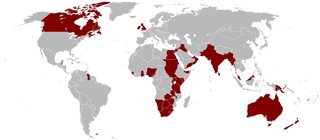
Despite being a relatively small nation, the UK is an influential player on the international stage. Largely as a result of its former colonial power, it has significantly shaped international affairs through exploration, trade and diplomacy. The imprint of its historical footprint is still evident today with enduring connections maintained with various regions around the world.
Connections through trade
The UK became part of the EC (European Community) in 1973 which later turned into the EU Trade Bloc. It stayed part of the Union until 2020 and benefitted from the fluidity of the bloc. During this time, the UK also had trade agreements with various other nations through its global connections. In July 2023, the UK became the first new member of the Comprehensive and Progressive Agreement for Trans-Pacific Partnership (CPTPP) strengthening ties with the UK and other countries across the Pacific.
According to Ststista.com, the UK’s GDP per capita in 2024 is forecasted to be $52,790 (£41,833). It has historically had a trade deficit, importing more than it exports. In 2023, the overall trade deficit was £37 billion (UK Parliament). Although this looks bad, the UK actually makes up its money through FDI into the country. In addition, the UK was ranked 5th in the world of global exports and 4th for global imports in 2022 (UK Parliament). Establishing new and nurturing existing trading connections is essential to the role the UK has with the wider world.
|
Top 6 UK exported goods |
Value (£ billion) |
Top 6 UK imported goods |
Value (£ billion) |
|
Cars |
36.6 |
Cars |
40.2 |
|
Mechanical power generators (intermediate) |
34.5 |
Refined oil |
28.2 |
|
Medicinal and pharmaceutical products |
26.1 |
Crude oil |
26.6 |
|
Crude oil |
19.8 |
Mechanical power generators (intermediate) |
26.4 |
|
Unspecified goods |
18.7 |
Medicinal and pharmaceutical products |
25.4 |
|
Refined oil |
12.0 |
Miscellaneous electrical goods (intermediate) |
21.2 |
Figure 3: Total value of UK imported and exported goods. Source: ONS
Transport and communications
The UK’s location and historical connections makes it an ideal transport hub. With its close proximity to Europe and North America and a range of airlines servicing most of the UK’s major airports, passengers can get to most parts of the world easily. For example, as of February 2024, London’s Heathrow airport is the 2nd busiest airport based on international flights (www.oag.com) with a capacity of 3.6 million seats and flying to 232 destinations.
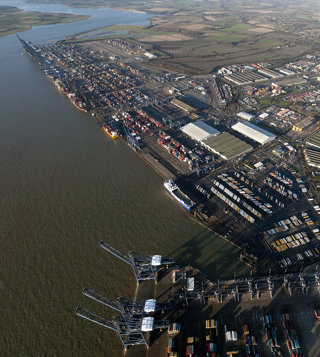
As an island with a long sea trade history and an abundance of natural harbours, the UK utilises its ports to transport goods in and out of the country. The top five ports handle between 500,000 and 4 million TEUs (twenty-foot equivalent units) per year from across the globe. In turn, these ports have a wide range of road and rail networks to ensure that the goods get to their destinations swiftly.
Since the construction of the Channel Tunnel in 1994, the UK can connect by rail to mainland Europe. Eurostar, a passenger train service which uses the Tunnel connects London with major cities in France, The Netherlands, Belgium and Germany. With average travel times of two and a half hours from London to Paris, it offers an alternative to air travel. In 2023, Eurostar announced that its passenger numbers for that year reached 18.9 million (theguardian.com). Additionally, Le Shuttle, the Tunnel’s vehicle passenger and freight service running from Folkstone in Kent to Calais in France handles approximately 1.5 million freight trucks every year between the UK and Europe. Since its completion in the 90’s, Le Shuttle states that they have transported ‘100 million vehicles and nearly 500 million people through the Channel Tunnel’ (Eurotunnel.com)
Global society
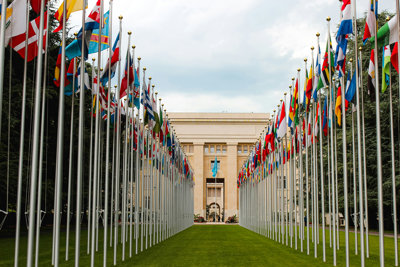
The UK maintains a pivotal role in shaping international decisions. For example, it is a permanent member of the UN Security Council which, along with four other nations, is at the forefront of influence in international policy. Additionally, the UK is part of the G7 and G20 which commit to international collaboration.
Rooted in its colonial past, the UK is part of the Commonwealth of 56 nations; King Charles III proceeded his mother – Queen Elizabeth II as its head. In addition, the Monarch is Head of State of 15 Commonwealth realms. Today, the group is a voluntary association of nations at various levels of economic development and largely consists of countries that were under British rule before independence. The Commonwealth has an extensive reach to over one-third of the global population, with meetings being held to find methods of promoting social, economic and environmental development in its member nations. For example, Commonwealth trade experts are currently working with 18 countries in the Caribbean, East Africa and Sri Lanka to improve their trading capabilities and establish economic development through stronger trade links.
The English language is spoken by approximately 1.5 million people (2023, Statista), giving it widespread influence. It is the most spoken language around the world and the biggest trading language. Therefore, its influence stretches far beyond the shores of the UK. The UK’s television exports accounted for £1.85bn in 2023 (Producers Alliance for Cinema and Television (PACT)) not to mention other forms of art such as music and literature, which allows the UK to have far reaching cultural influence.
According to Times Higher Education, in 2023, three of the top ten global universities reside in the UK with Oxford and Cambridge ranking number one and three respectively. In addition, all three of these universities have more international students than any other of the top ten. The British education system is recognised as one of the top in the world ranking 11th in the OECD’s PISA score in 2022. With the perception of a multicultural educational community and well regarded curriculum, the UK can still hold its own on the international stage.
Although a predominantly white community, the ethnic mix in England and Wales stands at 82% white, and 18% Black, Asian, mixed or other ethnic group (2021 Census data). This percentage varies in different parts of the country usually due to diaspora groups gathering in enclaves in urban areas. Having areas in the UK with the population from different heritages encourages connections to the wider world through the sharing of common culture.
|
Area name / % ethnic group |
Asian, Asian British, Asian Welsh: Indian |
Asian, Asian British, Asian Welsh: Pakistani |
Asian, Asian British, Asian Welsh: Bangladeshi |
Black, Black British, Black Welsh: African |
Black, Black British, Black Welsh: Caribbean |
Mixed or multiple ethnic groups |
White: English, Welsh, Scottish, Northern Irish or British |
White: Other (including Arab) |
|
Blackpool |
1 |
0 |
0 |
0 |
0 |
2 |
90 |
4 |
|
Plymouth |
1 |
0 |
0 |
1 |
0 |
2 |
90 |
5 |
|
Slough |
19 |
22 |
1 |
5 |
2 |
4 |
24 |
12 |
|
Colchester |
2 |
0 |
0 |
3 |
1 |
3 |
81 |
6 |
|
Guildford |
2 |
1 |
0 |
1 |
0 |
3 |
77 |
10 |
|
Newcastle |
2 |
3 |
2 |
3 |
0 |
2 |
75 |
5 |
|
Birmingham |
6 |
17 |
4 |
6 |
4 |
5 |
43 |
6 |
|
Croydon |
8 |
4 |
1 |
10 |
9 |
8 |
37 |
11 |
|
Hillingdon |
19 |
5 |
1 |
5 |
2 |
4 |
37 |
11 |
|
Kensington & Chelsea |
2 |
1 |
1 |
5 |
2 |
7 |
33 |
31 |
|
Newham |
11 |
9 |
16 |
12 |
4 |
5 |
15 |
16 |
|
Wrexham |
0 |
0 |
0 |
1 |
0 |
1 |
91 |
5 |
|
Cardiff |
2 |
2 |
2 |
3 |
0 |
4 |
74 |
6 |
Figure 5: UK population by area as a % of ethnicity adapted from ONS, 2021
Further reading
ONS statistics on UK trade 2023
Suggested learning activities
1. Organise a class discussion about how Empire played a role in the UK’s international identity.
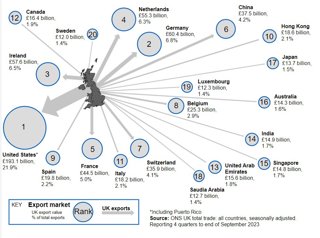
2. Describe the distribution of UK exports from the map in Figure 2. Explain why trade is important in connecting with the wider world.
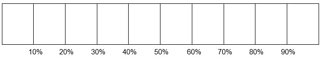
3. Geographical skill: create a divided bar (compound) graph to represent either the top imported or the top exported goods in the UK from Figure.3. You can do this by:
a. Converting the raw values into percentages by calculating the total value then dividing each good by the total and multiplying it by 100.
b. Starting with the highest value first, plot how far up the axis it should go. Draw a line to show where it is. Make sure this either has a code (colour or pattern) with a key or the name of the goods is written in the bar. Follow that by adding on the next value and the next until your bar is completed.
You could watch this instructional video to help you in creating a divided bar graph.
c. Analyse the data from the UK imports to exports.
Challenge: Why do you think the UK imports and exports similar goods?
4. Have a look at the interactive map showing flight destinations from Heathrow airport. Describe the distribution of flights and explain why airports make the UK an international transport hub.
5. Annotate the aerial photograph in Figure 4 to identify the different types of land use and transport that can be found there. Make sure you explain your reasoning in your annotations.
6. How many named examples of cultural influences from the UK can you think of? List them with examples where possible.
7. Explain how cultural influences keeps the UK an active player on the world stage?
8. Geographical skills: Using the data in Figure 5, create a series of radar graphs to compare the ethic mix in different places in the UK. Explain why this links to the UK and the wider world.
Challenge: What other data would be useful to add to ethnicity which isn’t already added? Explain your reasoning.
File nameFiles
File type
Size
Download
This resource was first published in 2024.