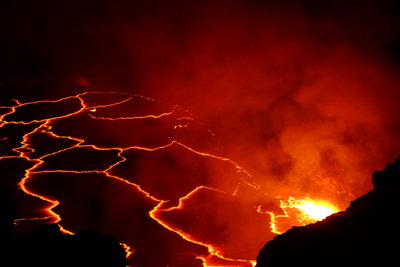
What are natural hazards?
GCSE Specification links
AQA
3.1.1.1. Natural Hazards: Natural hazards pose major risks to people and property.
Edexcel A & B
There is no direct link to the specification. However, this could be used as an introduction to Topic 2: Weather hazards and climate change (A) and Topic 1 Hazardous Earth (B) so that pupils have an understanding of hazards as a concept.
Eduqas A and WJEC
There is no direct link to the specification. However, this could be used as an introduction to Theme 3 (Tectonic Landscapes and Hazards) or Theme 4 (Coastal Hazards and their Management) so that pupils have an understanding of hazards as a concept.
OCR B
There is no direct link to the specification. However, this could be used as an introduction to Topic 1 – Global Hazards so that pupils have an understanding of hazards as a concept.
Key terminology
Natural Hazards
Extreme events created by nature which could impact human health, disruption to activities, damage to property and potentially loss of life.
Natural Event
An extreme event which has been created by nature.
Hazard risk
How likely a natural event will have an impact on humans in one form or another.
Vulnerability
The potential for humans to be harmed or impacted by natural events.
Types of hazard
Natural hazards are extreme events created by nature which have a social and/or economic impact on humans. For example, human health, disruption to activities, damage to property and potentially loss of life.
Natural events can be classified into many different categories some of which are defined below.
Geological
These events are triggered by the movement of the Earth’s plates.
Geomorphological
Events which are influenced by the movement of the landscape.
Atmospheric (including climatic and meteorological)
Events which happen as a result of changes in the atmosphere.
Hydrological
Events which happen as a result of water on the land.
Biological
Events which are as a result of living things.
Hazard risk
Hazards are influenced by whether or not a natural event will affect humans. This is called hazard risk.
The hazard risk increases if the vulnerability of the population is high and the exposure to the natural even is frequent. For example, if a population lived on a flood plain which regularly flooded and had poorly-built homes then they would have high risk. Conversely, if a population lived along a river which had flood management systems and it didn’t flood as frequently, the risk would be low.
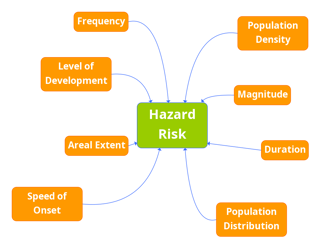
There are many factors which influence hazard risk. Some of these are detailed below.
Example of a natural hazard - Jishishan county Earthquake, December 2023
A 6.2 magnitude earthquake struck Jishishan county near the border of Gansu and Qinghai provinces just before Midnight on Monday 18 December 2023. More than 150 homes were damages or destroyed in the quake according to local media.
Several strong aftershocks were felt in the area triggering mud and landslides, damaging power lines and other local infrastructure.
It is thought that at least 134 people were killed in north-western Gansu province and neighbouring Qinghai. Due to the altitude, this area of China experiences severely low temperatures with -16oC which limited rescue efforts.
Over 4000 people, from firefighters to medics, were part of the rescue efforts and treating those who had been injured. 78 people had been rescued in Gansu but 20 people were still missing from two villages, where a mudslide swept through, half-burying many buildings in brown silt.
(adapted from article by Helen Davidson, 20 December 2023, www.theguardian.com)
Suggested learning activities
1. As pupils enter the classroom and settle for their learning, project the image of news headlines showing different natural hazards. Prompt them to consider what the lesson is going to be about. Use questioning to get them thinking about how to define a natural hazard. A challenging option could be to compare a natural event to a natural hazard.
2. Pupils can copy the definition of natural hazards into their notes, highlight key terms in a pre-printed definition and write their own definition based on the discussion from learning suggestion 1.
3. Hand out definitions of the types of hazards along with the set of images of natural events. Pupils work in groups to sort the images under their appropriate categories. Challenge them with questions about crossover categories and/or any categories they feel should be in the classifications that are not there.
4. Pupils could use the example of a natural hazard to create a hazard event profile using the factors affecting hazard risk in Figure 1.
5. Hand out additional information on the factors which affect hazard risk. In small groups, pupils create a short verbal presentation based on the information given. Pupils should complete notes on their risk factor in their preferred learning style (i.e. mind maps, tables etc). Pupils swap their knowledge of their factor with their peers, by having quick discussions and moving to speak to others, until all factors are covered. They then need to add to their own notes to have an understanding of each factor.
6. Annotate the spider diagram to develop into a mind map to explain how each factor can create a natural hazard. A challenging task could be to classify the factors into social and economic.
7. Data skills: pupils could go onto Our World in Data and can analyse data to look at areas of the world which are affected by different (or all) natural hazards. There are various filters and presentation formats for pupils to be able to look at to provide them with a picture of different hazardous zones.
8. Annotate the article to identify the different factors making it a natural hazard rather than a natural event.
Further reading
Full article on the Gansu Earthquake, Helen Davidson, the Guardian, 2023
- Case study

New Zealand floods
One of the worst flood events to strike New Zealand occurred on 27 January 2023, with prolonged rainfall causing unprecedented flooding
- Case Study

Australian wildfires
In Australia, the 2019/2020 fire season has seen abnormally high temperatures and vast wildfires
- Interactive

Am I a global citizen? Areas at risk from natural hazards
An interactive resource looking at areas at risk from natural hazards

John Kreft - Senior Analyst Natural Hazards
John Kreft is a Senior Analyst Natural Hazards at WSP based in New Zealand
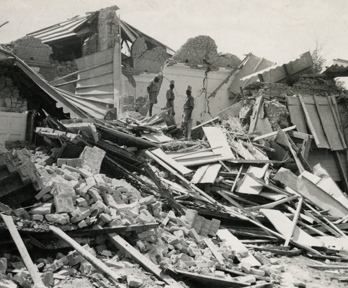
Natural hazards and empire
An exploration of how natural hazards were studied and experienced under the conditions of empire, drawing on examples from the Society's Collections.

I am a geographer
Meet geographers working across a range of sectors and hear about the careers their geography degree led to.
File nameFiles
File type
Size
Download
This resource was first published in 2024.