Celebrating this year's Esmond B. Martin Prize recipients
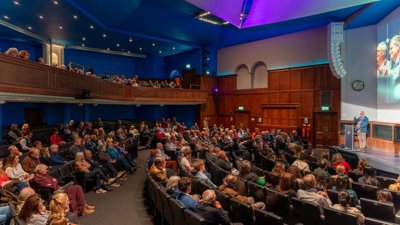
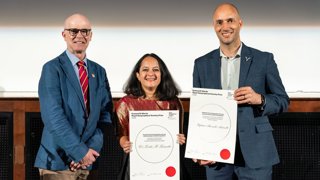
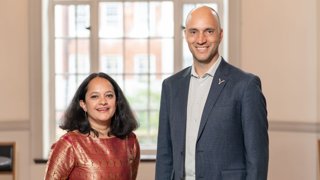
Last Monday, we held the prizegiving ceremony for our 2026 Esmond B. Martin Prize with talks presented by this year’s two awardees.
Dr Krithi K. Karanth leads the Centre for Wildlife Studies (CWS), one of India’s foremost international centres for scholarship, policy and public education. Professor Alexandre Antonelli is Executive Director of Science at the Royal Botanic Gardens, Kew, where he leads the work of 600 scientists across more than 100 countries.
Nature and communities
Hosted by Professor Jamie Woodward, Chair of the Esmond B. Martin selection panel this year, the two awardees delivered passionate and insightful lectures exploring why biodiversity matters, who decides what we protect, and how global science and local conservation can work together for nature and communities.
Both lectures reinforced and congregated around key areas: biodiversity matters because it supports both nature and people; conservation is not just a case of science but about community and the education of future generations is key to addressing global challenges.
Scientific research and lived experience
Both speakers were advocators of science – and although that won’t come as any surprise, the point underlined repeatedly was that lasting solutions for our planet require a combination of scientific knowledge and local lived experience.
Long term local data
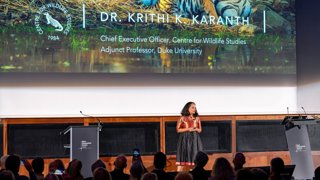
Dr Krithi K. Karanth spoke of geography in action, and outlined how long-term and local data – documenting patterns of human-wildlife conflict – can help policy makers create better preventative measures. This would protect both people and the natural world. She also called for investment in education from the earliest years, to safeguard future generations.
Krithi gave examples of how the CWS teams have worked intensively with communities in India who are experiencing human-wildlife conflict, revealing that they are not necessarily anti-conservation. Given the right tools and information, many are prepared to live alongside wildlife and are willing to look for solutions – like creating habitats for larger animals.
The best of times, the worst of times
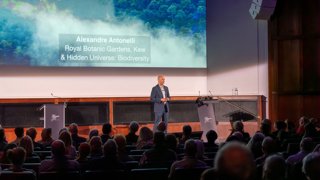
Professor Alexandre Antonelli drew the audience’s attention to a startling fact: that many species are disappearing before science has even described them – particularly in the case of plants and fungi, often overlooked and deemed not immediately ‘relatable’ to the human experience.
He spoke about the importance of broadening focus when it comes to global funding, policy and research. All too often, certain regions or species are concentrated on whilst others, frequently in the Global South, are left behind.
Alexandre and his team at the Royal Botanic Gardens, Kew are working across continents to map and name plant life and are seeing first-hand how discovery and disappearance are happening at the same time.
Biodiversity matters
Both Krithi and Alex underlined the importance of urgency suffused with hope – and the need to appreciate that biodiversity loss is not just a scientific challenge but also requires the involvement of local communities, lived experience and inclusion.
If you're a member, you can watch the recording of Krithi and Alex's talks.
- RGS news

New Chartered Geographers approved by the Society’s Council
Congratulations to the 35 Society Fellows who were recently awarded Chartered Geographer status by Council!
Wednesday 14 Oct 2026 - RGS news
Four leading conservationists and explorers to chair RGS Explore Weekend
The 2026 RGS Explore Weekend will be chaired by four leading conservationists and explorers. Read on to find out who...
Tuesday 6 Oct 2026 - RGS news
Apply now for our 2027 grants
We are now accepting applications for the 2027 grants cycle, with deadlines in November and January. Whether you’re a student, teacher or researcher, discover what’s on offer.
Monday 5 Oct 2026