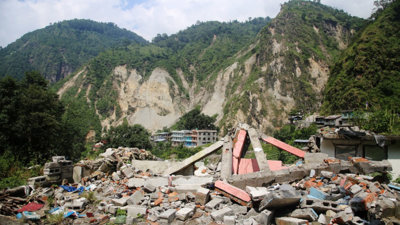
Building resilience to earthquake and landslide hazards in Nepal
Earthquakes and their associated secondary hazards, such as landslides, are a major and recurring threat to lives and infrastructure in mountainous countries like Nepal.
Whilst the shaking during an earthquake can trigger many thousands of landslides, the continuing impacts of landsliding can persist for far longer.
Approach
Early research on seismic landslides primarily looked at slope stability and the occurrence of new landslides.
However, much less attention has been given to how long these landslides remain active and even less to the hazards and risks they continue to pose post-earthquake.
To better improve this understanding and the resilience to landslides, the researchers at Durham University trained a team of specialist mappers at National Society for Earthquake Technology (NSET) Nepal to generate critical geospatial data.
Freely available satellite imagery was used to map and monitor the location and extent of all landslides in Nepal two times per year from 2014 to 2020.
Using this, researchers produced a detailed map where landslide impacts were located and scenario-based models predicting communities at risk in the future.
Impact
The research produced the only comprehensive assessment of landslides that occurred during and after the Gorkha earthquake, a dataset which has been sustained and updated ever since.
These maps helped to assess the likely scale and geography of future earthquakes impacts, which is essential for preparedness planning.
Local planning decisions have been developed drawing on this research to support vulnerable communities living in high-risk areas, incorporating the risk associated with these areas with construction and land management.
The research also led to modelling to help produce scenarios for future preparedness. These scenarios are now utilised by the United Nations, the Government of Nepal, and major international NGOs to underpin the national earthquake Emergency Response Preparedness Plan.
This provides the basis for the response to the next major earthquake.
More information
- Read the full project summary: nepal2015eq.webspace.durham.ac.uk
- Institution: Durham University
- Lead Researchers: Professor Nick Rosser and Professor Alex Densmore