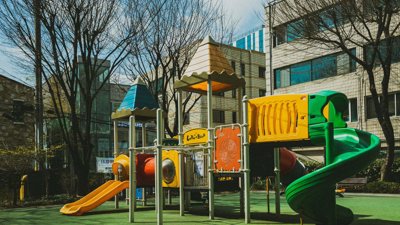
Mapping children’s access to playgrounds across England
Access to playgrounds and play areas are important to children’s health, well-being, and social development. The University of Sheffield have been investigating how access is dictated by geography and deprivation, and the inequality of provision.
Issue
Children’s playgrounds are an important component providing opportunities for children’s play. The provision of playgrounds varies considerably, with limited information available on the location of these facilities. This means that there is limited strategic planning or targeted provision.
Approach
The distribution of playgrounds across England was mapped using OS Open Greenspace to identify their locations and sizes.
The 2019 Index of Multiple Deprivation was incorporated using LSOA‑level data (each representing around 1,500 residents) to understand deprivation levels in the areas where children live near play spaces.
To assess the proximity of playgrounds to children, LSOA‑level population data for England was downloaded from Nomis, to find of the average number of children living within each area.
Impact
The study reveals that in some regions, there are five times more children per playground than others, with deprived communities often having fewer, smaller, and more distant play spaces.
The research can support local councils to better direct resources to underserved areas, guided by an evidence-based framework.
Furthermore, the work supports the creation of a National Play Strategy, offering a coordinated approach to address play inequalities and guarantee every child has the right to play.
More information
- Institution: The University of Sheffield
- Read the full study on mpdi.com