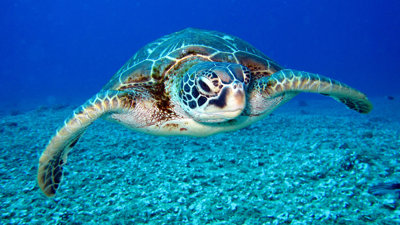
Resurgence of the green turtle
Introduction
Since the 1980s, the Green turtle has been listed as endangered on the International Union for Conservation of Nature’s Red List of Threatened Species (IUCN Red List) but finally, due to extensive conservation efforts, their numbers are growing and they have, for the first time in recent history, been categorised as ‘least concern’.
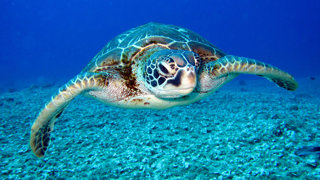
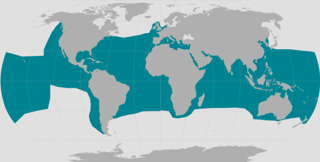
Where are the green turtles?
Green turtles can be found in over 140 different countries and nest in over 80. They live in the warmer subtropical and temperate regions of all three oceans as well as the Mediterranean Sea.
They are the largest species of sea turtle and can grow up to 1.2 metres and weigh up to 136 kg. Green turtles migrate vast distances between feeding and nesting sites – often returning to the place of their own birth area to lay eggs.
They have three main habitat areas:
Foraging grounds: shallow areas of seagrass meadows, algae rich flats, estuaries and mangrove roots.
Resting spots: sheltered coral reefs and rock ledges where they can rest with some protection from predators.
Nesting beaches: Green turtles need open, gently sloping sandy beaches to lay their eggs.
Importance and threats
Although occasionally they will eat species such as small jelly fish and discarded bait, the green turtle’s main diet is seagrass and algae making them the only herbivore turtle species.
Green turtles are an essential part of the ecosystems they inhabit. They continuously graze areas of algae and seagrass, maintaining their levels and helping them to grow at a healthy rate. This also benefits the microhabitats that thrive in these areas and form an important part of the food web for these ecosystems.
Green turtle numbers were rapidly declining due to several human factors. Their eggs were seen as a delicacy in some cultures, their meat for soups, and shells for decorative pieces for jewellery and ornaments which meant that they were hunted in their thousands. They were also caught in fishing nets or hooks and drowned. As a result, their population started to collapse, and they were listed as critically threatened by the 1980s.
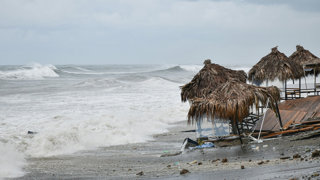
In addition, climate change has increased the temperature of the sand where eggs are laid, leading to predominantly female hatchlings and changing the ratio of the population’s gender. As well as this, sea level rise and increased severity of storms along the coastline are washing away nesting sites.
Conservation
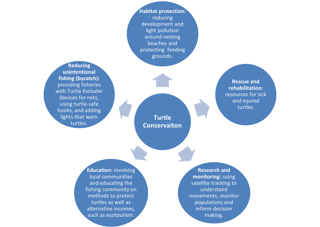
Seeing the decline of these turtles, many organisations worked to help protect and conserve their numbers. Due to the area they covered, this meant that many organisations had to work together and across international lines to ensure that the turtles were protected.
Examples of some of the conservation strategies are below:
Further reading
Green turtle bounces back from brink in conservation 'win'. BBC, October 10, 2025.
Global green turtle population rebounds thanks to conservation efforts. WWF, October 10, 2025.
Climate change could make more turtles female – but some are starting to adapt. The Conversation, February 21, 2025.
After Decades of Decline, Some Good News Is Here for Green Sea Turtles. Smithsonian Magazine, October 17, 2025.
File nameFiles
File type
Size
Download