Introduction
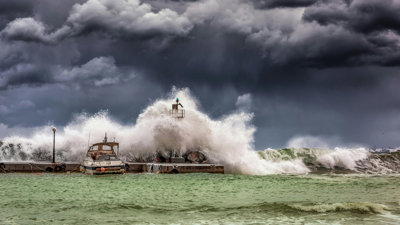
On January 8 and 9 2026, Storm Goretti, named by Météo-France (the French national meteorological and climatological service), hit the southwest of England. The storm had impacts across the UK and Ireland.
It was classed as a Multi-Hazardous Event due to the associated wind speeds, snowfall and rainfall. This article mainly focuses on Storm Goretti, but it also acknowledges two other storms which hit the region in close succession: Storms Ingrid and Chandra.
Causes
Storm Goretti was a low-pressure system which formed in the Atlantic and built in intensity as it moved towards the region.
The low-pressure depression produced winds of up to 159kph (99mph) – representing the strongest wind speeds recorded in the far southwest of England for 47 years.
As a result, the Met Office issued a rare red weather warning (danger to life, take action).
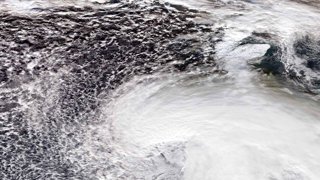
The storm was identified as a weather bomb – a system which rapidly drops in air pressure. In Goretti’s case, the pressure dropped by 30mb in 18 hours. As a result, a sting jet was created which brought with it strong and highly concentrated winds.
Across other parts of the UK, significant snowfall was experienced in parts of Scotland, Wales, the Midlands and northern England, with 16cm recorded in Powys, Wales and 27cm in Altnaharra, Scotland.
Additionally, large amounts of rain fell in parts of Cornwall, southwest Wales and parts of England with the highest amount of rain recorded at Colliford Dam, Cornwall of 61.8mm.
Effects
There were many effects, some of which are classified in the table below.
| Wind | Snow (and ice) | Rain |
|
|
|
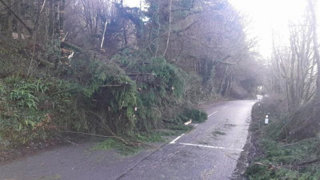
The southwest of England was subsequently hit by two more storms: Ingrid (January 23 and 24, 2026) and Chandra (January 26 and 27, 2026) which caused further impacts including loss of power, fallen trees, contaminated water containing sewage in the streets of Stithians, Cornwall, and localised flooding, as water fell on already saturated land.
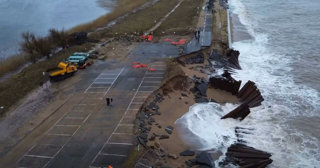
Sections of the A397 between Torcross and Slapton in Devon was severely damaged by the succession of storms that hit the area. Waves breached coastal defences, removing the road and sections of the car park which gives access to this famous tourist destination. Although there are other routes into the area, the coastal road was closed to all traffic while it was made safe.
Sources and further reading
Storm Goretti brings 99mph wind gusts to UK as rare red 'danger to life' warning in force. BBC, January 8, 2026.
Storm Goretti map: Where Britain will be hit by heavy snow with yellow warnings in place. The Independent, January 9, 2026.
Storm Goretti: Key stats from the multi-hazard event. Met Office, January 9, 2026.
The story of Storm Goretti – what happened that night in Cornwall. Natalie Ashbee (RHS).
What next after Storm Goretti tree 'devastation'? Kirk England, BBC, January 24, 2026.
What to do when your home is at risk of falling into the sea – the hard choices facing Britain’s storm-battered coasts The Conversation, February 5, 2026.
Britain’s relentless rain shows climate predictions playing out as expected. The Conversation, February 13, 2026.
File nameFiles
File type
Size
Download