Reinterpreting the Collections at Lowther Lodge
Since the Society’s move to South Kensington in 1913, the number of items in our care has grown. Today, our Collections encompasses over two million objects of geographical significance. It includes maps, globes, planning materials and artefacts from expeditions, and artwork, some of which are displayed around the building for members and visitors to view.
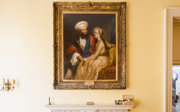
Recent work at the Society by the Collections team and colleagues has focused on redressing and reinterpreting the spaces throughout the building to tell stories across the breadth of the Collections. A dedicated committee has been reviewing our public displays and improving interpretation to better communicate the provenance and contexts of objects.
How are our public Collections displays being reinterpreted?
Artefacts are being displayed in spaces previously unused, or in new ways, to reveal the expansive coverage of the Collections, with many items originating from different places across the world and from different time periods. This includes more recent acquisitions, including contemporary artwork and Indigenous maps, a strength of our Collections that have not previously been displayed.
These changes aim to show a more comprehensive representation of geography that seeks to understand the human and natural world beyond a Western lens.
Items across the building have been rehung in thematic displays, drawing on key foci in our Collections. As a result, the Education Centre displays artefacts and photographs related to Everest, while the Map Room showcases the past, present, and future of mapping.
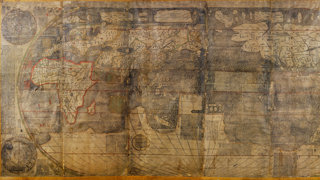
In the Map Room, the theme is explored through modern interpretations of mapping such as an embroidered scarf depicting the White Nile based on satellite imagery, which sit alongside older Society holdings such as the Kunyu Wanguo Quantu.
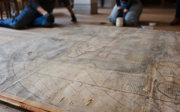
This 17th century world map, also known as an example of a ‘Ricci’ map, shows the Sino-Western intellectual collaboration as well as Chinese geographical practices. Part of the work of rehanging also involves active conservation reviews, particularly for older items within the Collections, such as the Kunyu Wanguo Quantu, that require specialist attention for their future preservation.
The Society are actively seeking opportunities and fundraising to support this work.
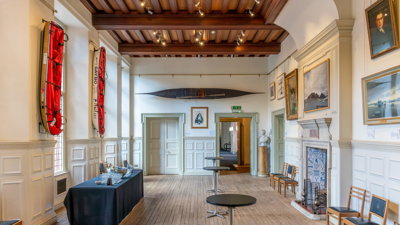
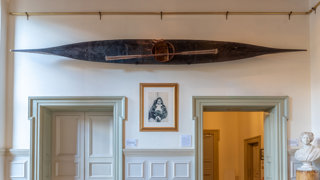
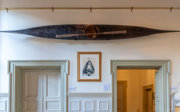
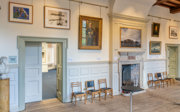
One of the newest examples of the redressing is in the Main Hall, situated within the Victorian Lowther Lodge side of the site, which now displays highlights from the Society's Polar Collections. Portraits of Western polar explorers, Robert Falcon Scott and Ernest Shackleton, are hung alongside a contemporary photograph of Louise Boyd Land in northeast Greenland (2018) by Anne Lydiat, a screenshot of the digital Pan-Inuit Trails Atlas, and a portrait of Arnarulunnguaq – a Greenlandic female Arctic explorer, amongst other works. Displaying these works together seeks to celebrate the diverse contributions to geography and the discipline throughout time.
On the remaining walls of the Main Hall, three watercraft have been hung which reflect different chronological periods of expeditions to polar regions. These include Gino Watkins' kayak and paddle from his trip to Greenland in 1932, during which the British Arctic explorer disappeared; Sir Ranulph Fiennes pulk used on his 1993 expedition with Mike Stroud where they crossed the Antarctic continent unsupported and, most recently, a pulk used in Antarctica in 2025 by Harpreet Kaur "Preet" Chandi – the first known woman of colour to reach the South Pole unassisted who also holds the record for the longest solo, unsupported polar expedition. Together, their display helps highlight the breadth of items in the Society's Collections and encourages an increasingly open and inclusive attitude to geographical expeditions.
Our team are actively and critically reflecting on the history of our Collections, including how we talk about and display them. Digital access to interpretation is also being improved, with QR codes directing visitors to information and online exhibitions on our website.
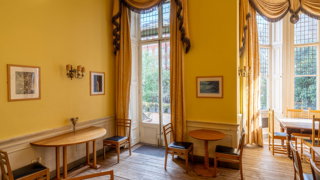
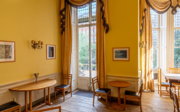
Future plans for the reinterpretation of the building include the Tea Room, as well as looking at current displays to ensure they show the range of chronological and geographical history represented within our Collections.
Despite much of the Collections having colonial origins, refreshing and reinterpreting what is displayed allows the Society to tell stories from around the world and reflect diverse perspectives in contemporary geography, showcasing underrepresented women and Indigenous peoples, and amplifying non-Western knowledges.
As we look at spaces across the Society's building to reinterpret and make more accessible, we look forward to collaborating with partners and communities through research, fundraising and engagement.
If you'd like to delve further into the stories of objects on display throughout Lowther Lodge, we're hosting tours of the building on the 17 September:
Keep an eye out for new tour dates - we'll be updating our events listings across the year.
- Research and higher education
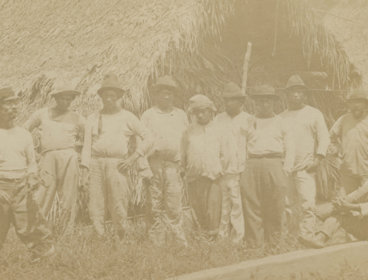
Stories from the Collections: The West India Regiments
Hear from one of our Collaborative Doctoral Awards students, Cat Sharples, on her work researching the role of military personnel in colonial science in the 19th century.
Wednesday 7 Oct 2026 - Geography news
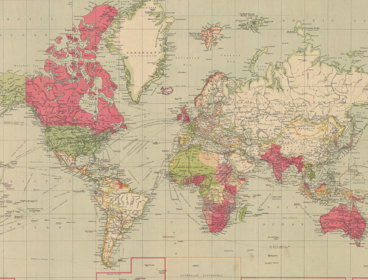
Dr Katie Parker on the UN’s vote to adopt a new world map
The Society’s Cartographic Collections Manager, Dr Katie Parker, explains the Mercator projection and looks at the UN resolution to formally phase it out.
Thursday 24 Sep 2026 - Research and higher education
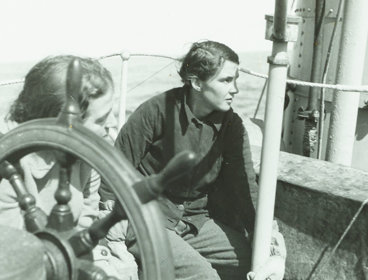
Stories beneath Greenland’s ice
Today, we're sharing a behind-the-scenes look into how hidden stories of UK-led exploration in Greenland have been gathered, curated and disseminated as part of the Greenland Connection project.
Friday 24 Jul 2026