Rwanda’s eucalyptus boom: how trees transform people and place
In this month’s research spotlight, we’re featuring an article from The Geographical Journal, which tells the story behind Rwanda’s eucalyptus boom.
Across the globe, people are planting trees in record numbers to mitigate and reduce the impacts of the climate and biodiversity crises. Perhaps you’ve attended a tree planting event in your local area or used a search engine that plants trees as you browse. But how do schemes like these actually unfold on the ground, and what are their impacts, both positive and negative?
Dr Nathan Clay, based at the Stockholm Resilience Centre, is exploring this question through his work on sustainability and climate resilience in agri-food contexts. Nathan’s recent paper explores the impacts of eucalyptus reforestation on Rwanda’s agricultural communities.
When Trump started saying ‘let’s plant trees’, I thought we need to step back a little bit and say, but what trees are we planting? Where are we planting them? Who is benefitting from them and why?Nathan
Tree planting in Rwanda
In 2011, the Bonn Challenge was launched with the aim of bringing 350 million hectares of degraded and deforested landscapes across the globe into restoration by 2030. Rwanda was the first African nation to join the Bonn Challenge, committing to restoring two million hectares of degraded land.
The Bonn Challenge is the flagship initiative to have more tree cover around the world. It connects with the United Nations’ 2020 to 2030 decade on ecosystem restoration and the rise of nature-based solutions. In Rwanda, where 80% of people depend on agriculture for a livelihood, I was seeing a perfect storm of these different initiatives coming together.Nathan
Since becoming a signatory, Rwanda’s government have planted thousands of trees across the nation. Interestingly, it is eucalyptus, a tree that originated in Australia, that has dominated this. Eucalyptus first arrived in Rwanda nearly 100 years ago, at the hands of Belgian colonial officials.
From 2011 to 2018, around 400,000 hectares of the tree were planted, with eucalyptus now responsible for an estimated 80% of Rwanda’s tree cover.
Why eucalyptus?
You probably know eucalyptus from its distinctive smell recognisable in an array of products, from body washes to decongestants. But it isn’t for its scent that eucalyptus has been planted across Rwanda. Nathan explains how this tree has several qualities which has made it so popular with Rwanda’s government.
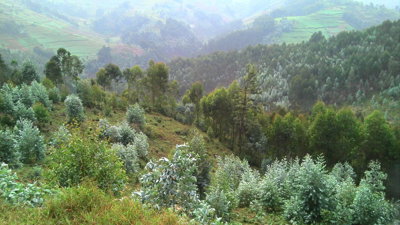
Eucalyptus grows really well and fast in a lot of conditions. It provides hard wood which is important for charcoal production. You can also see it really well. Eucalyptus have shimmering blue-green leaves, highly visible from satellite imagery which has become the norm in measuring global reforestation targets.Nathan
The suitability of eucalyptus for charcoal production is important in a country such as Rwanda where droughts can be severe. During these periods, when people are unable to make money from crops, they cut down trees which are processed and sold as charcoal.
I arrived at the end of one of the worst droughts the country had had in years. I noticed no one was working in the fields. Instead, I saw smoke rising up from kilns which I would learn are really important during drought. People cut down the trees and turn them into charcoal to sell when no food can grow.Nathan
The eucalyptus dilemma
While eucalyptus has important properties, the impacts of eucalyptus trees are not always positive for local communities. More ecologically diverse agro-forestry systems combining food and medicine crops with native trees are disappearing in favour of monoculture tree plantations.
Eucalyptus also contains toxic chemicals which leach into neighbouring crops, preventing them from growing. This is known as the eucalyptus dilemma, a phenomenon that has been noted for decades, yet has done little to slow the spread of the tree.
I met women in their fields that are on the edges of these eucalyptus plantations. These trees have a massive effect on the plants that are growing around them. They have very strong allelopathic chemicals in their leaves and in their roots which inhibit the growth of food crops.Nathan
As Nathan outlines, the eucalyptus dilemma particularly impacts women. Rwanda’s tree planting and charcoal industry is the domain of men who are increasingly leaving agriculture for these better paid jobs.
To plant trees, you need to own excess land that is not required for sustenance. This means that when crops are destroyed by eucalyptus, it is Rwanda’s least wealthy, female agriculturalists who must deal with the consequences.
Tree planting is a gendered and classed issue. Trees and the charcoal industry are only dealt with by men who are becoming less and less interested in doing agriculture. Woodlots are owned by wealthier people. People would say, ‘We wish we could have trees but that would mean having surplus land.’ This is simultaneously a transformation in the landscape and society.Nathan
For Nathan, his work in Rwanda has a clear message. We need to think critically about tree planting schemes, reflecting carefully on which trees we are planting and how these trees will affect surrounding communities and landscapes.
Clearing diverse treescapes to make way for eucalyptus cannot be the only answer to the climate and biodiversity crises.
Next steps
Nathan’s work has now taken him to the Mediterranean where he has swapped eucalyptus for almond trees. Here, almond trees are being planted to provide carbon sequestration and relief from drought.
In the future, Nathan hopes to return to Rwanda to explore climate change adaptations and identify what is working to generate hope for the future.
This spotlight was written by Safia Bailey (Cardiff University).
- Research and higher education
Mouldy homes: an issue of justice in a precarious housing market
Mouldy homes are more than an inconvenience, they are dangerous. In this research spotlight, we’re featuring Dr Sarah Klosterkamp’s research, published in Transactions, on justice in the German housing market.
Wednesday 9 Sep 2026 - RGS news

Over 2,800 geographers gather at Annual International Conference
After 600 sessions over four days, the Annual International Conference 2026 has concluded. 2,886 in-person and online delegates from around the world explored the theme Geographies of inequalities: towards just places.
Tuesday 8 Sep 2026 - Research and higher education
Learning to live with water scarcity
This month we’re featuring research published in the Geographical Journal on an issue all of us have been thinking about this summer – water scarcity.
Monday 17 Aug 2026